
Which Old Renaissance Masters Does ARTIST6 Reference? A Working Guide to the Studio’s Lineage
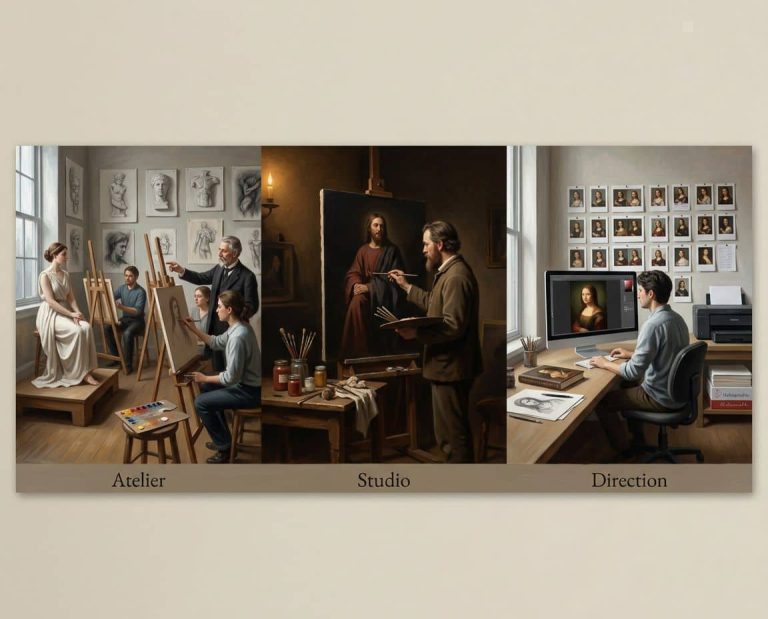
There is a sentence the AI-directed studio ARTIST6 returns to in almost every place it explains its practice, and it carries the entire architecture of how the studio thinks about its work. The studio writes that the pieces sit in the lineage of Caravaggio, Bronzino, La Tour, Zurbarán, Vermeer, and El Greco, and the broader Italian and Northern Renaissance traditions of chiaroscuro, sfumato, and reverent figurative composition. The next sentence states the discipline that holds the practice together: the work is in the tradition of, never in imitation of. The masters are the masters. The contemporary work is the inheritance, not the costume.
This article is a working guide to what that lineage actually means in practice. Six specific masters are named at the center. Around them, drawn in chapter by chapter, sits a wider roster of Renaissance painters whose technical solutions, compositional logic, and treatment of light continue to inform contemporary work in the tradition. The full lineage is not a costume box for the studio to dress up in. It is a working library that orients every piece released and every decision made about light, palette, composition, and subject. Understanding which masters the studio references, and why those specific masters rather than others, is one of the cleanest ways to understand what the work itself is trying to do.
What follows is a guide to the lineage in two layers. First, the core sextet that anchors every chapter and every public bio. Then, the wider roster that the three released chapters draw on, one painter at a time, as the subject of each piece requires.
The Core Sextet: The Six Masters That Anchor the Lineage
The studio’s core lineage is six painters working across the Italian and Northern Renaissance and into the early Baroque. The choice is deliberate. They are not the most famous names of the period (Leonardo, Raphael, Michelangelo are absent), and they are not chosen for marketability. They are chosen because each one solved a specific problem about light, attention, and the human face that continues to matter to working figurative practice today. Each is treated below.
Caravaggio: The Single Low Light
Michelangelo Merisi da Caravaggio, born in Milan in 1571 and dying in Porto Ercole in 1610, is the first name in the studio’s lineage for a specific reason. He is the painter who took the existing Renaissance vocabulary of chiaroscuro, the modeling of form through tonal contrast, and pushed it past anything Leonardo or Raphael had ever attempted. The result was what art historians later called tenebrism, the use of extreme dark backgrounds against sharply lit subjects, lit as if by a single hidden light source.
According to Britannica’s definition of tenebrism, the term comes from the Latin tenebrae, meaning darkness, and in tenebrist paintings the figures are often portrayed against a background of intense darkness, but the figures themselves are illuminated by a bright, searching light that sets off their three-dimensional forms by a harsh but exquisitely controlled chiaroscuro. The seventeenth-century biographer Giovanni Pietro Bellori described Caravaggio’s technique as placing his figures in the darkness of a closed room, with a lamp placed high so the light would fall straight down, revealing the principal part of the body and leaving the rest in shadow.
This is the technical inheritance that ARTIST6 draws on most consistently. The studio’s published landing page describes the work as built on a single low light, a face that turns three-quarters into the dark, and a palette of bronze, umber, ochre, oxblood, lapis, and gold. The single low light is the Caravaggio inheritance directly. It is not used because it is dramatic. It is used because it is one of the most reliable ways the masters worked out to make a contemporary face read with the seriousness the face deserves, and because the contemporary eye still responds to the same arrangement of light the seventeenth-century eye did.
The studio’s discipline around the Caravaggio reference is also specific. The Renaissance SEO and content strategy explicitly flags Caravaggio overuse as a risk to manage. Caravaggio is the most-searched and most-imitated Renaissance master, and over-reliance on his name makes any contemporary studio look derivative. The studio’s response is to reference him correctly but to rotate references across the full sextet, so that Caravaggio is one master among six rather than the sole reference point.
Bronzino: The Cool Court Portrait
Agnolo di Cosimo, known as Bronzino, born in 1503 and dying in 1572, is the second name in the lineage and the master most associated with the Florentine Mannerist portrait. Bronzino was the court painter to Cosimo I de’ Medici, the first Grand Duke of Tuscany, and is the canonical example of the High Mannerist court portrait, with smooth modeled surfaces, elongated proportions, an aloof but utterly elegant register, and a cool jewel-like palette that uses intermediate hues, violet, ultramarine, coral, soft yellows, and a wide range of greens, rather than the saturated reds and blues of Raphael.
According to the National Gallery in London’s overview, Bronzino was the leading painter of mid-sixteenth-century Florence, classed as a Mannerist, chiefly famous for portraits of Cosimo de’ Medici, his wife Eleonora di Toledo, their children, and members of their court. The refined and stylish artificiality associated with this Mannerist label can be best appreciated in his Allegory now in the National Gallery, but the dominant working surface of his career was the court portrait, in which the social position of the sitter, the elegance of the pose, and the restraint of the expression were all rendered with a quiet precision that influenced court portraiture for the next two centuries.
The Bronzino inheritance for ARTIST6 is the cool restraint. Where Caravaggio supplies the dramatic low light, Bronzino supplies the opposite end of the same spectrum: the calm, frontal or three-quarter portrait in a cool palette, the sitter holding the room with no theatrical gesture, the modeled flesh in soft glazed transition. The studio’s portrait register, when it works in the Bronzino tradition, holds the subject the way Bronzino held Cosimo or Eleonora, with dignity, restraint, and an unhurried gaze. Several pieces across the studio’s chapters work explicitly in this register, with the contemporary subject treated with the cool gravity Bronzino reserved for the Medici court.
Georges de La Tour: The Single Candle
Georges de La Tour, born in Vic-sur-Seille in 1593 and dying in Lunéville in 1652, is the third name in the lineage and the master most associated with candlelight painting in the European tradition. La Tour worked in the Duchy of Lorraine, was appointed first painter to King Louis XIII in 1639, and was forgotten for nearly three centuries after his death before being rediscovered in 1915 by the German art historian Hermann Voss. His paintings had previously been misattributed to Murillo, Zurbarán, Honthorst, Ribera, and Vermeer, which is itself a useful indication of the company La Tour keeps in the European post-Caravaggesque tradition.
What La Tour worked out, in roughly forty surviving paintings, was the optics of a single small light source rendered with absolute fidelity. According to The Art Story’s biography of La Tour, La Tour’s sophisticated handling of chiaroscuro expresses itself in sharp tenebrism, allowing his figures to be illuminated by the light of a single candle, often hidden behind a hand or an object so that only the tip of the flame or a sliver of light is visible. A single candle, often partially hidden behind a hand or an object, illuminates a face or a small group of figures, and the rest of the scene falls away into deep tenebrist shadow. The Magdalene at the Mirror, Joseph the Carpenter, the various Saint Sebastians, and the Newborn are the canonical examples. The technical specificity of La Tour’s candlelight, the way it falls on a knuckle, glints on a fingernail, picks out the curve of a cheekbone, is one of the most refined optical achievements in European painting.
The La Tour inheritance for ARTIST6 is the quiet candle scene as a working compositional model. Several pieces in the Anima Mundi chapter, particularly in the fire sub-series, draw on the La Tour register: the warm hearth, the late-afternoon stone holding its accumulated warmth, the small steady source of light against the broader cooler dark. La Tour also offers something Caravaggio does not, which is the absence of theatrical drama. A La Tour scene is contemplative rather than urgent. The candle does not announce a miracle in progress. It announces a quiet hour, a sleeping child, a woman lost in thought, a working figure at the day’s close. For a studio interested in reverent figurative composition without theatrical drama, La Tour is one of the most useful reference points in the post-Renaissance tradition.
Francisco de Zurbarán: The Spanish Monastic Restraint
Francisco de Zurbarán, born in 1598 and dying in 1664, is the fourth name in the lineage and the master most associated with the Spanish monastic and devotional tradition. Working primarily in Seville, Zurbarán painted for the great Spanish religious orders, the Carthusians, the Mercedarians, the Hieronymites, and developed a visual language that combined Caravaggesque tenebrism with an austere geometric clarity and a particular reverence for the still-life object. His paintings of single monks at prayer, his rendering of the white wool of Carthusian habits against deep absorbing shadow, and his small still-life compositions of clay pots and citrus fruit are the canonical examples.
The Zurbarán inheritance is restraint. Where Caravaggio went theatrical and La Tour went intimate, Zurbarán went architectural. A Zurbarán saint stands as still as a column. The folds of the habit are rendered with the geometric clarity of dressed stone. The hands are held with the patience of a sundial. The light is single, low, and warm, but it serves the form rather than the drama. The whole effect is of a face or a body that has been brought into the room with absolute seriousness and no flourish.
The Zurbarán reference shapes the studio’s treatment of the contemporary religious or quasi-religious subject. The studio’s Renaissance-niche risk register explicitly notes that religious subjects must be handled with care, framed as contemporary and secular, in the tradition rather than devotional. Zurbarán is the model for how to do this honestly. His paintings are devotional in their original Catholic context, but their structural restraint, the still figure, the simple background, the single light, the absence of any visual hype, makes them readable in a secular contemporary frame without losing their gravity. A studio working today in the Zurbarán tradition is not making devotional art. It is inheriting Zurbarán’s compositional discipline and applying it to subjects that ask for the same seriousness.
Johannes Vermeer: The Calm Northern Interior
Johannes Vermeer, born in Delft in 1632 and dying there in 1675, is the fifth name in the lineage and the master who anchors the studio’s Northern Renaissance and Dutch Golden Age reference. Vermeer’s surviving oeuvre is small, around thirty-five attributed paintings, but its influence on subsequent thinking about how light behaves in an interior is almost impossible to overstate. Vermeer painted, with very few exceptions, the interior of a single working domestic space, with light entering from a window on the left, falling on the figures and the objects in the room, and producing the optical effects that the human eye actually receives when it stands in such a room. The Milkmaid, the Girl with a Pearl Earring, the View of Delft, the Lacemaker, the Woman in Blue Reading a Letter, the Geographer.
Vermeer’s calmness, his treatment of the everyday domestic moment as a subject worthy of the patient close attention previously reserved for sacred scenes, is the inheritance ARTIST6 draws on most directly in the chapters that move outside the figure piece. The studio’s Lumen Sylvarum and Anima Mundi chapters, both of which include observational pieces without a central figure, owe a recognizable debt to the Vermeer treatment of the everyday as a serious subject. The piece of an interior morning kitchen, the close study of a brass candlestick on a windowsill, the high terrace looking onto a quiet valley, all of these work in the register Vermeer made possible. Vermeer is also the master most associated with the working window as the natural light source in a contemporary figurative composition, which is one of the studio’s recurring compositional moves when it steps outside the single low warm light of the Caravaggesque tradition.
It is worth noting that Vermeer is technically a Dutch Golden Age painter rather than a Renaissance painter in the strict period sense. The studio’s framing is honest about this. The published bios speak of the broader Italian and Northern Renaissance traditions of chiaroscuro, sfumato, and reverent figurative composition. The Northern Renaissance proper ends around 1580. Vermeer arrives a generation later. But the technical and compositional inheritance Vermeer himself carries forward from Van Eyck, Memling, and the Bruges tradition makes him a working extension of the Northern Renaissance into the seventeenth century, and the studio treats him as such.
El Greco: The Spiritual Mannerist
Doménikos Theotokópoulos, known as El Greco, born in Crete in 1541 and dying in Toledo in 1614, is the sixth name in the lineage and the master most associated with the late Mannerist and devotional Spanish tradition. El Greco’s biography is itself a working argument for the European Renaissance as a connected international tradition. Born in Greek Crete and trained as a Byzantine icon painter, he moved to Venice in the 1560s, absorbed Titian and Tintoretto, moved to Rome and was influenced by Michelangelo, and finally settled in Toledo in 1577, where he produced the elongated, spiritually charged paintings he became famous for: The Burial of the Count of Orgaz, the View of Toledo, the various Saint Francis paintings, the Apostles.
What El Greco offers the contemporary studio is the spiritual register without the literal religious frame. El Greco’s figures, with their elongated proportions, their inwardly focused gazes, their robes painted in jewel-toned blues and reds and silvers, read as figures inside an interior spiritual experience that is legible to the contemporary viewer even when the original Catholic theological content is no longer the viewer’s frame. A face by El Greco is doing something a face by Caravaggio is not doing. It is turned inward. The light source is not always external; sometimes the light seems to come from the figure itself.
For ARTIST6, El Greco is the reference point for the contemporary figure piece that asks the viewer for slow, interior attention rather than urgent narrative attention. Several pieces in the studio’s chapters, particularly the figure pieces in Lumen Sylvarum and the listener piece in Anima Mundi, draw on this El Greco register. The composition is calm. The figure is alone. The light is soft. The viewer is invited into the figure’s interior experience rather than into a witnessed event.
A Comparison of the Core Sextet
The table below pulls out the working differences between the six masters that anchor the studio’s lineage, with the diagnostic features the studio draws on from each.
| Master | Dates | Location | Specific Inheritance | Palette | Subject |
|---|---|---|---|---|---|
| Caravaggio | 1571 to 1610 | Rome, Naples, Malta, Sicily | Single low warm light, tenebrism, the face against the dark | Umber, oxblood, lead white | Religious, narrative, dramatic |
| Bronzino | 1503 to 1572 | Florence | The cool court portrait, smooth modeled surface, restraint | Cool intermediate hues, violet, ultramarine, coral | Court portraiture, allegory |
| La Tour | 1593 to 1652 | Lorraine | Single candle source, quiet contemplative scene, no drama | Warm amber and umber against cool dark | Quiet religious, candlelit interior |
| Zurbarán | 1598 to 1664 | Seville | Geometric monastic clarity, still figure, low warm light | Bone white against deep brown shadow | Monastic, devotional, still life |
| Vermeer | 1632 to 1675 | Delft | Northern window light, calm interior, the domestic as serious subject | Lead white, lead-tin yellow, ultramarine, soft umber | Domestic interior, the everyday |
| El Greco | 1541 to 1614 | Crete, Venice, Rome, Toledo | The interior spiritual register, elongated proportions, soft inward light | Jewel-toned blues, reds, silvers | Religious, mystical, portrait |
The sextet is balanced deliberately across several axes. Italian and Northern. Catholic and post-Catholic. Dramatic and contemplative. Religious and secular. The studio does not stand inside a single tradition. It stands inside the conversation between traditions, and each chapter draws on whichever masters in the sextet best fit the chapter’s subject.
The Wider Roster: The Renaissance Painters Drawn In Chapter by Chapter
The core sextet anchors the studio’s public lineage, but the actual working library is larger. Each of the studio’s released chapters draws on additional Renaissance painters, named explicitly on the relevant product pages, who provide the specific tradition each individual piece works in. Three chapters have been released, and each carries its own set of named references.
The Hortus Editions Roster
The Hortus Editions, the studio’s first wellness and biophilic chapter built around the Renaissance hortus conclusus tradition, draws on a roster of Italian masters whose work is associated with gardens, cloisters, Madonnas in landscape, and saints in cultivated settings. The named references on the chapter’s twelve product pages include Fra Angelico, whose San Marco Annunciation establishes the canonical enclosed-garden composition for the entire Italian Renaissance Annunciation tradition. Antonello da Messina, the Sicilian-Venetian painter whose Saint Jerome in His Study at the National Gallery in London is the canonical scholar saint in a cultivated interior space. Giovanni Bellini, whose late Veneto Madonnas in landscape establish the working logic of the figure-in-cultivated-garden composition with a distant landscape at the horizon line. Lorenzo Lotto, whose intimate sacred and secular figure pieces sit in the contemplative register the chapter takes as its dominant mode. Piero di Cosimo, whose mythological and pastoral scenes inform the chapter’s treatment of the human body at rest in nature. Piero della Francesca, whose architectural clarity informs the chapter’s structural compositions.
Lumen Sylvarum Roster
Lumen Sylvarum, the second chapter, opens the cultivated garden outward into the wider biophilic register of the Renaissance imagination. The chapter’s roster broadens correspondingly. Hans Memling, the Bruges master, supplies the opening Northern Renaissance treatment of cool dawn light on a single observed object. Domenico Ghirlandaio, the Florentine fresco painter, supplies the plein-air observation of working figures in landscape. Pisanello, the late International Gothic and early Renaissance painter, supplies the close natural observation of birds, hares, and animals integrated into broader compositions. Pietro Perugino supplies the long quiet mid-morning landscape and the soft Umbrian plains. Filippo Lippi supplies the tender treatment of the wildflower meadow and the figure at midday. Andrea Mantegna supplies the archaeological hard clarity of the noon-hour falconer’s rest. The Venetian villa tradition supplies the late-quattrocento and early-cinquecento high-terrace landscape. The late Bellini mainland tradition supplies the late-afternoon plain. Lorenzo Lotto returns for the evening fountain. The late-quattrocento Sienese school closes the chapter with the moonrise nocturnal.
Anima Mundi Roster
Anima Mundi, the third chapter, organized around the four classical elements (earth, water, air, fire), draws on a roster of late-quattrocento and early-cinquecento Italian masters whose work sits in the quieter biophilic register of the Renaissance landscape and figure-in-landscape tradition. Cima da Conegliano, the Treviso-Veneto landscape master, anchors the chapter’s earth and water sub-series with his figure-in-landscape compositional logic, particularly the small witness inside the larger natural setting. Bartolomeo Veneto supplies the close stone-and-spring observational study. Vittore Carpaccio supplies the bowed-branch fruit-tree composition. Lorenzo Costa supplies the rain-on-still-water observation. Bernardino Luini supplies the riverbank seated figure. Bartolomeo Montagna supplies the wind-in-wheat landscape. Boccaccio Boccaccino supplies the high-cloud composition. Andrea Previtali supplies the listener under the cypress. Sebastiano del Piombo supplies the close stone-and-sun architecture study. Defendente Ferrari supplies the late-day interior hearth scene. Lorenzo di Credi closes the chapter with the soft evening landscape.
This is a longer list than most contemporary studios working in the Renaissance tradition would name, and the specificity is itself part of the studio’s discipline. A piece in the Cima da Conegliano tradition does not just look generically Renaissance. It works in the particular Treviso-Veneto register Cima developed in the late fifteenth century, with the small figure inside the larger landscape, the cool first-hour light, the quiet calm modeling, and the soft atmospheric perspective Cima used in his mature work. The piece is not pretending to be a Cima painting; it is inheriting Cima’s specific working solutions for a contemporary subject.
What “In the Tradition Of, Never in Imitation Of” Actually Means
The studio’s lineage discipline is built on a single phrase that recurs across its published documents: in the tradition of, never in imitation of. This is not casual language. It is the working ethic that distinguishes serious contemporary Renaissance-tradition work from generic AI-generated Renaissance pastiche.
In practice, the discipline cashes out in several specific ways. The first is that no ARTIST6 piece reproduces a historical painting. The studio does not produce a contemporary version of the Mona Lisa, or the Arnolfini Portrait, or any other identifiable Renaissance work. The pieces are described as imagined lost works, paintings the named master could plausibly have produced in their hand and in their tradition, but never did. The Gardener’s Annunciation, in the Hortus Editions chapter, is not a reproduction of Fra Angelico’s Cortona Annunciation. It is an original composition that asks what an Annunciation might have looked like if Fra Angelico had set the scene in a working herb garden rather than a marble loggia. The lineage is honored; the master is not impersonated.
The second is that the studio refuses what its risk register calls the master-imitation framing. The studio does not claim to be a master. The artist statement is explicit: I do not claim to be a master. I work in the lineage of, never in imitation of. This is not false modesty. It is a precise position. The masters were the masters. ARTIST6 is an inheritor.
The third is that every art-historical claim the studio makes is fact-checked against museum or academic sources before being published. The Renaissance SEO and content strategy is explicit about this. The studio also rotates its lineage references deliberately, to avoid the Caravaggio overuse trap, so that no single master comes to define the studio’s public identity.
The fourth, and perhaps the most important, is that the lineage is treated as a working library rather than a brand asset. The masters are named because they continue to teach the studio’s working practice, not because they decorate the studio’s marketing. The Caravaggio inheritance changes how a contemporary face is composed under a single light. The Bronzino inheritance changes how a contemporary portrait holds the room. The La Tour inheritance changes how a contemporary interior treats a small warm light source against a larger cool dark. Each lineage name corresponds to an actual technical solution that informs the studio’s daily work.
Why These Six, and Not the More Famous Names
A reader familiar with the Renaissance period will notice that the most famous names of the Italian Renaissance, Leonardo, Raphael, Michelangelo, Titian, are not in the core sextet. This is deliberate, and worth explaining.
The very famous names sit at the absolute peak of the Renaissance tradition. They are the masters every contemporary studio working in the tradition has to reckon with, but they are not the most useful working references for a contemporary practice. Leonardo’s sfumato is a working tool, but it is so specific to Leonardo’s own decades of patient layered glazing that no contemporary studio can claim to inherit it without overreach. Raphael’s compositional balance is one of the great achievements of Western painting, but it is also so completely realized that contemporary work in the Raphael tradition risks looking like imitation by default. Michelangelo’s bodies are at a sculptural level no living painter, working in any medium, has matched in five centuries. Titian’s color is its own world.
The studio’s sextet is, by contrast, made of masters who solved specific technical problems that contemporary work can still genuinely inherit. Caravaggio’s single light source is a working principle, not a finished achievement. Bronzino’s cool court portrait is a working compositional register. La Tour’s candle is a working light-source convention. Zurbarán’s geometric monastic clarity is a working compositional discipline. Vermeer’s window-lit interior is a working spatial logic. El Greco’s interior spiritual register is a working emotional posture. None of these is a closed achievement that a contemporary studio can only imitate. Each is an open tradition that a contemporary studio can continue, in its own register, with its own subjects, using its own tools.
This is what the studio means when it writes that the masters worked out things about light, attention, and the human face that still work. The sextet is the working library of what continues to work. The very famous names are honored from a respectful distance and not claimed as direct working references.
The Northern and Italian Balance
One other point worth making about the studio’s lineage is its deliberate balance between the Italian and the Northern Renaissance traditions. The sextet contains four Italian or Italian-trained masters (Caravaggio, Bronzino, La Tour through his Caravaggesque inheritance, El Greco through his Venetian and Roman training) and two Northern masters (Vermeer, and El Greco’s Cretan-Byzantine origins). The wider roster across the three released chapters contains both Italian and Northern names in roughly equal weight: Fra Angelico, Bellini, Lotto, Carpaccio, Cima da Conegliano, Mantegna, Perugino, Lippi, Ghirlandaio, and so on, alongside Memling, the Antwerp world-landscape tradition, and the Northern still-life tradition.
This balance matters. A studio that drew only on the Italian tradition would tilt toward the warm dramatic register and miss the cool observational discipline the Northern tradition brought to European painting. A studio that drew only on the Northern tradition would tilt toward the close detail of the observed object and miss the heroic figurative register the Italians brought. The studio’s lineage holds both, and the contemporary work it produces holds both.
How to Spot the Lineage in the Work
For the reader trying to recognize which master is being inherited in a given ARTIST6 piece, a few practical signals are worth knowing.
If the piece shows a single face turned three-quarters into deep tenebrist shadow under a low warm light, with no visible light source, with the background absorbed into near-black, you are looking at a Caravaggesque piece. The studio’s portrait register in this mode owes its compositional logic to Caravaggio directly.
If the piece shows a calm three-quarter or frontal portrait against a quiet neutral background, in a cool intermediate palette, with the sitter holding the room without theatrical gesture, you are looking at a Bronzino-tradition piece. The discipline here is restraint.
If the piece shows a small interior scene illuminated by a single candle or small warm light source, often partially hidden, against a larger cool dark, with no theatrical drama, you are looking at a La Tour-tradition piece.
If the piece shows a still figure with the geometric clarity of a column, the folds of clothing rendered with architectural precision, the background absorbed into deep warm brown, you are looking at a Zurbarán-tradition piece.
If the piece shows a calm interior with light entering from a window, the everyday treated with the patience previously reserved for sacred subjects, you are looking at a Vermeer-tradition piece.
If the piece shows an elongated figure with an inward gaze, in jewel-toned blues and reds, with the light source soft and partially internal to the figure, you are looking at an El Greco-tradition piece.
The wider roster signals are more specific. A piece in the Cima da Conegliano tradition shows a small figure inside a larger landscape, with the cool first-hour light and the gentle Treviso-Veneto compositional logic. A piece in the Fra Angelico tradition treats a sacred or quasi-sacred subject with the calm clarity of the San Marco frescoes. A piece in the Bellini tradition shows a figure framed by a distant high-horizon Veneto landscape. The studio’s product pages name the specific lineage for each individual piece, which is one of the cleanest ways for a viewer or a collector to understand exactly what each piece is doing. Find original Renaissance fine artists on the Artist6.com homepage.