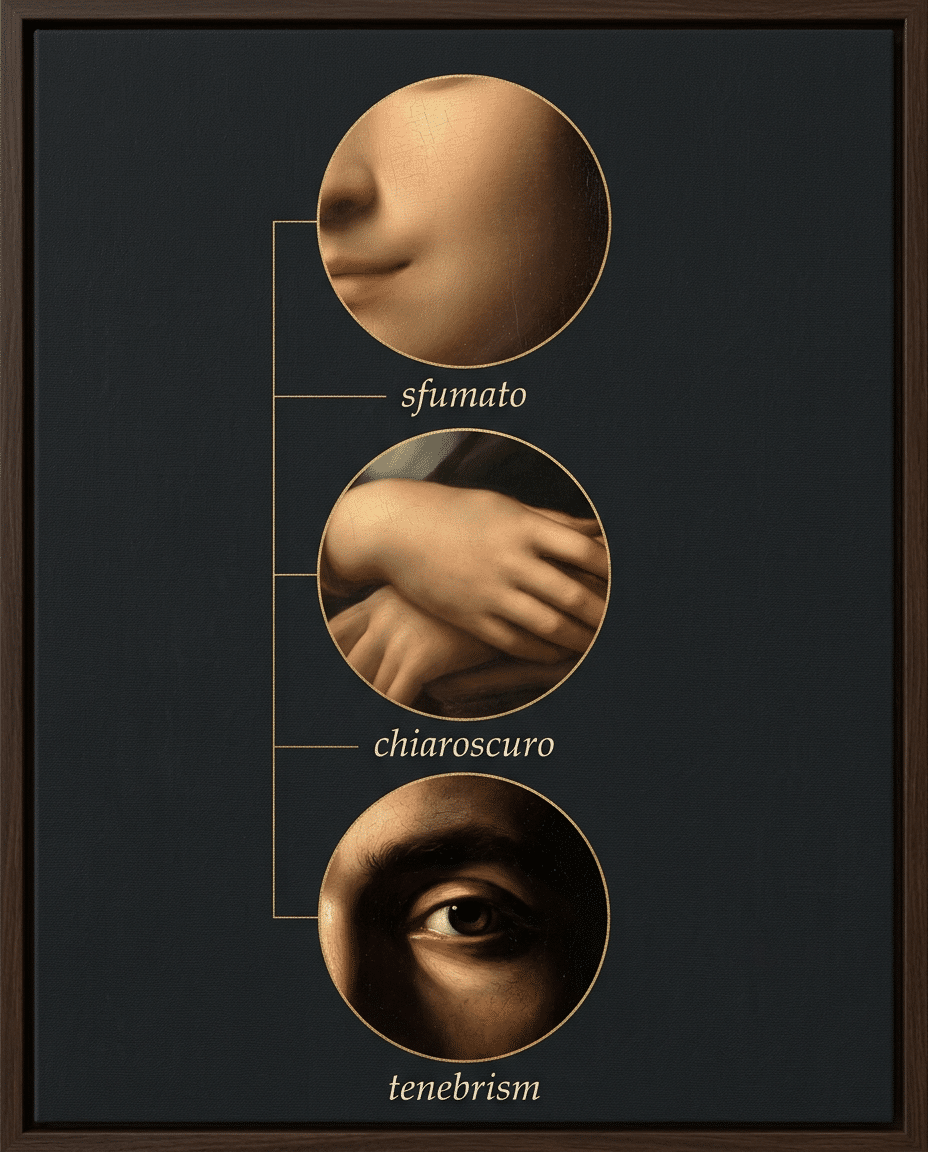
Chiaroscuro vs. Tenebrism vs. Sfumato: How the Renaissance Mastered Light, Shadow, and Smoke
There is a moment, the first time you stand close to a Caravaggio in a dim chapel in Rome, where the painting stops feeling like a painting and starts feeling like a witnessed event. The figures step out of the dark, lit from one side, and the rest of the canvas vanishes into something the eye can barely register. Then you walk a few rooms over, find yourself in front of a Leonardo, and the experience reverses. There is no spotlight here. There are no sharp edges anywhere. A face emerges from the shadow the way breath emerges in cold air. Same century, same Italian peninsula, and yet two completely different ideas of what light is supposed to do.
That difference, the difference between drama and atmosphere, between the spotlight and the veil, is essentially the difference between Renaissance Chiaroscuro, its more theatrical cousin tenebrism, and sfumato. All three are about light and shadow. None of the three is interchangeable with the others. And once you learn to see them, you stop being able to unsee them, which is one of the small permanent gifts of paying attention to old paintings.
This piece is for the reader who has heard the three words and quietly suspected they meant roughly the same thing. They do not. Here is what they actually are, where they came from, who used them, and how to tell them apart at a glance.
What Chiaroscuro Actually Is (and What It Isn’t)
The word is Italian, and it is doing exactly what it sounds like. Chiaro means light, or clear. Scuro means dark, or obscure. Put them together and you get a technique built around the deliberate contrast of the two. The point of chiaroscuro is not darkness for its own sake. The point is volume. The point is that a flat surface, a panel of poplar or a stretched piece of linen, can be tricked into feeling three-dimensional if light and shadow are placed with enough understanding of how a real surface curves.
This is what makes chiaroscuro different from, say, a painting that just happens to have a dark background. A scene that is gloomy is not automatically chiaroscuro. A nighttime painting is not automatically chiaroscuro. The word refers to a specific intent, the modeling of form through tonal contrast, and a specific result, the illusion of solid bodies occupying believable space.
The technique is one of the four canonical painting modes of the Renaissance, alongside cangiante, sfumato, and unione. Each of those modes was a different solution to the same problem the Renaissance was trying to solve, which was how to make painted figures feel like real bodies that a viewer could plausibly walk around. Chiaroscuro was the most architectural of the four. It built the figure the way a sculptor builds a figure, by understanding which side the light is coming from and what every curve and hollow does to that light.
A Short History of How It Got Here
Chiaroscuro did not appear all at once. It is the result of nearly two centuries of working painters trying to escape the flat, gilded, slightly stiff conventions of the late medieval period. Giotto, in the early 14th century, was already feeling his way toward solid figures with weight. By the time Leonardo da Vinci was working in Florence in the 1470s, the technique was being treated as something that could be taught, refined, and pushed. Leonardo himself was the figure who made chiaroscuro a system, not just a habit.
The word itself, though, came to refer to more than just shading. It eventually came to describe entire pictures organized around the principle, and even a printmaking method that used multiple woodblocks to layer tones onto a single page. A chiaroscuro woodcut is a different object from a chiaroscuro painting, but both are doing the same thing in spirit, using carefully placed light and dark to give the image its weight.
How to Spot It
The simplest test is this. If you can see the light source, or at least feel where it is coming from, and if the contrast between lit and shaded areas is doing the work of building the figure, you are looking at chiaroscuro. The light may be strong. The shadows may be deep. But the scene is still legible, the background is still part of the world, and the figure feels modeled rather than spotlit.
Renaissance Sfumato: The Smoke at the Edges
If chiaroscuro is architecture, sfumato is atmosphere. The word comes from the Italian sfumare, which means to evaporate, or to vanish like smoke, and that is exactly what the technique does to the lines and edges in a painting. There are no hard contours. There are no places where one tone stops and another begins with a clean border. Everything dissolves into everything else by way of impossibly small gradations of color and value.
Leonardo da Vinci is the figure most associated with the technique, and for good reason. He did not invent soft blending from nothing, but he pushed it further than anyone before or after him. According to the National Gallery in London, Leonardo painted The Virgin of the Rocks in such a way that his brushstrokes are essentially indiscernible, with the edges of forms blurred and softened where they turn into shadow, producing the smoky effect that would later be named sfumato after the Italian verb meaning to turn to smoke. Look at the Virgin’s temples, or the curve of her nose, and you can see what conservation specialists describe as a deliberate refusal of the contour line.
Leonardo’s reasoning for this was not just aesthetic. He spent years studying optics and human vision. He understood that the human eye does not actually perceive sharp edges in everyday life, particularly in low light. He understood that the pupil dilates in dimness, and that the world we actually see is full of soft transitions and uncertain boundaries. Sfumato, in other words, was an attempt to paint the world the way the eye actually receives it, rather than the way a draftsman might prefer to draw it.
How It Was Made
The technique was painstaking. Leonardo built his surfaces with dozens of layers of thin, transparent glazes, each one only a few microns thick, each one adjusting the underlying tone by a fraction. Modern scientific analysis of his paintings has confirmed something that the painters who tried to imitate him already suspected, which is that the technique is essentially uncopyable in a hurry. It requires patience the way frescoes require speed. It is one of the reasons Leonardo had a reputation, even in his lifetime, for being painfully slow at finishing a commission.
Sfumato was also adopted, in various dilutions, by Correggio, Raphael, Giorgione, and the network of painters who worked in or around Leonardo’s studio. None of them used it with the same near-obsessive thinness, but all of them learned from it.
Sfumato Renaissance Art at Its Most Recognizable
If you have ever stood in front of the Mona Lisa, even briefly, you have already met sfumato whether or not you knew the word. The reason her expression seems to shift the longer you look at it is that Leonardo deliberately refused to fix the corners of her mouth, or the edges of her eyes, with anything resembling a hard line. The face never resolves. The smile never quite stabilizes. That refusal of contour, that letting the form drift into shadow, is the technique at its most concentrated.
The Virgin of the Rocks, in both its Louvre and London versions, is the other canonical example. So is Saint John the Baptist. So, more recently, is the heavily debated Salvator Mundi. In all of these works, the eye does not so much read the face as feel its way around it.
Tenebrism: When Chiaroscuro Goes Theatrical
Now we move from Florence and Milan to Rome, and from the 15th and early 16th centuries to the late 16th. A new painter shows up. His name is Michelangelo Merisi da Caravaggio, and he is going to take the principle of chiaroscuro and push it past anything Leonardo or Raphael ever imagined.
Tenebrism, according to Britannica’s definition, is the use of extreme contrasts of light and dark in figurative compositions to heighten their dramatic effect. The term comes from the Latin tenebrae, meaning darkness. In a tenebrist painting, figures are typically portrayed against a background of intense darkness, but the figures themselves are illuminated by a bright, searching light that sets off their three-dimensional forms by what Britannica calls a harsh but exquisitely controlled chiaroscuro.
That phrase is worth holding onto. Tenebrism is not the opposite of chiaroscuro. It is chiaroscuro turned up. It is chiaroscuro that has stopped being polite about its drama.
What Caravaggio Did
Walk into the Contarelli Chapel in San Luigi dei Francesi in Rome and look at The Calling of Saint Matthew. The room itself is dim. The painting absorbs most of what little light there is. Out of that absorbed darkness, a beam of light cuts diagonally across the canvas, and you watch Jesus call Matthew to follow him, and the rest of the world simply does not exist outside the lit zone. There is no soft transition. There is no atmospheric haze. There is a figure and there is the void, and the void is not a passive background but an active compositional element.
This was new. Caravaggio’s contemporaries noticed. His imitators, who were eventually so numerous they got their own collective name (the Caravaggisti), spread the technique across Europe in the early 17th century. Spanish painters like Jusepe de Ribera and Francisco de Zurbarán took it up. Dutch painters in the Utrecht school took it up. Even Rembrandt, who would eventually find his own warmer, more luminous version of dramatic light, was clearly responding to what Caravaggio had set in motion.
Tenebrism vs. Chiaroscuro: Where the Line Is
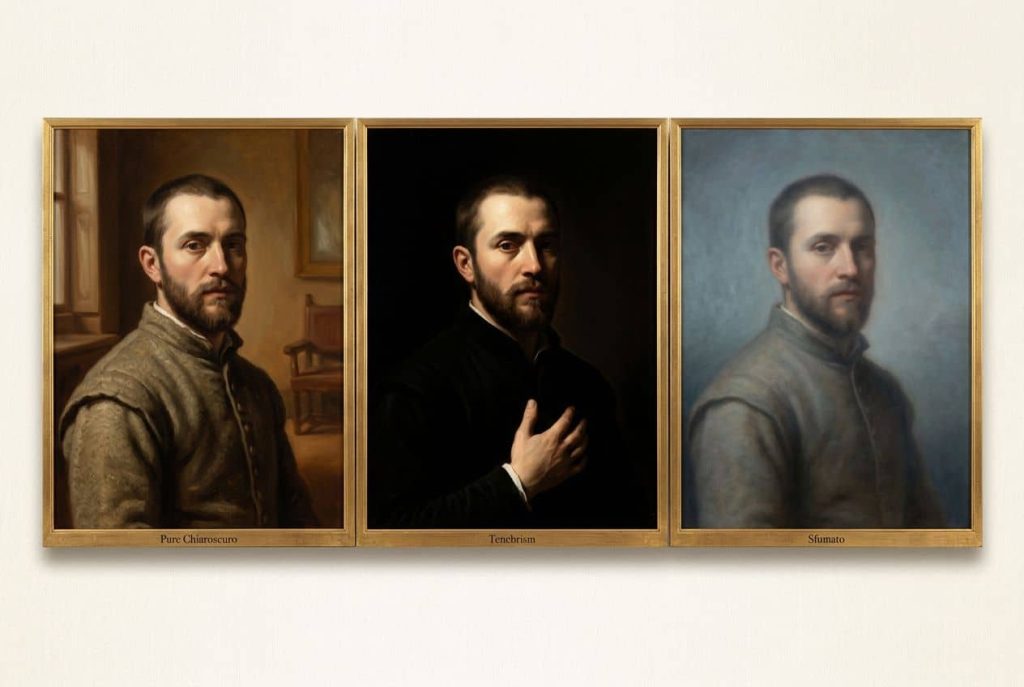
The difference is one of degree at first, and then of kind. In a chiaroscuro painting, you can usually still see the room. The background may be dark, but it is a place. In a tenebrist painting, the background ceases to be a place at all. It becomes negative space, which is the technical term for empty area that the artist is using as a compositional element rather than as a setting. The figure does not exist within a scene; the figure exists against an absence.
There is also the question of the light source itself. In most chiaroscuro work, the source is identifiable, even visible. In tenebrism, the source is almost never visible. The light arrives from outside the frame, from somewhere the viewer cannot see, with the implication that something just beyond the canvas is happening that we are not allowed to witness directly. That implied off-frame source is part of why tenebrist paintings often feel cinematic to a modern viewer. They are, in a real sense, the ancestors of film noir lighting.
A Direct Comparison Table
Sometimes the cleanest way to hold these three techniques in mind is to put them side by side. The table below pulls out the diagnostic features that let you tell them apart in front of a painting, with no art-history vocabulary required.
| Feature | Chiaroscuro | Tenebrism | Sfumato |
|---|---|---|---|
| Italian root | Chiaro (light) + scuro (dark) | Tenebrae (Latin for darkness) | Sfumare (to evaporate as smoke) |
| Core purpose | Build volume through contrast | Heighten drama with extreme contrast | Soften transitions to mimic real vision |
| Light source | Often visible or clearly implied | Almost always hidden, off-frame | Diffuse, ambient, not directional |
| Background | Part of the scene, legible | Dissolves into near-black void | Atmospheric, hazy, often landscape |
| Edges of figures | Modeled, defined | Sharply cut by light | Blurred, soft, dissolving |
| Emotional register | Solid, grounded, dignified | Theatrical, urgent, dramatic | Mysterious, contemplative, alive |
| Period of dominance | Renaissance into Baroque | Late 16th to 17th century | High Renaissance, especially Leonardo |
| Key figures | Leonardo, Raphael, Correggio | Caravaggio, Ribera, La Tour | Leonardo, Giorgione, Correggio |
| Famous example | Raphael’s portraits | The Calling of Saint Matthew | Mona Lisa, Virgin of the Rocks |
| One-line shortcut | Modeled form with visible contrast | Spotlight against the void | Smoke at the edges |
Renaissance Styles That Used These Techniques
It is worth saying clearly that no painter of the period used only one of these three. Leonardo, the master of sfumato, was also a master of chiaroscuro, and he used both in the same paintings, often in the same passages of the same painting. The face uses sfumato for its softness. The folds of the drapery use chiaroscuro for their weight. The two techniques are not in competition; they are doing different jobs in the same image.
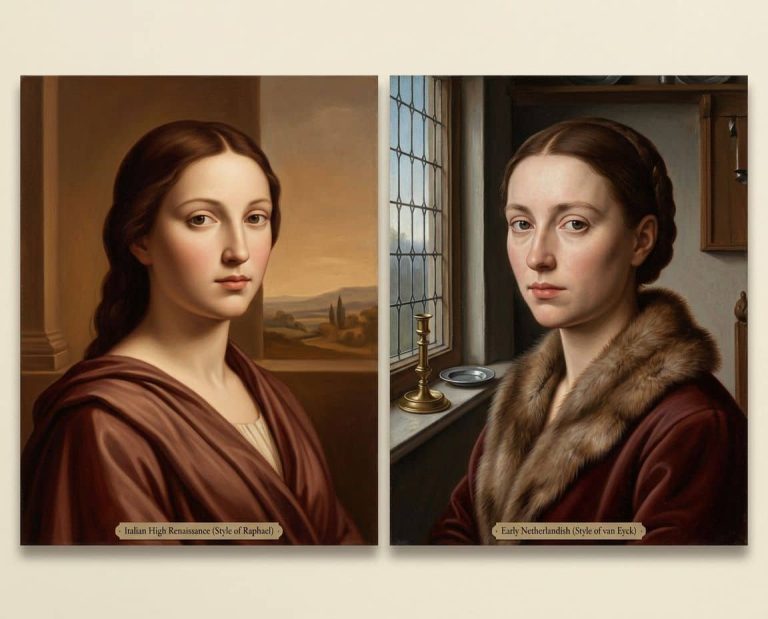
The same is true of the Renaissance more broadly. Italian Renaissance painting in particular evolved through a long conversation between modes. Early Renaissance painters, working in tempera, were largely confined to bright, clear colors and relatively sharp contours, because the medium dried too quickly to let them blend much. The shift to oil paint, particularly through the influence of Northern Renaissance painters like Jan van Eyck, gave Italian artists a medium that could be layered, glazed, and softened. Sfumato, in particular, was only possible because oil paint allowed Leonardo to lay glaze upon glaze without disturbing what was beneath.
The Venetian school developed its own approach, less concerned with sharply modeled form and more interested in color and atmosphere, which is why painters like Titian and Giorgione produced work that feels closer to sfumato in spirit even when it is not technically sfumato. The Florentine school, by contrast, was more architectural, more drawn to chiaroscuro and to the clear modeling of form. Mannerist painters at the end of the High Renaissance period began stretching all of these conventions, often dramatically, in ways that pointed toward the Baroque and toward Caravaggio.
Renaissance Methods, Compared to What Came After
One useful frame, especially for the modern viewer, is to ask what problem each technique was trying to solve, and how that problem changed over time.
Early Renaissance Painters
For early Renaissance painters, the problem was almost embarrassingly basic. They were trying to figure out how to make a figure look like a real body. Outline-based, flat, gilded medieval painting had been the dominant mode for centuries. Adding even a little bit of shadow on one side of a face, to suggest that the face was a curved surface rather than a flat shape, was a meaningful step forward. Chiaroscuro, in its early form, was the answer to that problem.
The High Renaissance
By the High Renaissance, that problem was essentially solved. Painters now had volume, they had perspective, they had anatomy. The new problem was making the image feel alive, atmospheric, plausible as a window onto a world. Sfumato was Leonardo’s answer to that problem. So was the development of aerial perspective, which is the technique of making distant objects paler and bluer to suggest the intervening air.
The Baroque
By the Baroque, the problem had shifted again. The Counter-Reformation church wanted art that would move ordinary worshipers emotionally, urgently, even violently. Quiet, balanced High Renaissance composition was no longer enough. Painters needed drama. Caravaggio gave them tenebrism, and the technique spread because it answered an emotional and religious need as much as an aesthetic one.
Renaissance Techniques in the Studio Today
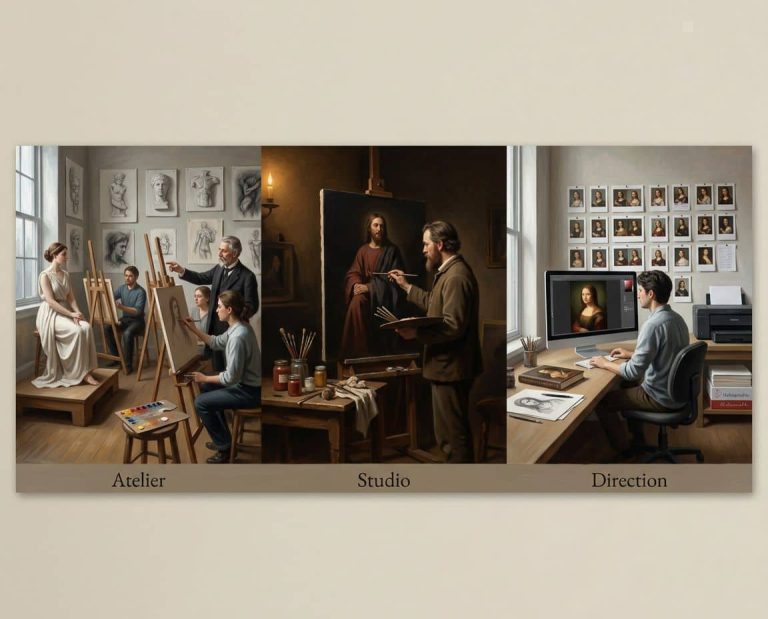
It is one thing to discuss these techniques as historical artifacts. It is another to recognize that they are still working tools for any artist who wants to use light seriously, including in contemporary practice. Single-source warm light, the kind that anchors a Caravaggio, is still single-source warm light when a portrait photographer uses it in 2026. The soft modeling of a face the way Leonardo modeled the Mona Lisa is still what a working portrait painter is doing when they want a likeness to feel alive rather than waxen.
The techniques have also crossed into other media in ways the original masters could not have imagined. Film noir cinematography is, almost line for line, the grammar of tenebrism applied to a moving image. Black-and-white portrait photography, particularly in the studio tradition, leans heavily on chiaroscuro. Even modern animation and game design borrow these techniques, often quite explicitly, when they want a character to feel weighted and present in a scene.
In the contemporary studio, especially in the small but committed circle of artists working in the Renaissance tradition, the techniques are still studied as living methods. According to The Art Story’s history of these three techniques, chiaroscuro, tenebrism, and sfumato were used by artists for different purposes, including creating an air of mystery, suggesting private intimacy, evoking psychological complexity, and producing haunting dramatic encounters. Those purposes have not gone away. The reasons a painter would want a face to emerge from shadow, or a figure to be lit by a single off-frame source, are exactly the same reasons they were five hundred years ago.
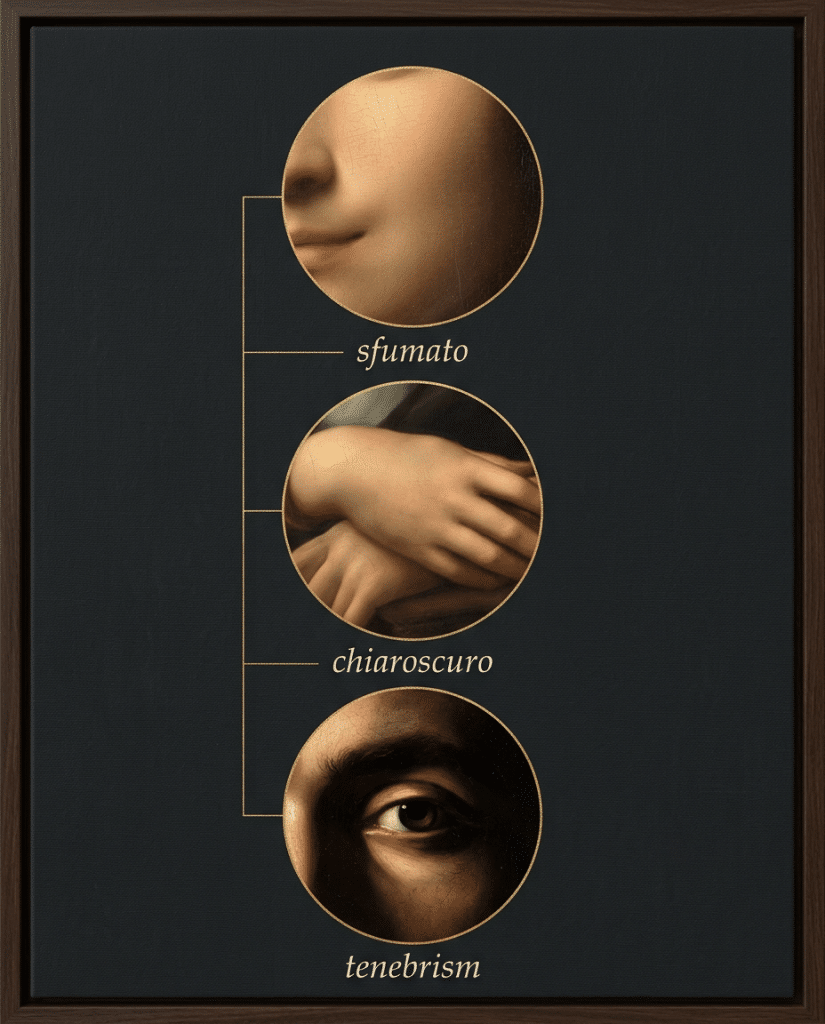
Sfumato Renaissance Art Compared to Renaissance Tenebrism: A Closer Look
To make the distinction even more concrete, consider what each technique does to a single subject. Take a face.
In a sfumato treatment, the face emerges from atmosphere. There is no clean edge between the cheek and the air behind it. The corners of the mouth dissolve into shadow so gradually that you cannot quite tell where the smile begins. The painter is essentially refusing to draw, in the conventional sense. There is no outline being filled in. The face is being built entirely out of transitions.
In a chiaroscuro treatment, the same face has clear modeling. Light arrives from one side, usually from above, and the artist uses that light to build the cheekbones, the bridge of the nose, the curve of the forehead. There is still drama, but the face is legible, located, and the room around it is part of the picture.
In a tenebrist treatment, the face is hit by a single beam of light, and everything outside that beam disappears. The shoulder may be in light; the rest of the body may be in near-black. The viewer’s eye is forced to the lit zone, often to a single gesture or expression, and the rest of the canvas exists as compositional weight, not as scenery.
This is why looking at three different portraits, one by Leonardo, one by Raphael, and one by Caravaggio, gives such a different emotional reading even when the sitter is doing roughly the same thing in each. The technique is the meaning. The technique is, in a real sense, the painting.
Renaissance Techniques That Often Get Confused
A few common confusions are worth clearing up, because they come up repeatedly in casual conversations about old paintings.
Chiaroscuro Is Not the Same as a Dark Painting
A painting can be dim, gloomy, or set at night without being a chiaroscuro work. The defining feature of chiaroscuro is not the amount of darkness but the use of light-dark contrast to build form. A genuinely dim painting that does not model its figures through tonal contrast is just a dim painting.
Tenebrism Is Not a Synonym for Caravaggio’s Style
Caravaggio is the most famous tenebrist, but tenebrism as a technique was used both before him in scattered form and after him by dozens of painters across Europe. It is more useful to think of tenebrism as a tool that Caravaggio perfected than as a style that belongs only to him.
Sfumato Is Not the Same as Blurry Painting
Sfumato is not soft focus. It is not a generally hazy look. It is a deliberate, controlled refusal of the contour line in places where the human eye would not perceive one in real life. A blurry painting is just blurry. A sfumato painting is doing something specific with edges, and the difference is visible at close range.
How to Tell Which Is Which in Under Five Seconds
For the visitor walking through a gallery, here is the working shortcut.
If the painting feels like a spotlight is hitting the subject and the rest of the canvas has gone dark on purpose, think tenebrism. If the painting is modeled, weighted, has clear contrast but the background still feels like a room or a landscape, think chiaroscuro. If you cannot find a single hard edge anywhere on the figure’s face and the face seems to drift in and out of focus the longer you look, think sfumato.
If you see two or three of these things happening in the same painting, congratulations, you are probably looking at a High Renaissance work that is using more than one technique at once, which is a sign of a serious painter and a sign that the painting deserves more time.
A Note on Why This Matters
It would be easy to treat these three words as art-history trivia, the kind of thing you memorize for a museum audio guide and then forget. That would be a mistake. The reason these techniques have lasted, and the reason they keep returning in contemporary art, photography, and film, is that they are not just stylistic preferences. They are solutions to deep, persistent problems about how images work on the human eye and the human nervous system.
Chiaroscuro answers the question of how a flat surface can feel solid. Sfumato answers the question of how a painted image can feel alive rather than diagrammatic. Tenebrism answers the question of how a single image can carry the emotional weight of a witnessed event. Each one is, in its way, a technical answer to a problem that artists, including contemporary artists working with new tools, are still trying to solve.
The masters did not invent these techniques to be admired in a museum five hundred years later. They invented them because the alternative did not work. What the masters worked out about light still works. That is the simplest reason to take all three seriously, and the simplest reason any serious working studio still studies them today. Click here to see the Artist6 studio Renaissance artworks.