
Fine Artist Prints: Techniques, Editions, and How to Buy
A sheet of Somerset Velvet comes off a freshly inked copper plate with a soft pull of the press. I check the wiped plate, compare the impression with the working proof, and set aside any sheet that doesn't belong in the edition.
That small act contains the questions behind every careful purchase. How was the image made? How many impressions exist? Who signed it? What records support it? Will the paper and ink endure? Fine artist prints become easier to understand when you treat those questions as a risk model, not as decoration.
Table of Contents
- A First Impression and the Questions It Raises
- What a Fine Artist Print Actually Is
- Print Techniques and the Materials Behind Them
- Editioning, Numbering, and the Marks of Scarcity
- How to Evaluate and Authenticate a Print
- Pricing, Resale Value, and the AI-Assisted Question
- Conservation and Framing for Long-Term Value
- A Studio Case Study in Transparent Editions
A First Impression and the Questions It Raises
The first inspection happens before the print dries. I look at the plate mark, the pressure at the edges, and the way the ink sits in the recessed lines. A clean wipe leaves the plate bright around the image. Too much ink muddies the margin. Too little weakens the dark passages. The impression gets read against a proof, not against an idea of what it ought to be.
The paper matters immediately. Somerset Velvet has a particular tooth and softness. Dampened for intaglio, it receives the copper plate's pressure and the ink held in its etched lines. I check the margins, the registration, and any burr or accidental mark. Some sheets survive as finished impressions. Others become trials, printer's proofs, or discarded pulls.
For a collector, the studio actions translate into four practical questions:
- Method: Was this etched, lithographed, screenprinted, carved, photographed, or printed from a digital file?
- Structure: Is the run fixed, and does the denominator on the sheet match the published edition?
- Authorship: Did the artist conceive and supervise the work, and is the signature genuine?
- Durability: Do the paper, ink, framing, and display conditions support long-term preservation?
Since the late nineteenth century, fine art prints have generally moved away from open-ended mechanical reproduction toward limited, documented editions. Museum guidance from Tate's explanation of print editions notes that modern artists' prints commonly range from 2 to 1,000 or more impressions, with editioned prints usually signed and numbered. An edition of 25, for example, is marked 1/25, 2/25, and so forth.
That numbering isn't a flourish. It creates a finite object that can be checked against a record.
What a Fine Artist Print Actually Is
A fine artist print is an original multiple. The artist conceives the image and remains directly involved in the making, either by preparing the matrix, creating the digital source, supervising a printer, or completing physical stages in the studio. The result is intended as a finite work in its own right, not as a copy of a painting.
Four conditions usually make the distinction useful:
- The artist creates the source. This may be a copper plate, stone drawing, woodblock, screen stencil, photograph, or digital file.
- The artist controls the production. The artist may print personally or work with a master printer under declared specifications.
- The edition is stated and marked. A signed and numbered fraction identifies the impression's position and the total run.
- The materials suit the work's intended life. Archival pigment inks, stable paper, and appropriate framing form part of the object rather than an afterthought.
A giclée reproduction can use excellent equipment and archival paper, yet still remain a reproduction if it copies an existing painting or photograph without functioning as a separately conceived edition. The word giclée describes an inkjet process. It doesn't, by itself, establish authorship, scarcity, or collectibility. An open-edition print may look refined, but if the seller can continue producing it without a declared cap, its scarcity is different.
| Criterion | Fine Artist Print | Giclée Reproduction | Poster |
|---|---|---|---|
| Source | Artist-conceived matrix or digital work | Usually a reproduction of an existing work | Reproduction prepared for broad distribution |
| Artist involvement | Direct making or documented supervision | May be limited or absent | Usually absent after approval |
| Edition | Fixed, stated, signed, and numbered | May be limited or open | Usually open-ended |
| Materials | Archival substrate and ink are normally specified | Quality varies by printer and paper | Usually selected for economical production |
| Collecting evidence | Edition record, signature, certificate, provenance | Depends on the publisher | Seller label or product description |
The edges can blur. A photograph may be an original artistic work printed through a digital workflow. A digital plate can serve the same conceptual role as a physical matrix when the artist defines its output and closes the edition. AI-assisted work raises a related question. The important issue isn't whether software appears in the process. It's whether the artist declares the tool, curates and develops the result, specifies the edition, and documents what the buyer receives.
Print Techniques and the Materials Behind Them
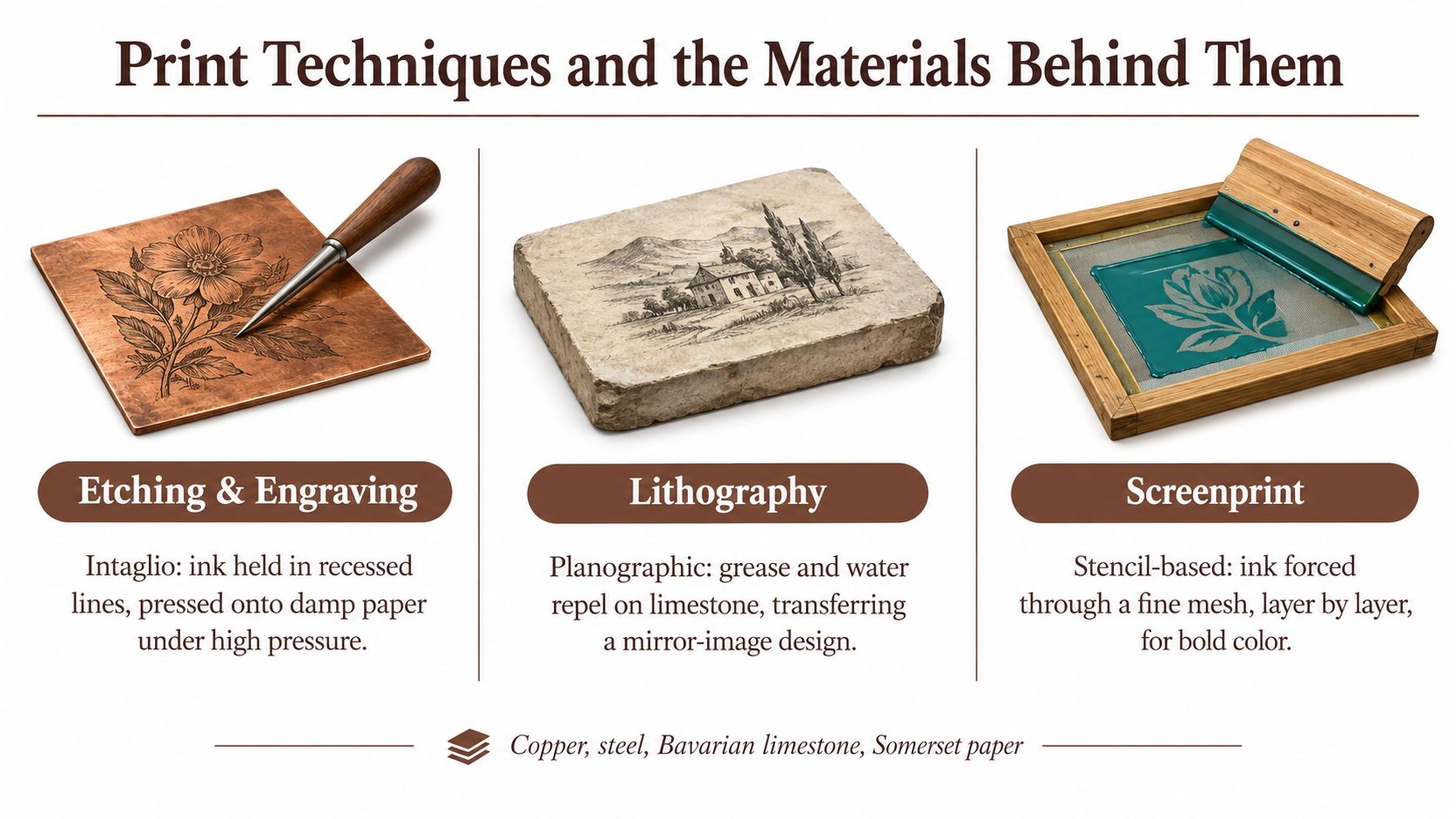
A collector can learn to recognize a print without becoming a printer. The useful question is what each process leaves on the sheet: a recessed line, a raised ink film, a grainy transfer, or a continuous digital tone. Those traces form a physical vocabulary, and they also help you assess whether the artist's stated technique fits the object in front of you.
Intaglio and planographic methods
Etching and engraving begin with a copper or steel plate, but the mark is made differently. In etching, acid bites lines exposed through a protective ground. In engraving, a burin cuts the line directly. Ink settles into the recesses, the surface is wiped, and damp paper passes through a press under high pressure. A plate mark, the indented border left by the plate, can support that identification. Intaglio ink may also sit with a slight deposit, rather than appearing entirely flat.
Lithography and screenprinting share the room with intaglio, but they behave differently. Lithography is planographic, so the image is drawn on the surface rather than cut into a recess. On Bavarian or Somerset limestone, grease and water repel each other. A lithographic crayon leaves a grain that can produce broad, powdery tonal changes, and the printed image transfers in reverse.
Screenprint uses a mesh screen, a stencil, and a squeegee. The printer pushes ink through the open areas, one colour layer at a time. On cotton rag paper, this often produces flat colour fields, sharp edges, and small registration differences where successive layers meet. Those visible traits are useful clues, although paper, ink, and the printer's handling can change their strength.
Relief, single impressions, and photography
Woodcut and linocut remove the areas that should remain unprinted. Ink covers the raised surface and transfers to paper. Wood grain may interrupt a broad field, while a lino block usually gives a cleaner cut. With several blocks or colours, hand registration becomes part of the print's character and can leave small, understandable shifts.
A monotype starts with a smooth plate carrying a one-off image. A related ghost impression may be pulled, but the process does not normally create a repeatable edition like a carved block or etched plate.
An archival pigment print uses pigment-based inkjet technology on selected fine art paper. It commonly shows continuous tone, smooth gradients, and no plate mark. The result depends on the source file, colour management, ink, paper, and display conditions. This conservation-oriented guide to archival prints reports roughly 60 to 200 or more years of display life for colour pigment prints, while black-and-white pigment prints on suitable media can exceed 400 years. Dark storage can test at 200 or more years, but these figures depend on the complete material and display system.
Silver gelatin photography uses a light-sensitive emulsion on fibre or resin-coated photographic paper. Exposed silver particles create continuous tone, often giving the blacks a depth that differs from pigment inkjet.
Paper changes the image. Cotton content, surface sizing, weight, tooth, and absorbency affect how a mark settles and how it ages. Conservation standards guidance on permanent paper describes ISO 9706 criteria, including pH 7.5 to 10.0, an alkaline reserve of at least 2% calcium carbonate equivalent, and limits on lignin and copper. These specifications help reduce acid-driven embrittlement and yellowing.
Editioning, Numbering, and the Marks of Scarcity
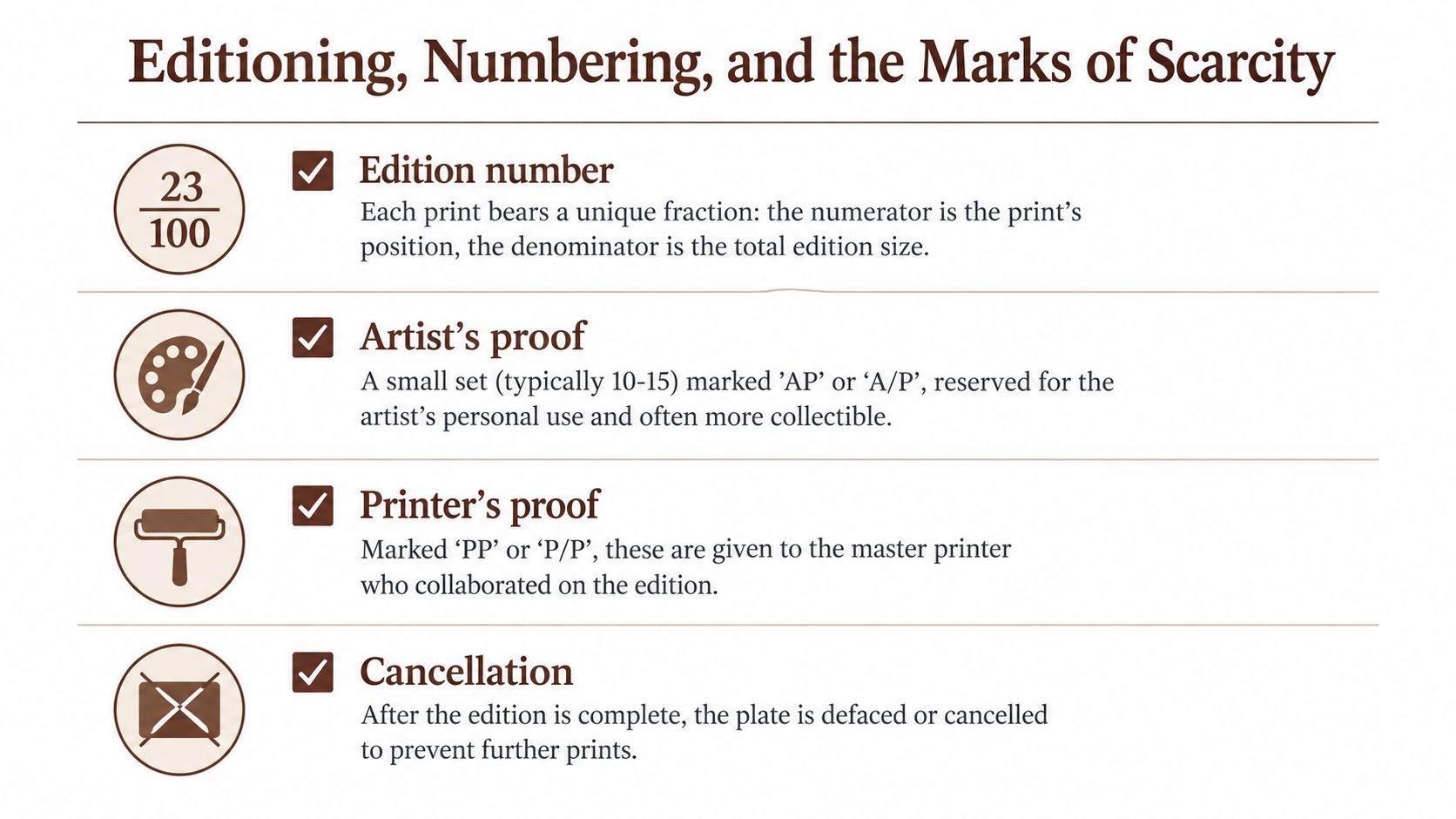
Editioning turns a potentially unlimited run into a finite object. The denominator states the boundary. On a sheet marked 23/100, 23 identifies the impression and 100 identifies the declared edition size. The fraction only carries weight when the studio has rules for proofs, cancellations, re-issues, and records.
Proofs sit beside the numbered edition, but they aren't interchangeable. A trial proof tests colour, pressure, wiping, or registration. B.A.T., or bon à tirer, is the approved reference impression for the printer. A.P. or A/P means artist's proof. P.P. or P/P means printer's proof. H.C. commonly identifies hors commerce impressions, while B.A.T. marks the standard the printer should match.
The marks on the paper should agree with the written record:
- Graphite signature: A hand-applied pencil signature is usually easier to distinguish from a printed mark than a signature integrated into the image.
- Sequential number: The numerator should fall within the declared run.
- Blind stamp: A raised seal pressed into the sheet leaves an impression without ink.
- Embossed chop or studio seal: This identifies the artist, workshop, publisher, or printer.
- Registry identifier: Contemporary studios may add a database or blockchain reference, provided the record remains accessible and meaningful.
Closing the run
A colophon or certificate should state the edition size, process, paper, printer where relevant, proof policy, and closure method. In traditional printmaking, the artist may deface or cancel the plate after the run. A cancelled plate can show a line, cross, or other deliberate interruption that prevents the original image from being printed in its previous form.
Modern digital editions need a comparable rule. The studio may close the master file, delete production access, retain a registry, and state that no smaller reissue or poster will follow. A physical plate isn't the only possible control, but the buyer still needs a clear closure statement.
Practical rule: A limited edition is finite because the maker documents and closes it. An open edition remains available because no equivalent cap governs production.
The phrase limited edition therefore means more than a low number on a product page. An unsigned, unlimited decorative print may be described as an edition in commercial language, but it doesn't carry the same scarcity mechanism as a signed and numbered work with a published denominator. A guide to limited-edition signed and numbered prints gives collectors the useful basic test. Ask what is fixed, what is marked, and what prevents the artist or seller from producing more.
How to Evaluate and Authenticate a Print
Start with the sheet, not the certificate. A document can repeat a claim. The paper can confirm or contradict it.
A repeatable inspection order
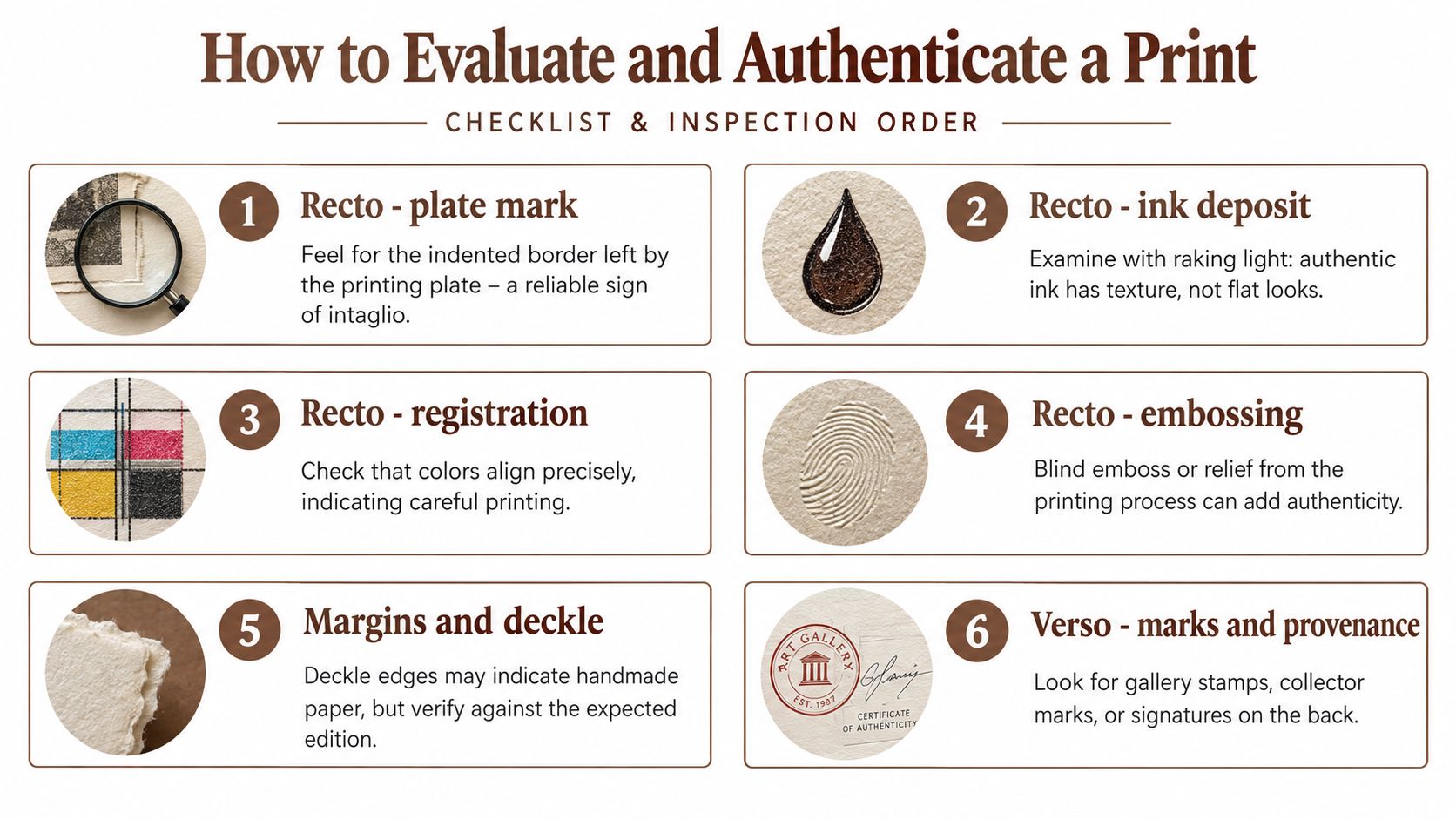
Recto first. Hold the print at an angle and inspect the image side. An intaglio plate mark should be physically present where the technique calls for one. Raking light can reveal ink deposit, surface texture, screen layers, embossing, registration, and unexpected flatness.
Then inspect the margins. Check deckle edges, trimmed edges, corner condition, foxing, handling marks, and any inscription. A handmade deckle may support the stated paper specification, but it isn't proof of authenticity by itself.
Turn to the verso. Look for watermarks, publisher stamps, workshop seals, collector marks, and handwritten references. The back can reveal whether the sheet belongs to the stated paper stock or carries a different publisher history.
Read the documents together. A useful file may include a signed certificate of authenticity, the edition size, a condition statement, an invoice from the gallery or publisher, shipping records, exhibition paperwork, and a provenance trail leading back to the artist or estate. Hahnemühle certificate guidance identifies the artist's or photographer's signature, edition number, and artwork title as core documentation elements.
Public records add another layer. Look for a registry number, a gallery or publisher invoice, a catalogue raisonné entry, and, where applicable, an AI-assisted edition record on the artist's own platform. A registry should match the impression number and status. It shouldn't exist as an isolated PDF with no corresponding record.
A generic COA, ballpoint or marker signature, an edition number beyond the published run, mixed paper stocks, or dimensions that don't match the catalogue plate size should slow the purchase. For a higher-value work or disputed attribution, specialist review may be appropriate. This overview of the cost of art verification services helps explain what professional authentication can involve before you commission an assessment.
Before payment, ask the seller:
- What is the complete edition size, including A.P., P.P., H.C., and B.A.T. impressions?
- Where can I verify this impression number?
- Which paper and ink or photographic process were used?
- Can you provide a condition report and photographs of the recto, verso, signature, and margins?
- Does the provenance lead to the artist, publisher, gallery, or estate?
Pricing, Resale Value, and the AI-Assisted Question
Price begins with the edition structure, then moves through condition, format, paper, and provenance. A signed numbered impression with clean margins and a documented history usually has a different market position from an unsigned shop print, even when the image is identical.
Published pricing frameworks make the relationship visible. One guide lists 8 × 10 inch prints in an edition of 50 at $150 to $300, 16 × 20 inch prints in an edition of 25 at $350 to $700, 24 × 30 inch prints in an edition of 15 at $700 to $1,500, 30 × 40 inch prints in an edition of 10 at $1,200 to $2,500, and 40 × 60 inch prints in an edition of 5 at $2,000 to $4,500. These are industry guidance bands, not guarantees, and the framework is published by ShootRate's fine-art photography pricing guide.
| Impression Type | Typical Position vs. Edition Price | Key Driver |
|---|---|---|
| Numbered and signed | Closest to the stated edition price | Condition, demand, and documentation |
| Artist's proof | May command a premium in a strong edition | Proof policy and collector preference |
| Printer's proof | Depends on the printer's role and disclosed count | Collaboration record and scarcity |
| Unsigned shop impression | Usually weaker than the signed edition | Lack of authorship and edition evidence |
| AI-assisted open print | Lower-tier decorative positioning is common | Disclosure, production cap, and resale record |
Market commentary places many prints, silkscreens, and etchings around 20 to 75 works per edition, with prices often around 3% to 10% of a comparable unique work's price. A broader dealer rule puts an edition object around 10% to 20% of the unique work's price, depending on edition size. These rules of thumb appear in edition-market pricing commentary, and they should be treated as context rather than appraisal.
AI-assisted work can be legitimate without pretending to be a hand-carved plate. Some channels report AI-art print or kit pricing around $5 to $30, with wholesale print listings as low as $0.50, as summarized by market coverage of best-selling AI art. The difference from established signed prints is substantial. It reflects a different product position, not automatically a defect.
Pay above the issue price only when the extra amount buys evidence, condition, scarcity, or a record you can independently verify.
A fixed, hand-signed AI-assisted edition can occupy the collectible end of the spectrum if the studio identifies the workflow and closes the run. An open AI print with no signature, cap, or registry behaves more like decor. Buyers comparing contemporary figurative work can also use this overview of contemporary fine art to distinguish the visual subject from the edition structure.
Sellers building a direct channel may find a practical sell art online guide useful for understanding how product information, fulfillment, and presentation affect a buyer's confidence. For collectors, the same principle runs in reverse. Clear information is part of what you're paying for.
Conservation and Framing for Long-Term Value
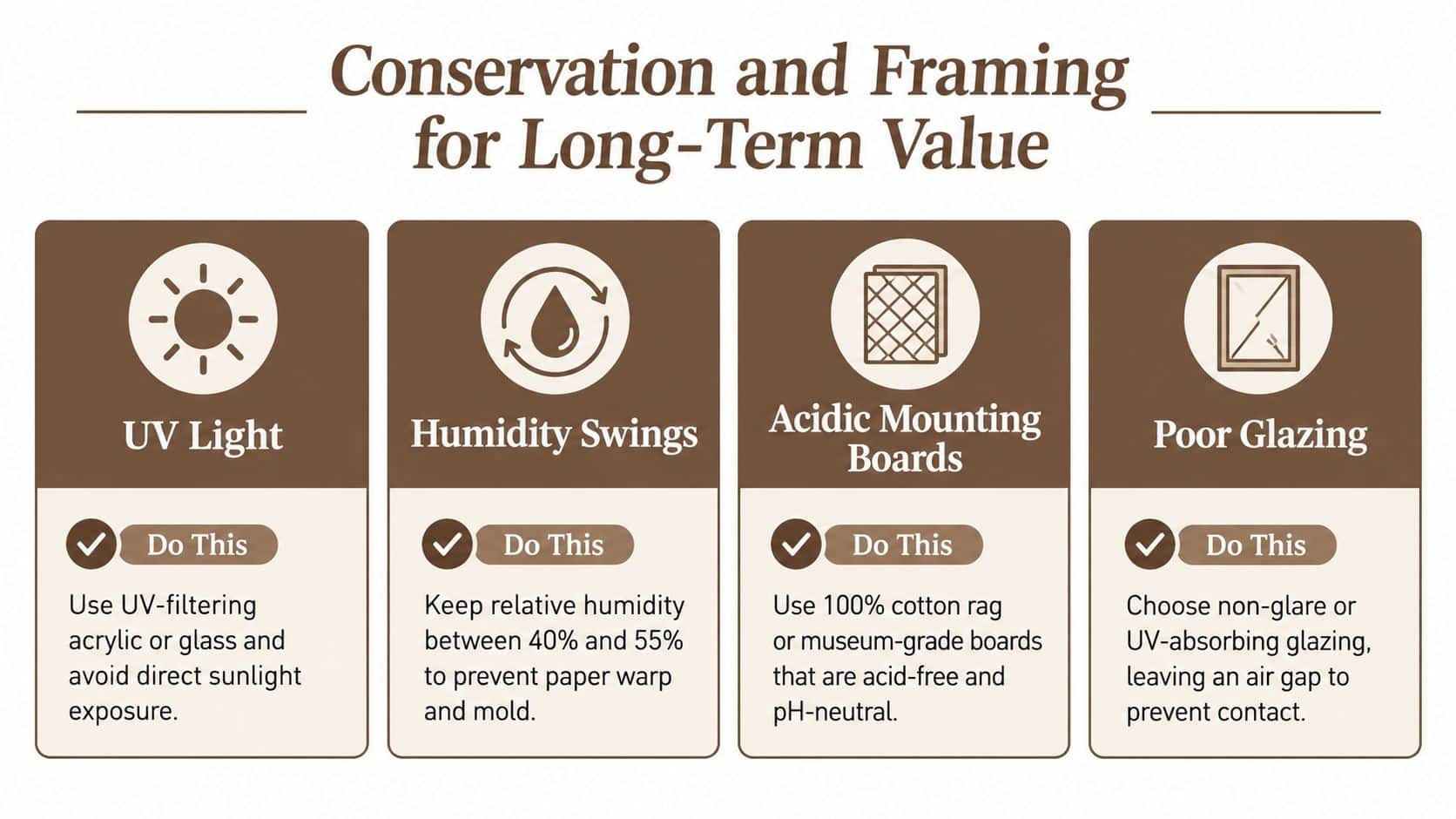
A fine artist print can lose value long before the image fades. The first risks are usually environmental, not dramatic: ultraviolet light, humidity swings, acidic mounting materials, and glazing that lets the sheet touch the glass. Calling a paper archival does not remove those risks.
Use acid-free cotton rag hinges and museum board. Mount the sheet with reversible methods, usually along the upper edge, so it can move with changes in humidity without tearing. Spacers keep the paper off the glazing. Optium Museum Acrylic is lighter and more impact-resistant than standard Plexiglas, and UV-filtering glass or acrylic can reduce ultraviolet exposure. Direct sunlight is still direct sunlight.
A stable room matters as much as the frame.
Aim for relative humidity between 40% and 55%. That range is used in the conservation framing guidance for this article's visual reference, and it gives a practical household target for limiting paper movement and mould risk. Sudden swings matter as much as the number itself. A bedroom with heating changes, a bathroom with steam, or an exterior wall that turns cold can all stress the sheet. A stable interior wall, away from radiators, vents, fireplaces, and direct sun, is a calmer home for the work.
Decorative framing fills a wall. Conservation framing protects an object. Choose a mat wide enough to separate the image from the frame and glazing, keep hinges out of the image area, and label the back board with the artist, title, edition number, process, paper, acquisition date, and framing date. A future owner should be able to identify the work without opening the frame.
Material choice, light exposure, paper base, and air quality all work together. The conservation literature on permanent paper supports pairing archival pigment inks with cotton rag or alpha-cellulose papers that meet permanence standards, then limiting UV and pollutant exposure. Stable materials help, but a print still suffers if it hangs in harsh light.
Record the work at acquisition. Photograph the recto, verso, signature, margins, frame, and any existing marks. Write down the condition. If the print is valuable, ask your insurer whether a fine-art rider fits the piece, and keep the invoice, certificate, registry record, and condition photos together. That file supports a future claim and gives a later buyer a clear starting point.
A Studio Case Study in Transparent Editions
A transparent studio doesn't ask the collector to infer scarcity from atmosphere. It publishes the rules.
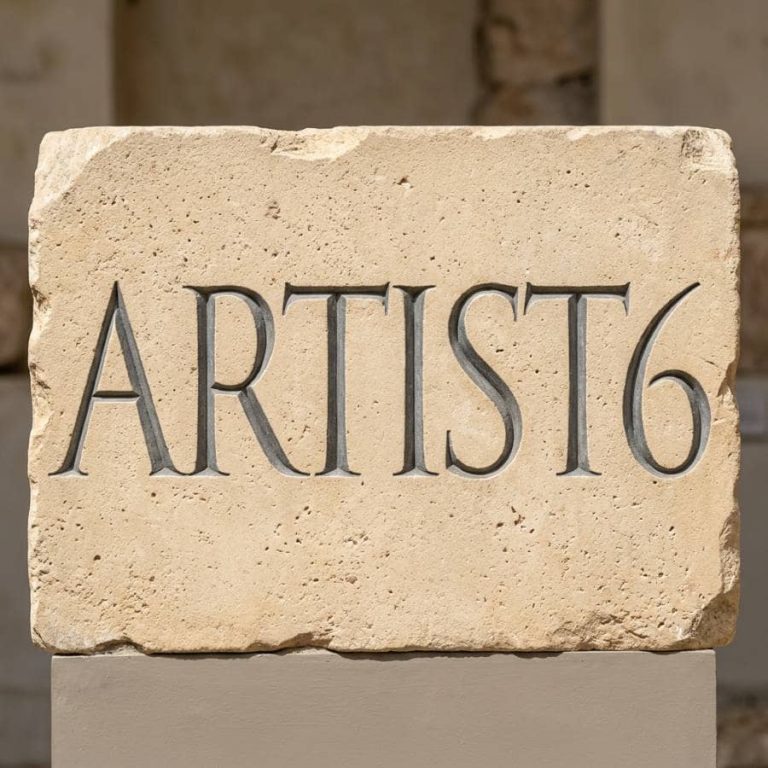
ARTIST6 offers a useful example of that approach. Its practice releases limited, signed, numbered, and sealed archival prints in fixed editions of 6, organized into chapter-based bodies of work. The studio identifies the paper or substrate, names the technique, documents its materials and printer, applies the artist's hand signature, and marks each impression with a numbered fraction and a blind stamp or studio seal. Its permanent public registry allows a buyer to look up an impression by number after the edition sells out.
The method also makes the digital process legible. ARTIST6 uses AI image generation as a tool comparable to a camera, then curates, hand-finishes, and prints the selected work on archival paper. That statement doesn't turn an AI-assisted image into a traditional etching. It tells the buyer what kind of authorship and production to evaluate.
What the record should contain
The proof policy matters as much as the headline edition size. A studio should state how B.A.T., A.P., and P.P. impressions are counted, whether they sit outside the numbered edition, and how many exist. It should also explain what happens to destroyed pulls, failed sheets, re-issues, and post-publication corrections.
A registry entry should identify the work, edition status, impression number, certificate details, and sale history where the studio records it. The buyer can compare the physical sheet with that entry. If a correction affects a title, substrate, or edition status, the studio should preserve the original record and show the correction rather than replacing it.
| Documentation Element | Transparent Studio, for example ARTIST6 | Opaque or Open Edition |
|---|---|---|
| Edition cap | Published fixed size | Missing, flexible, or unlimited |
| Physical marks | Hand signature, fraction, seal | May be unsigned or printed |
| Substrate | Paper or other material specified | Often described only as “fine art paper” |
| Proof policy | B.A.T., A.P., and P.P. treatment disclosed | Usually absent |
| Registry | Public record remains available | No independent lookup |
| Re-issues | Rules state whether they are prohibited | Seller may continue production |
| Pricing | Published schedule tied to edition status | Seller sets price without a fixed cap |
An open edition can still be attractive. It offers a different ownership proposition. Without a registry or fixed cap, the buyer is purchasing the image and the seller’s current representation, not a documented place within a closed population.
ARTIST6 publishes chapter-based contemporary Renaissance fine art as signed, numbered, sealed archival prints, with documented materials and a permanent public edition registry. Visit ARTIST6 to review the available works before choosing a print.