
Limited Edition Print Signed and Numbered Explained
A signature is not proof by itself. It can identify an artist, but it doesn’t establish how many impressions exist, whether the edition was closed, or whether the sheet in front of you belongs to the artist’s documented records. A serious limited edition print signed and numbered is supported by a system of controls, materials, records, and provenance.
The familiar fraction, such as 3/25, matters because it connects the individual impression to a finite edition. The paper, pencil marks, certificate, production notes, and registry matter because they let someone examine that connection later. The strongest studios treat editioning as part of the work, not as a final gesture added after printing.
Table of Contents
- Why a Signature Alone Is Not Enough
- Reading the Edition Fraction
- The Physical and Documentary Anatomy of an Edition
- How Scarcity and Transparent Pricing Build Trust
- A Chapter-Based Release Model in Practice
- A Practical Verification Checklist for Collectors
- What Makes a Contemporary Edition Collectible
Why a Signature Alone Is Not Enough
A handwritten signature carries authority because it comes directly from the artist. It still has limits. A signature without a fixed edition size, consistent numbering, and supporting provenance is only a mark on paper. It doesn’t tell you whether the artist authorized the impression, whether additional copies were made, or whether the sheet has changed hands through a traceable chain.
The modern signed-and-numbered convention itself is relatively recent. Musashino Art University’s glossary entry on signatures and editions notes that signing and edition-numbering prints wasn’t customary until the nineteenth century. At the Vienna Third International Congress of Plastic Arts in 1960, delegates declared that serialized edition numbers should accompany signatures for a work to be recognized as an original print. Commercial print distribution helped establish the format after 1960.
That history makes the convention clearer. Signing and numbering aren’t timeless guarantees. They’re part of a developed professional framework.
The apparatus around the autograph
A defensible edition usually begins before the first sale. The artist fixes the total edition size, records the production details, chooses suitable materials, and maintains a consistent numbering system. The artist then closes the edition when the stated number is reached, rather than treating the edition size as a flexible sales target.
A collector should be able to connect several elements:
- The physical sheet: The print carries the artist’s signature and edition fraction in a consistent position and medium.
- The edition record: Studio documentation identifies the title, edition size, process, materials, and relevant dates.
- The provenance trail: A certificate, gallery record, registry entry, or ownership history supports the print’s passage from studio to buyer.
- The closure rule: The artist has stated whether reprints, smaller reissues, posters, or digital files are excluded after closure.
Modern proof systems can extend this structure without replacing the physical work. For a useful overview of how integrated documentation can connect an object with its records, see DPP Grid’s guide to integrated proof systems.
The practical conclusion is quiet but important: trust comes from agreement between the print and the records. If the signature looks familiar but the edition size is unclear, the number doesn’t match the certificate, or no one can explain whether the edition remains open, the autograph cannot answer the central questions.
Reading the Edition Fraction
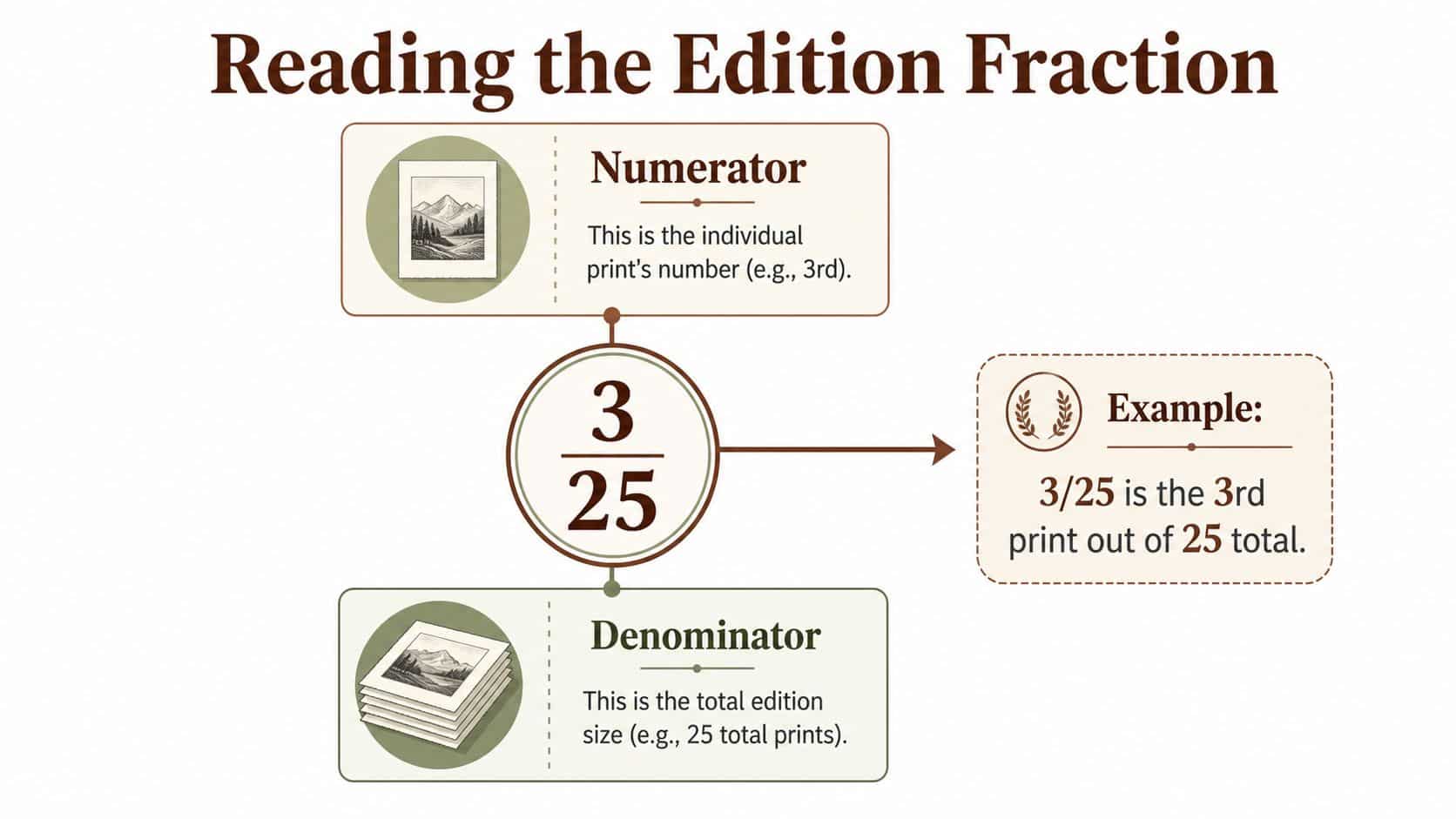
Look at the margin before assigning meaning to the number. On an editioned print, the notation usually appears as a fraction beside the artist’s signature. Tate describes the convention with examples such as 1/25 and 2/25. The lower number gives the total edition size, while the upper number identifies the particular impression within that finite run. Tate’s explanation of editioned prints sets out this basic reading.
So, 3/25 means one identified impression in an edition of 25. The denominator is the scarcity boundary. The numerator identifies the sheet you’re holding.
What the number doesn’t tell you
Collectors sometimes assume that 1/25 was printed first, followed by 2/25 and 3/25. That assumption is unreliable. Tate notes that the numbering doesn’t have to reflect the actual production order. An artist or print studio may print the sheets in one sequence, inspect or finish them in another, and assign numbers according to a separate administrative system.
That distinction matters for provenance. A low numerator doesn’t automatically make an impression more desirable, more important, or more valuable. The number identifies the impression. It isn’t a ranking.
Check the fraction against the certificate and any available studio record. A cataloging record should preserve the title, dimensions, medium, edition size, and identifying details in a form that remains legible after the sale. Colorado Art Services’ cataloging guide offers useful context for organizing those records.
A careful visual examination
Examine the lower margin for three things:
- The fraction: Confirm that the numerator and denominator are clear and consistent with the documentation.
- The signature: Compare its placement, medium, and character with other authenticated examples from the same practice.
- The surrounding paper: Look for an unprinted margin where the marks can be inspected without interference from the image.
A fraction is meaningful only when the edition size was fixed and the studio has kept the number tied to its records. The ink or graphite mark is the visible part of a larger administrative decision.
The Physical and Documentary Anatomy of an Edition
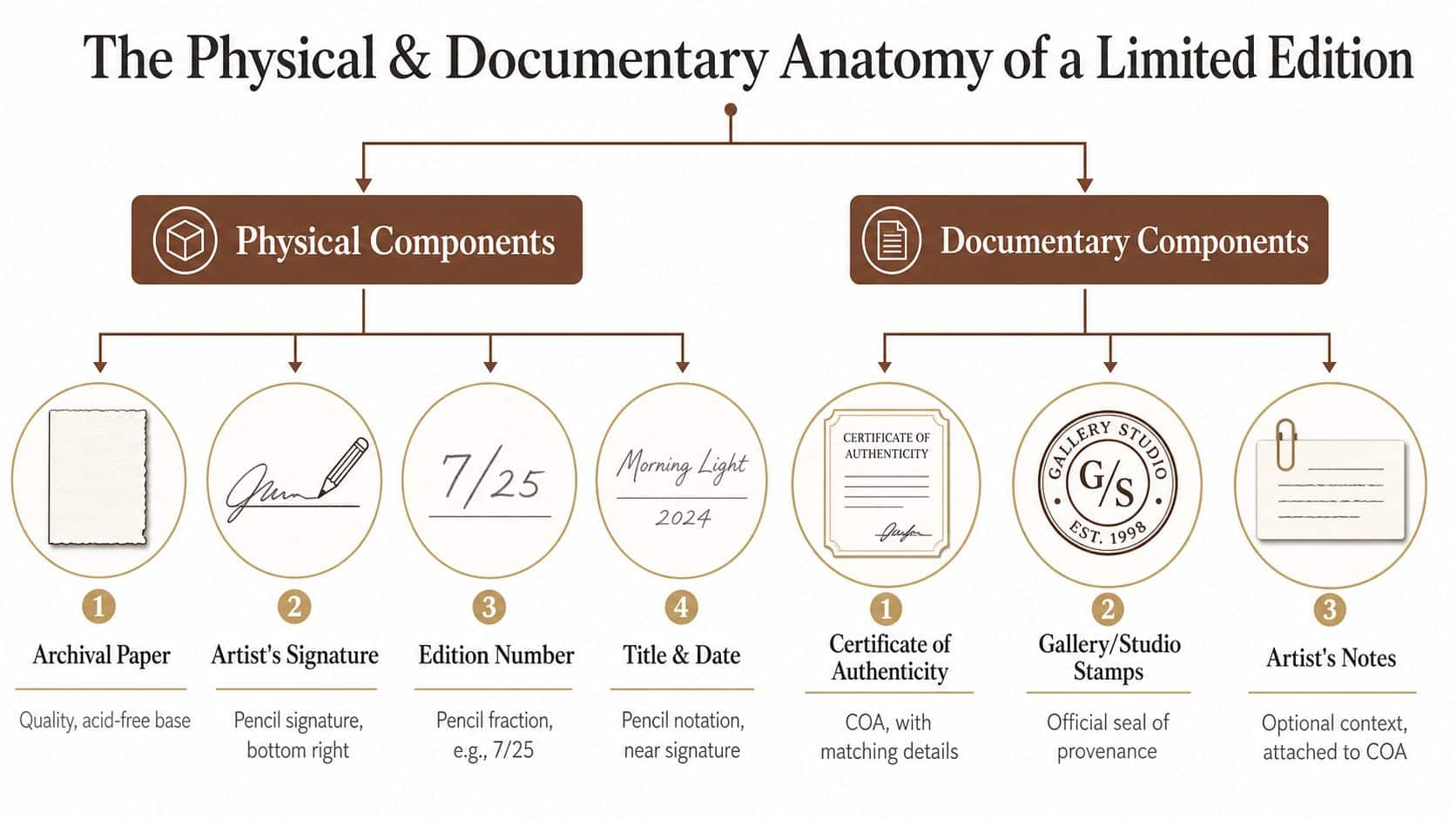
A well-made edition has two bodies. The first is physical, consisting of paper, image, margins, signature, and number. The second is documentary, consisting of records that describe what was made and how the studio controlled it. Either body can be weakened while the other appears convincing.
For archival work, material choices matter. Printmaking references recommend graphite pencil for signatures and edition marks because graphite resists fading and is harder to alter than ink. The point isn’t visual tradition alone. A pencil mark gives the collector a durable, inspectable sign that was applied to the sheet rather than embedded in the reproduction process.
Physical controls
The paper should be identified rather than described only as “fine art paper.” A useful record names the manufacturer and type. The sheet should also be examined for its surface, weight, margins, and condition. Archival paper supports long-term preservation, but the collector still needs the actual specification.
The signature and fraction should be applied consistently. Title and date notation may appear near them, depending on the studio’s convention. A seal or embossed mark can add another physical identifier, though it shouldn’t be treated as a substitute for a complete record.
Records that survive the sale
The College Art Association’s printmaker guidelines recommend documenting the title, publication date, paper size, image size, paper manufacturer and type, edition size, proof counts, numbering system, and printing process. These details turn a signed object into a documented edition.
A certificate of authenticity should mirror the physical sheet. It should identify the title, medium, edition size, and edition number, with details that match the studio record. Artist’s notes may add context, while gallery or studio stamps can support the chain of provenance.
Practical rule: A certificate is useful when it repeats identifiable facts. Decorative language is less valuable than a matching title, number, material description, and record of origin.
Public registries are a modern extension of the traditional paper trail. They can preserve the edition status after a work sells out and give a later owner a place to check the print’s identity. A tamper-resistant certificate or persistent ownership record can strengthen that system, provided the record remains accessible and the physical details continue to match.
What works is alignment. What doesn’t work is a polished certificate with no fixed edition record, or a registry entry that omits the number and material details needed to identify the sheet.
How Scarcity and Transparent Pricing Build Trust
Scarcity has a mechanical basis. A fixed edition limits supply, and the relationship between fixed supply and growing demand can support higher prices than an open edition, as explained in this market guide to scarcity and artwork pricing. The effect depends on the work, the artist, and the market. A small edition alone doesn’t create meaning.
The stronger point is that scarcity becomes credible when the artist enforces it. The edition size should be set before sales begin. Once the stated number has been reached, the edition should close, with no further copies added to that edition. A studio that changes the cap, introduces a smaller reissue, or sells the same image as an unannounced poster weakens the original promise.
Pricing as part of the record
Price transparency adds a second layer of trust. A studio can publish an edition size and a price schedule in advance, then define step increases at clear sell-through thresholds. The collector can see the rule before purchasing instead of negotiating against an opaque inventory system.
This doesn’t guarantee faster sales or higher resale prices. There isn’t enough verified evidence to make that promise. It does reduce one practical source of friction. Collectors aren’t forced to guess whether a later buyer will receive the same work under a different price or edition condition.
ARTIST6 uses a published price schedule with step increases at 25%, 50%, and 75% sell-through, as described in its studio information. Its strict edition policy excludes reprints, smaller reissues, posters, and digital-file releases after closure. Collectors can review available works through the ARTIST6 shop.
Why this matters for emerging print markets
The question becomes more complex when artists use AI-assisted workflows. A 2026 industry summary projects the AI-generated art market from $3.2 billion in 2024 to $40.4 billion by 2033, and that projection is reported by Smartphoto’s industry commentary. The figures are a projection, not a guarantee. Legal and market discussions still wrestle with authorship and valuation when human and machine processes meet.
In that setting, transparent edition rules can help separate two questions. The first is how the image was made. The second is whether the physical object has been controlled, documented, and represented accurately. A registry, fixed cap, disclosed process, and visible pricing schedule don’t resolve authorship debates. They do give collectors clearer facts about the object they’re buying.
A Chapter-Based Release Model in Practice
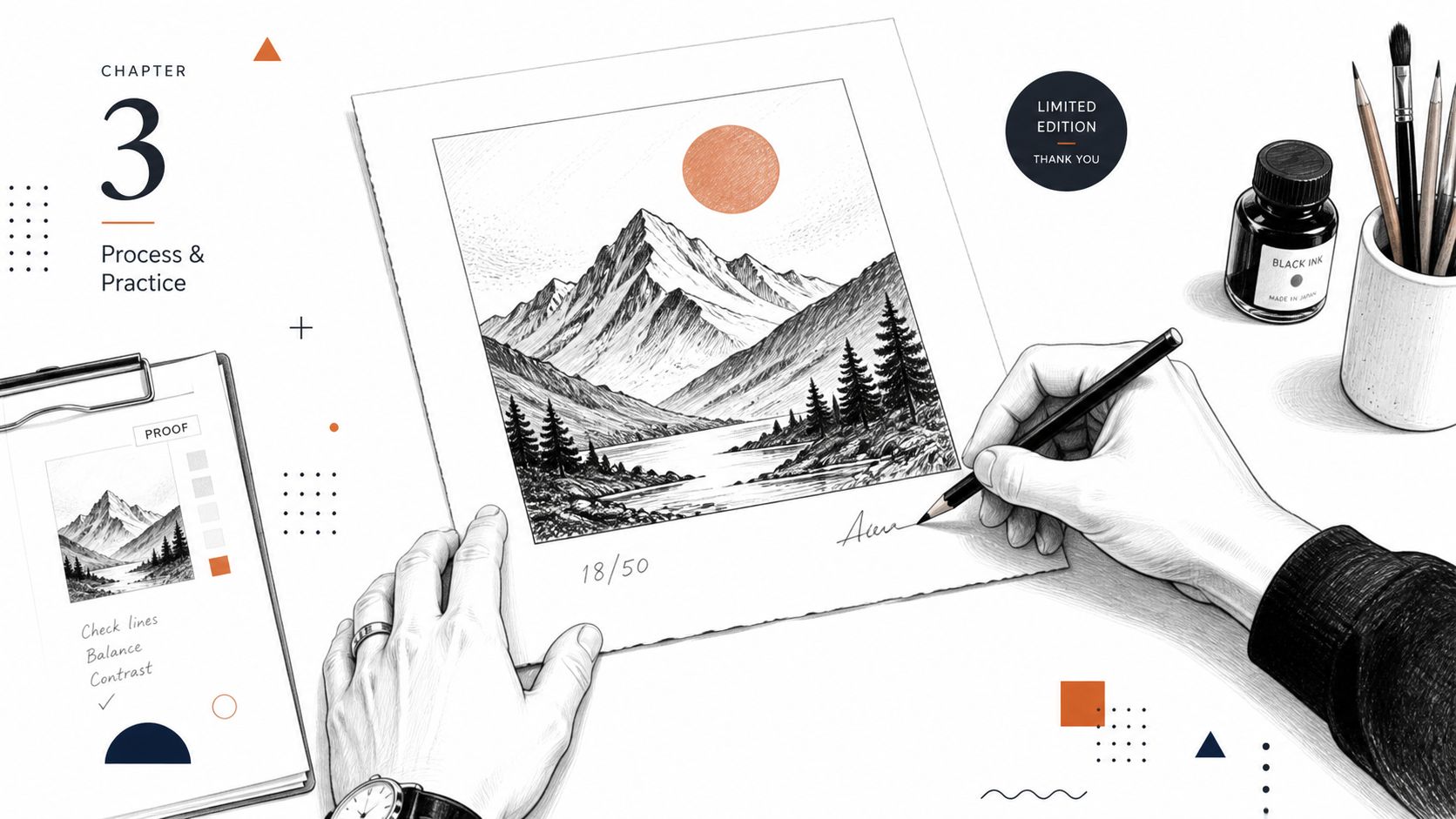
A chapter-based studio doesn’t treat each print as an isolated product. It builds a body of work with a defined visual grammar, then releases that body at a measured pace. ARTIST6 provides a concrete example, with chapters comprising 12-piece bodies of work and editions of 6, each print signed, numbered, and sealed.
That structure changes the collecting experience. A collector isn’t choosing from unrelated images that happen to share a storefront. The works arrive as a coherent series, suitable for a considered arrangement and for collecting over time. Current chapters include ANIMA MUNDI, LUMEN SYLVARUM, and THE HORTUS EDITIONS.
The physical edition remains central. Prints are produced on archival paper before signing, and each signed and numbered piece is accompanied by an embossed certificate of authenticity and a public provenance registry entry. The registry remains visible after sell-out, preserving the work’s edition status rather than allowing the record to disappear when the purchase window closes.
A release without artificial urgency
The model is deliberately unhurried. The studio focuses on one contemporary Renaissance universe, drawing on chiaroscuro, figurative composition, triangular structures, and a palette that includes bronze, umber, ochre, oxblood, lapis, and gold. The work doesn’t pivot to short-lived trends just to fill an edition.
The process is also declared. AI image generation is used as a tool comparable to a camera. Outputs are curated, hand-finished, and printed on archival paper. The studio’s Journal and Manifesto document tools, materials, iteration logic, printer, and paper, giving collectors information about a workflow that could otherwise remain opaque.
A collector encounters the work in several stages:
- Announcement: The chapter establishes its theme and the relationship between its pieces.
- Acquisition: Available impressions carry the fixed edition number, signature, and seal.
- Sell-out: The edition closes under the stated no-reprint policy.
- Afterward: The public registry keeps a record of the work and its edition status.
The value of this model isn’t that it removes judgment from collecting. It gives judgment a stable context. The buyer can consider the image, materials, price, and long-term coherence without relying on a disappearing sales page or an informal promise.
A Practical Verification Checklist for Collectors
Verification should begin before payment. Don’t stop at the signature. Compare the print with its certificate, the certificate with the studio record, and the studio record with any public provenance entry. A clear chain of ownership remains important for legitimacy and resale value, as summarized in MyArtBroker’s buyer’s guide to prints and editions.
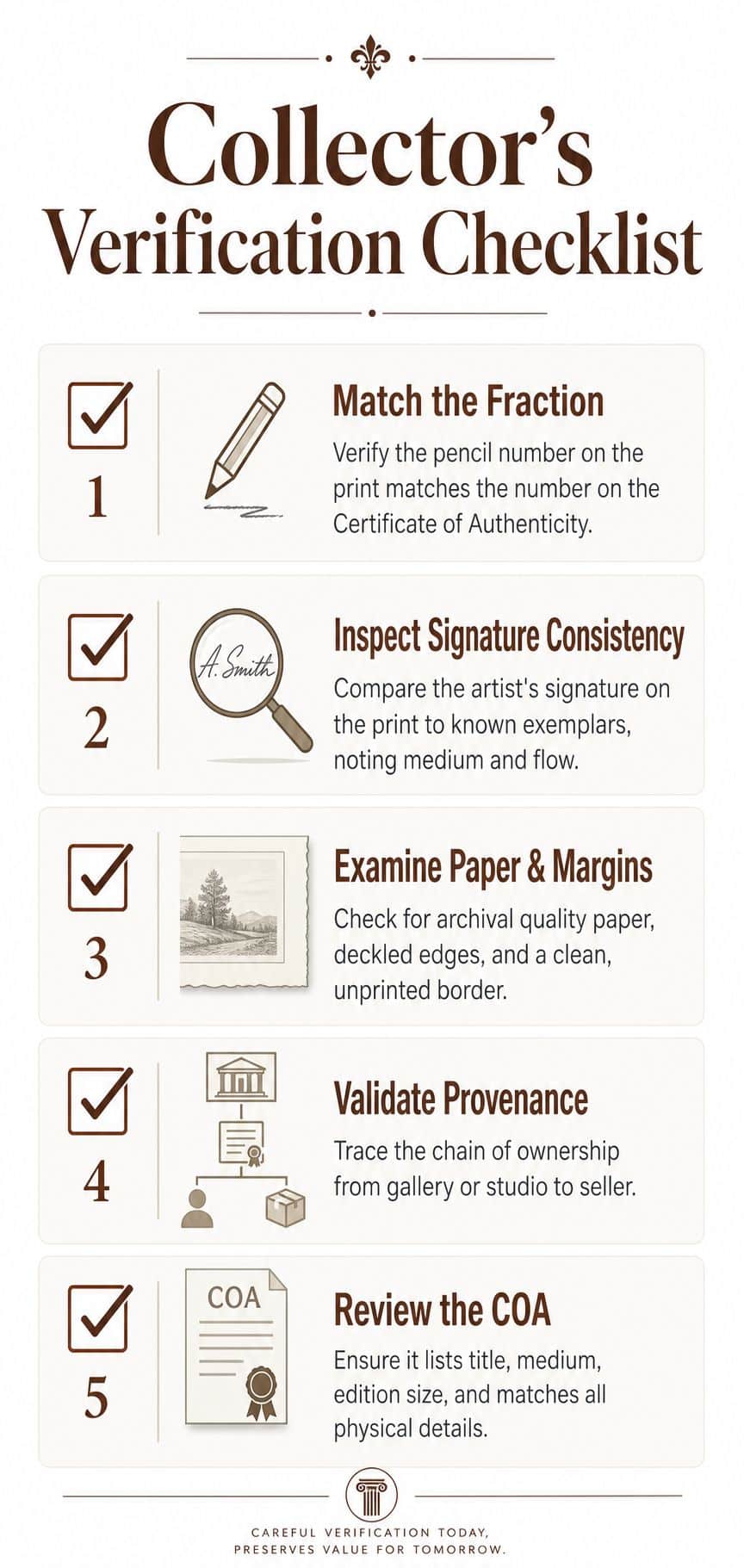
Use the following checks as a working file, not as a ritual.
- Match the fraction. Confirm that the pencil number on the print matches the number on the certificate. The denominator should also match the declared total edition size. If the certificate says one thing and the sheet says another, pause the transaction until the studio explains the discrepancy.
- Inspect the signature medium. Look closely at the signature’s medium, pressure, placement, and flow. Graphite has practical archival advantages, but the medium alone doesn’t authenticate a work. Compare the mark with known examples from the same artist and ask whether the signature was applied by hand to the physical print.
- Examine paper and margins. Identify the paper manufacturer and type where possible. Check the unprinted border, surface, edges, and condition. A clean margin makes the fraction and signature easier to inspect, while a documented archival specification gives the object a clearer preservation context.
- Validate provenance. Trace the chain from the artist or studio to the gallery, first buyer, and current seller. A public registry is useful when it preserves the work after sell-out and records the edition number, title, and status. A private claim that can’t be checked later is weaker than a durable record.
- Review the certificate. Ensure it lists the title, medium, edition size, and physical details that match the print. Look for a studio or gallery seal, and treat tamper-resistant features as supporting controls rather than complete proof.
The ARTIST6 Journal offers an example of how process documentation can sit beside the edition record. The important question isn’t whether every studio uses the same format. It’s whether the format is consistent, available, and connected to the object.
What Makes a Contemporary Edition Collectible
The collectible quality of a contemporary edition rests on more than scarcity. It depends on mechanical enforcement, archival materials, consistent records, and a coherent studio practice. The signature and fraction make those conditions visible, but the registry and provenance trail let a later owner test them.
The historical development of the convention is instructive. Musashino Art University records the absence of a customary signed-and-numbered format until the nineteenth century, followed by formal recognition of serialized edition numbers alongside signatures at the Vienna Congress in 1960. Contemporary studios are extending that tradition with public registries, transparent pricing, and documented AI-assisted workflows.
A collector doesn’t need to prefer one medium, process, or subject. The useful framework is simpler. Ask whether the edition is fixed, whether closure is respected, whether the paper and production process are identified, whether the records remain accessible, and whether the studio has developed a practice that can be understood over time. For collectors seeking a work made to specific spatial or thematic requirements, ARTIST6 fine art commissions provide another route into that documented studio practice.
ARTIST6 offers limited, signed, and numbered archival prints organized into chapter-based series, with transparent edition rules and a permanent public registry. Visit ARTIST6 to review available works, read the studio documentation, and assess each edition through its physical and provenance records.