
Contemporary Fine Art: A Collector’s Guide
The most popular advice about contemporary fine art is also the least useful: buy what you love, follow the market, and treat traditional technique and artificial intelligence as opposing camps. A serious collection needs more than instinct or trend awareness. It needs a clear view of how a work was made, how its scarcity is documented, and whether it belongs in a sustained visual conversation with the rest of your holdings.
Contemporary fine art now includes figurative painting, mixed-media sculpture, archival printmaking, and hybrid digital-physical work. The strongest practices aren't defined by a single look. They're defined by authorial intent, material discipline, transparent editions, and a process that can withstand inspection.
Table of Contents
- What Contemporary Fine Art Actually Means Today
- The Current Market for Contemporary Art
- Renaissance Techniques in Contemporary Practice
- AI-Assisted Workflows and Authorship in Fine Art
- How Editions and Provenance Protect Collectors
- Collecting Strategies by Buyer Profile
- Building a Coherent Contemporary Fine Art Collection
What Contemporary Fine Art Actually Means Today
Many collectors still use “contemporary art” as shorthand for abstraction, conceptual installations, or provocative readymades. Those forms matter, but the definition is too narrow. A figurative oil painting can be contemporary. So can a pigment print built from a digital composition, a sculpture combining cast resin and found material, or a work that begins in an AI-assisted studio and ends with hand-applied glazes.
The word contemporary primarily identifies a period and a living practice. It doesn't prescribe a style. In market reporting, contemporary art is treated as a distinct category within the wider fine-art economy, but the studio reality is broader than auction labels suggest. Artists continue to work with inherited methods while addressing present subjects, present technologies, and present systems of circulation.
A useful distinction: contemporary art describes when and within what cultural context a work is made. Contemporary fine art describes a disciplined practice in which the work's materials, process, and authorship carry real weight.
That distinction helps separate serious work from decorative output. A polished image isn't automatically fine art. A technically old-fashioned medium isn't automatically authoritative either. The relevant questions are more exact:
- What is the artist trying to construct?
- Which decisions belong to the artist, and which belong to a tool or collaborator?
- Are the materials appropriate to the intended life of the work?
- Can the edition, signature, and ownership history be verified?
The category now includes artists who use Renaissance-derived composition beside computational tools. Chiaroscuro, preparatory drawing, geometric structure, and layered color can coexist with digital sketches, image-generation systems, and archival pigment printing. Treating tradition and technology as opposites mistakes the tool for the practice.
A camera obscura didn't eliminate authorship when artists adopted optical assistance. Photoshop didn't make composition irrelevant. AI-assisted workflows raise sharper questions about selection, disclosure, and intervention, but those questions belong inside studio practice rather than outside it.
What matters to a collector is integrity across the chain of decisions. A work should have a declared process, stable materials, and a clear relationship between the artist's intention and the finished object. Stylistic novelty may attract attention. Verifiable practice gives the work a foundation.
The Current Market for Contemporary Art
Auction headlines capture only one part of the contemporary fine art market. Art Basel and UBS estimated global art sales at $57.5 billion in 2024, a 12% year-on-year decline. Dealers accounted for $34.1 billion, the market's largest share, according to the Art Basel and UBS market reporting summarized by CNN.
Contemporary auctions faced pressure during the same period. The report estimated contemporary auction sales at about $1.4 billion, down 36%, their lowest level since 2018. Collectors continued to buy contemporary work, but auctions remain sensitive to confidence, consignments, and the supply of highly priced pieces, particularly above the $1 million threshold.
Artprice's 2024 report shows a related pattern from another angle. Contemporary art produced about $1.89 billion in global auction turnover across roughly 132,380 lots. The number of contemporary works sold reached a record even as revenue fell 18% from the previous year. Contemporary art represented 17% of total global auction turnover across fine art and NFTs, while the unsold rate rose to 35.6%. The average sold lot was about $14,300, and the year's top contemporary auction result reached $46.5 million for a Basquiat. Taken together, the figures indicate substantial volume, wide participation at lower price points, and a concentrated upper tier. (Artprice by Artmarket's 2024 Contemporary Art Market Report)
Where collectors actually buy
Collectors often begin with galleries, artist studios, fairs, advisors, or online viewing rooms rather than a headline auction. A dealer can clarify condition, framing, edition history, and the artist's broader body of work. That context is difficult to recover from a single auction listing.
| Market Tier | Price Range | Typical Media | Primary Acquisition Channel |
|---|---|---|---|
| Entry and accessible contemporary work | Not fixed | Archival prints, works on paper, photography | Artist studios, galleries, online platforms |
| Established mid-market practice | Not fixed | Painting, sculpture, limited editions, mixed media | Galleries, fairs, advisors |
| Blue-chip auction tier | Not fixed | Major paintings, sculpture, landmark works | Auction houses, private sales |
| Digital and hybrid practice | Not fixed | Digital works, pigment prints, physical-digital hybrids | Studios, galleries, specialist platforms |
Price depends on the artist, medium, scale, edition structure, exhibition history, and documentation. Medium alone is a poor proxy for value. A small, well-documented edition may be a more coherent acquisition than a larger painting purchased without a clear provenance file.
For digital or blockchain-linked works, examine two separate things: the artwork and the system recording its history. Blocsys Technologies’ discussion of Robinhood Chain in UAE blockchain adoption provides context for how enterprise blockchain systems are framed. A ledger can support verification, but it cannot replace the artist’s process disclosure, a certificate, or a traceable ownership record. Collectors should also check whether the physical object, digital file, edition terms, and provenance documents describe the same work.
Renaissance Techniques in Contemporary Practice
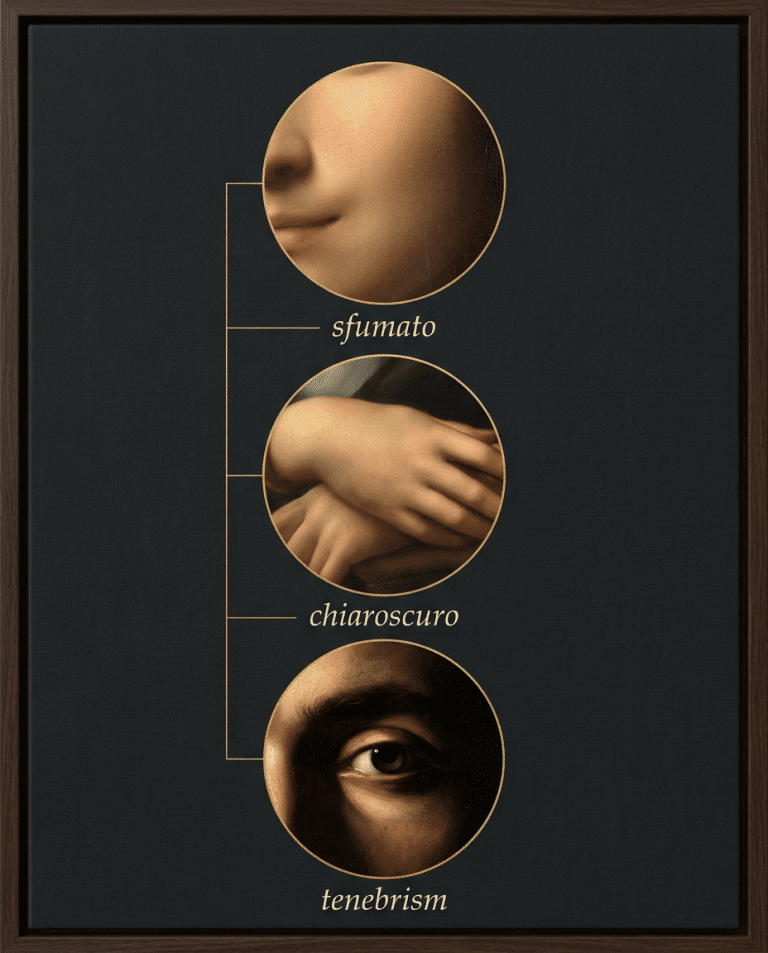
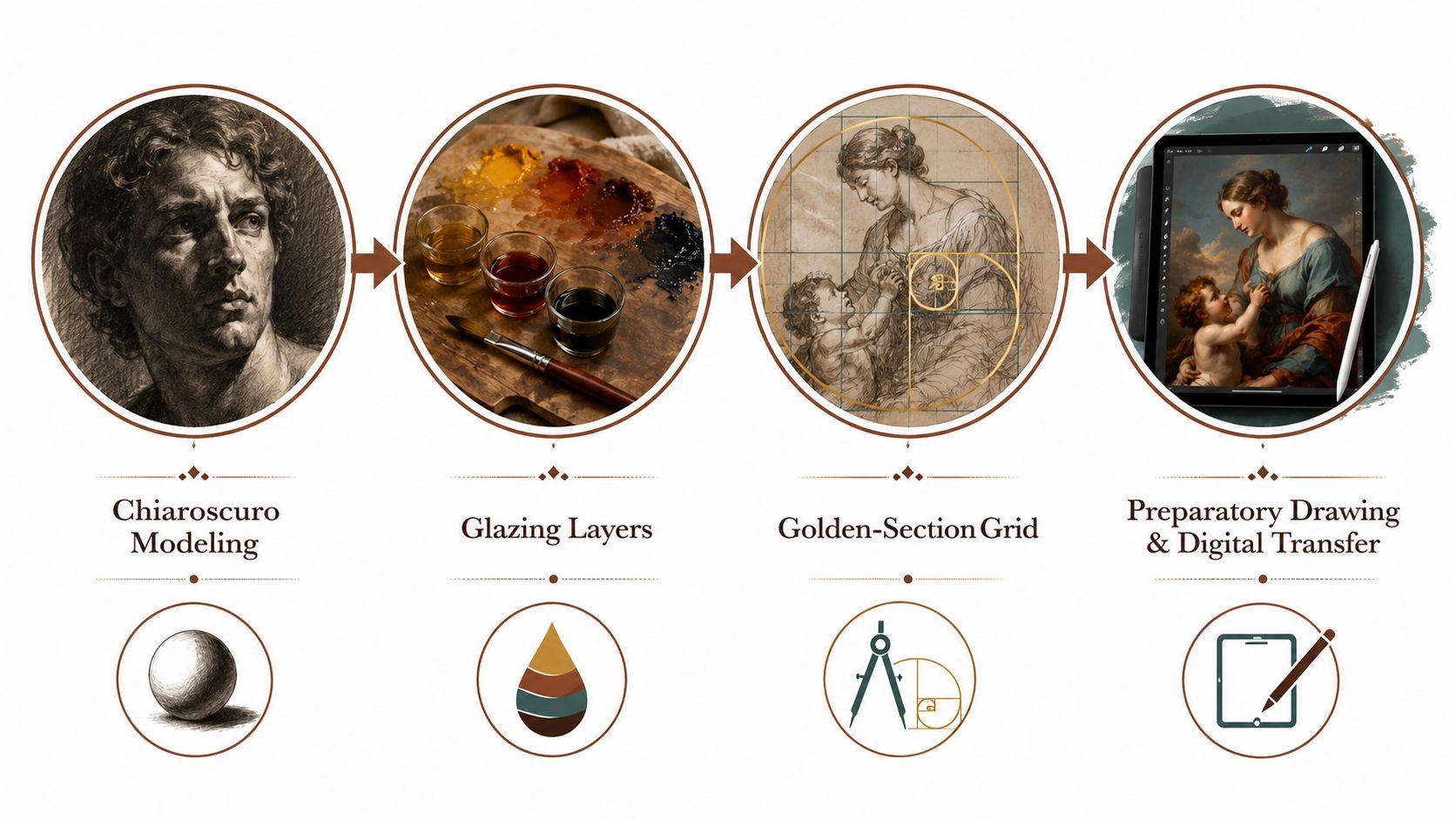
Renaissance-derived methods remain useful because they solve visual problems. Chiaroscuro is the controlled modulation of light and dark to create volume, not a synonym for a moody image. Its art-historical meaning is rooted in Renaissance practice, where transitions between illumination and shadow give the figure weight and spatial presence. (Harvard’s chiaroscuro reference)
A contemporary painter might begin with a charcoal value study, establish the major planes of a face, and then transfer that structure to a prepared panel. A ground made with lead-white pigment, rabbit-skin glue sizing, or another carefully selected preparation changes how subsequent layers sit on the surface. Cold-pressed linseed oil and hand-ground pigments give the artist control over transparency, saturation, and drying behavior.
The layer remains the argument
Transparent oil glazes aren’t decoration added at the end. They alter the relationship between light and color. A painter can establish a restrained underpainting, allow it to dry, and build depth through thin passages that preserve the structure below. The result depends on patience and proportion. Thick paint in the wrong place can’t be rescued by a historical reference.
Golden-section proportions and preparatory drawing also survive because they organize attention. Silverpoint and sanguine studies offer precise ways to test gesture, contour, and tonal rhythm before committing to a larger surface. Today, a digital drawing tablet may sit beside those materials. The tool changes the speed of revision, not the need for judgment.
Collectors don’t need to identify every pigment by sight. They should be able to ask whether the artist understands the surface as a structure rather than a screen. Acrylic can be entirely appropriate for a work. The issue isn’t whether a medium is old or new. It’s whether the chosen materials suit the image, the support, and the intended lifespan.
For a focused explanation of Renaissance-derived contrast and related methods, the ARTIST6 guide to chiaroscuro, tenebrism, and sfumato provides a useful technical reference.
A short studio walkthrough can clarify the difference between a visual effect and a controlled method:
The best contemporary figurative work doesn’t reproduce Renaissance painting. It borrows tested ways of shaping attention, then directs them toward present subjects and present conditions.
AI-Assisted Workflows and Authorship in Fine Art
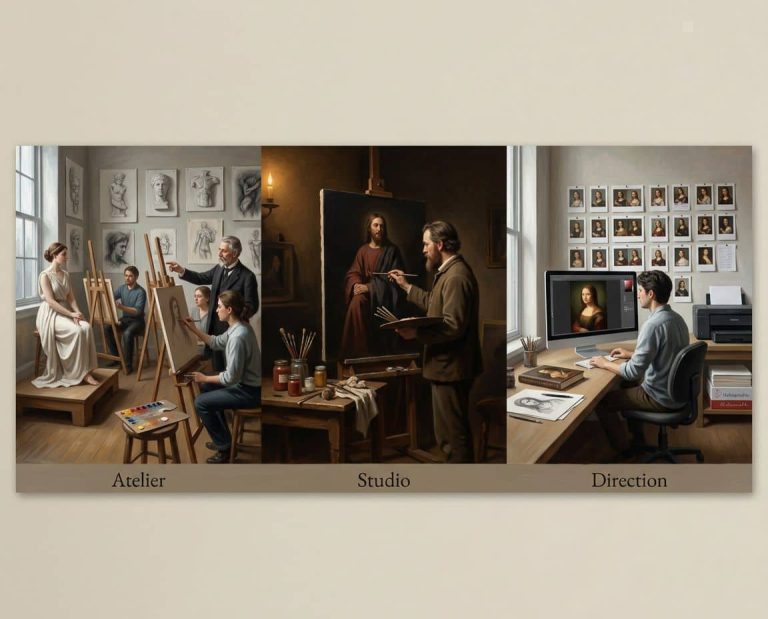
AI image generation belongs to a long history of studio assistance. The camera obscura, the airbrush, Photoshop, and digital drawing tools all changed how artists tested form and composition. None of those tools determined what a finished work meant. The artist still selected, edited, rejected, and resolved.
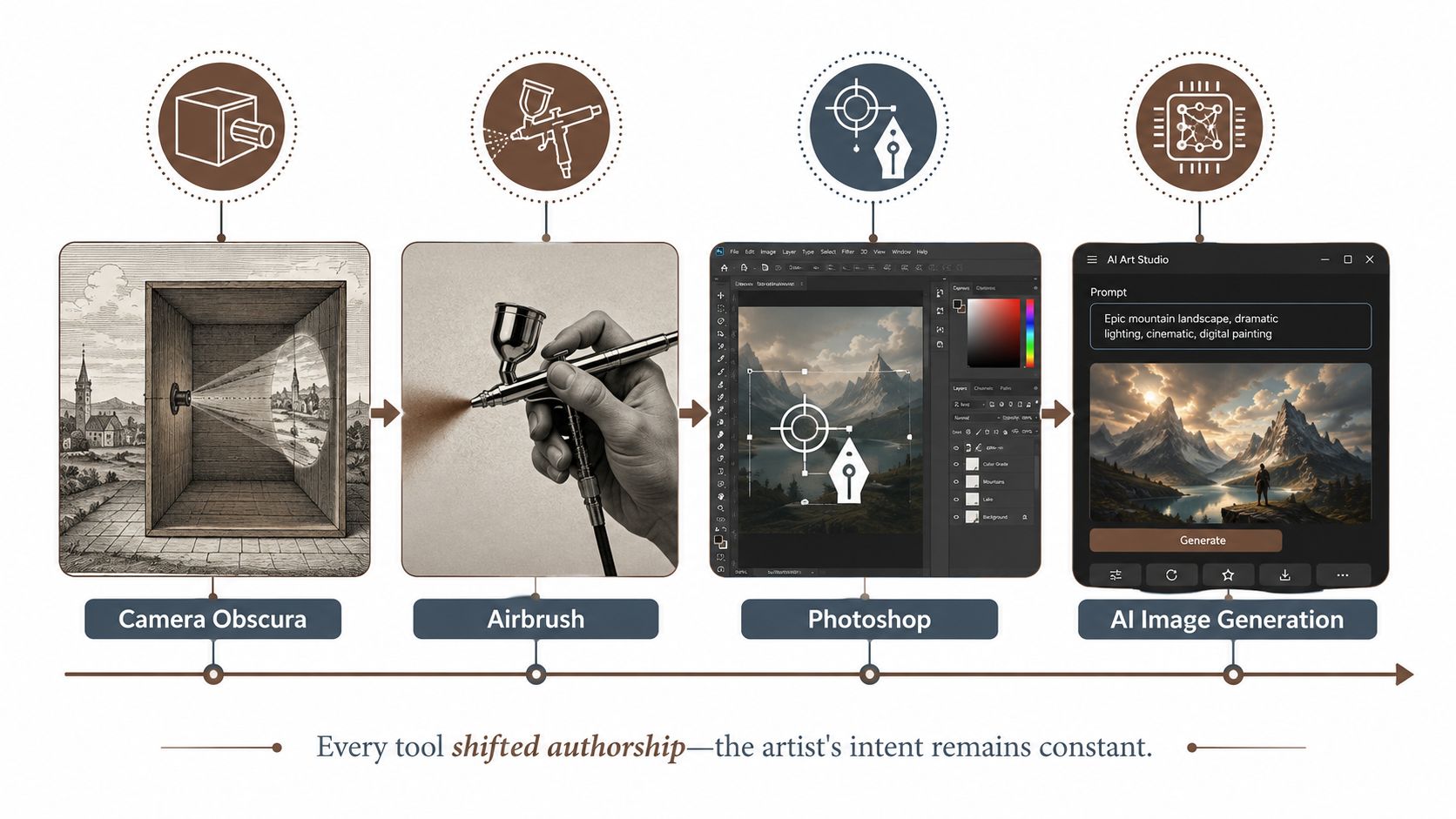
The distinction between a disciplined workflow and a raw output is practical. A studio may use a generative model to explore figure groupings, make tonal studies, or test a palette. Those studies can then be redrawn, recomposed, printed, collaged, or translated into oil. The model supplies possibilities. It doesn’t supply the final artistic decision.
What authorship looks like in practice
Authorship becomes legible through intervention. The artist chooses the subject, establishes constraints, selects among outputs, corrects anatomy or spatial relationships, and decides what survives into the physical work. In a hybrid practice, that may include:
- Digital scaffolding: Using generated studies to test composition, light direction, or the arrangement of figures.
- Material translation: Rebuilding the selected image as an oil painting, mixed-media object, or archival pigment print.
- Hand finishing: Adding overpainting, glazing, physical collage, or surface alteration that creates a material result unavailable in the original file.
- Documented disclosure: Recording the tools and stages so the collector understands how the image became an object.
AI-assisted underpainting can be useful when it remains subordinate to the composition. A painter might generate a rough tonal arrangement, print it as a guide, and then establish the surface through transparent oil layers. The finished painting carries the history of both systems, but its final color, texture, edge control, and material presence come from the studio.
The market is beginning to treat this as a collector-facing issue rather than a novelty. Artprice’s 2025 report analyzed public auction sales across more than 47,000 contemporary artists worldwide from July 2024 to June 2025 and highlighted AI influences. Art Basel and UBS reported that digital art’s share nearly tripled from 2024 to 2025, while an IEEE summary said just over half of surveyed fine-art collectors bought a digital artwork in 2025, making digital art the third most popular category after painting and sculpture. (Artprice’s 2025 Contemporary Art Market Report announcement)
The right question isn’t whether AI touched the work. Ask where the artist’s decisions begin and where the tool’s contribution ends. The ARTIST6 approach to contemporary Renaissance art is one example of a practice that places AI-assisted generation beside composition, hand finishing, and archival printing rather than presenting the software as the artwork itself.
How Editions and Provenance Protect Collectors
A limited edition is only as clear as its rules. “Limited” means little if the artist hasn’t stated the total run, the format, the paper, the printing method, and what happens when the listed units sell. Fixed, signed, numbered editions make supply visible. As remaining impressions decline, scarcity becomes an inventory fact that collectors can check rather than a mood created by marketing. (MyArtBroker’s guide to prints and editions)
A certificate of authenticity should identify the work precisely. Guidance for editioned prints recommends including the edition number, paper type, inks, printing method, signature, and a provenance note, with the edition also recorded in a public or semi-public registry with a persistent verification URL. (Smartphoto’s limited-edition guidance)
Read the edition language closely
A serious edition may contain the main numbered run, artist proofs, or hors commerce copies. Those categories should be declared before purchase. Artist proofs aren’t a reason to distrust an edition, but an undefined number of additional copies is a problem.
Pricing can also follow a schedule in which the price rises as the edition sells through. That structure can reward early buyers without pretending that every unit has the same market position. It only works when the schedule is public and doesn’t change retrospectively.
Before buying, ask:
- What is the hard cap? Request the total number of numbered works and any proofs or hors commerce copies.
- Will the edition close permanently? Confirm that there won’t be a smaller reissue, poster version, or digital-file release that weakens the original scarcity.
- What does the certificate identify? Check the number, dimensions, substrate, inks, process, signature, and date.
- Where is the record held? Look for an artist-controlled, gallery-maintained, or otherwise persistent registry.
- How is resale verified? Ask how a future owner updates the ownership chain and whether the registry remains visible after sell-out.
Materials are part of the provenance file
Archival paper is more than a sales phrase. Museum and archival papers are commonly made from 100% cotton and specified as acid-free and lignin-free. Some suppliers claim lifespans beyond 200 years under proper care, but collectors should treat that as a material claim dependent on display, storage, light, humidity, and framing. (Musea Lab’s archival printing guidance)
Ask whether the print uses pigment-based inks, whether the paper is museum-grade rag, and how the work is protected from ultraviolet exposure. UV-protective glazing can help, but it doesn’t correct poor storage or direct sunlight. The ARTIST6 guide to signed and numbered limited-edition prints offers a useful checklist for evaluating the relationship between edition structure and physical object.
Collecting Strategies by Buyer Profile
The same work can serve three different buyers in three different ways. A private collector may value a developing artist’s visual language. An interior designer may need a work to hold a room together at a specified scale. An institution may require conservation documentation and committee approval before anyone considers visual impact.

Private collectors
Build around a thesis rather than a shopping list. A collector with a long horizon can follow an emerging or mid-career practice, buy early in a declared edition, and develop a group around recurring concerns such as the figure, ritual, technology, or the relationship between image and object.
The strongest test is whether the work remains interesting without a resale story. Thematic resonance should lead. Market attention can follow, but it shouldn’t supply the reason for purchase.
Interior designers and trade buyers
Trade buyers have a different obligation. The work must meet the client’s spatial, material, and budget requirements without becoming generic decoration. Archival prints can offer control over scale and framing, while a strong figurative composition can provide a focal point without requiring the installation risks of a large sculpture.
Specify the substrate, glazing, hanging method, and viewing distance early. A work that reads well online may lose its structure under unsuitable lighting or an overly reflective frame.
Institutional and corporate acquirers
Museums, university galleries, hospitality groups, and corporate collections need a fuller file. They may need exhibition history, conservation notes, acquisition records, reproduction permissions, and a clear policy for future deaccession.
A decorative work can fit a lobby. It may not fit an institution’s curatorial program. Conversely, a conceptually demanding piece may be valuable to a university gallery while failing the brief for a client-facing reception area. Fit is not a compromise. It’s part of responsible acquisition.
Building a Coherent Contemporary Fine Art Collection
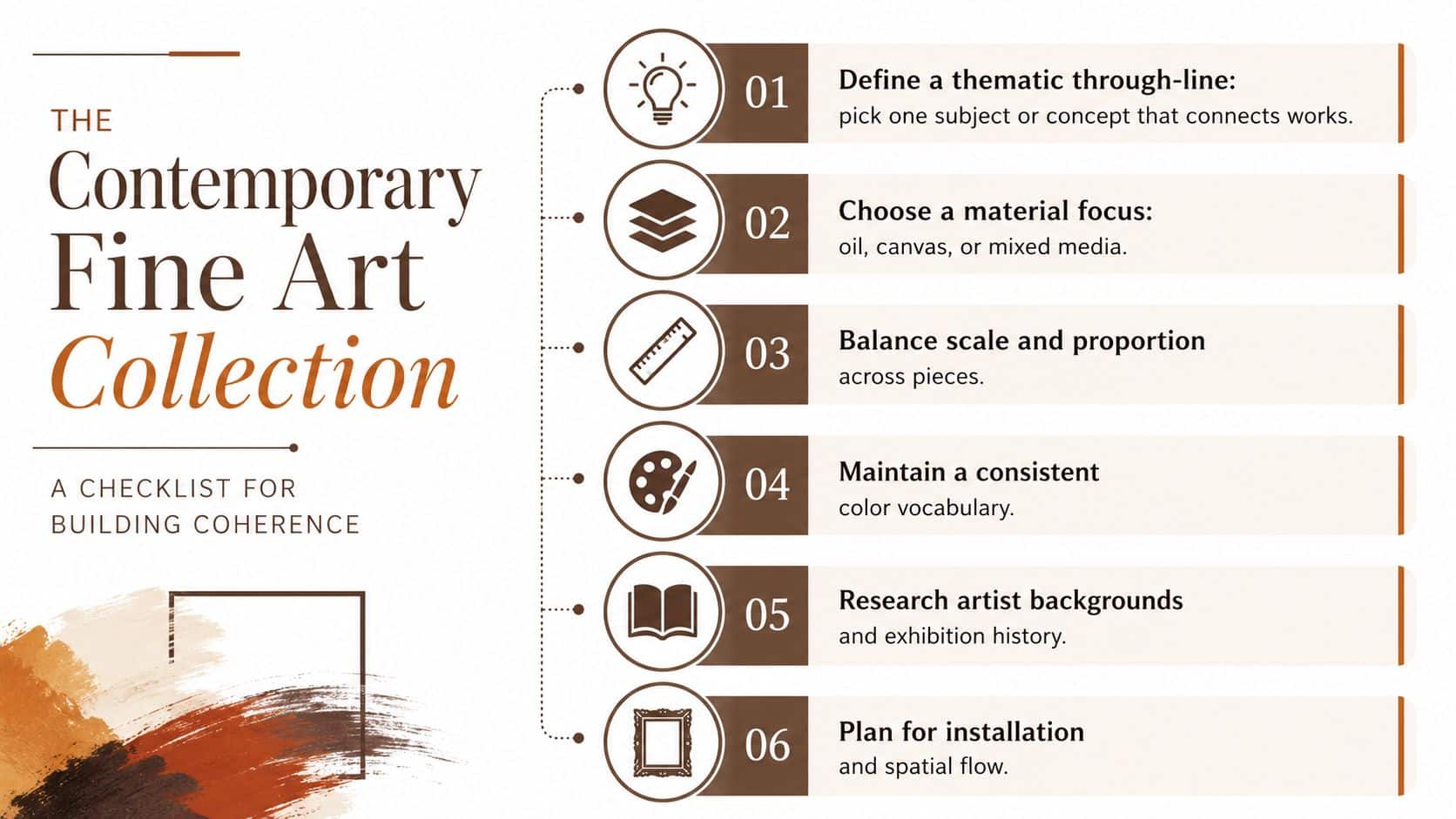
A collection becomes serious when its works speak to one another. Prestige helps neither hanging nor interpretation if each acquisition arrives as an isolated trophy. A stronger approach begins with a collecting thesis, then tests every proposed work against that thesis.
The connection can be thematic, material, or structural. You might collect contemporary figures that examine memory, works that move between bronze and umber, or images that use triangular composition and controlled shadow. Deliberate contrast matters too. A quiet work on paper can sharpen the presence of a larger painting rather than compete with it.
A practical curatorial framework
Start with a sentence that can guide a decision. “I collect contemporary figurative work that treats light as a psychological structure” is more useful than “I collect artists I like.” Then examine the collection through several lenses:
- Material conversation: Place oil, archival prints, photography, or mixed media in relation rather than treating each as a separate purchase category.
- Scale and proportion: Balance intimate works with larger pieces so the installation has rhythm.
- Career range: Combine emerging practices with artists whose exhibition history and market structure are more established.
- Works on paper and unique objects: Use editioned works to build continuity, then add unique pieces when they deepen the argument rather than merely raise the price.
- Documentation: Require transparent edition rules, provenance, and conservation information for every acquisition.
Collection rule: If you can’t explain why a work belongs beside the others, wait before buying it.
Deaccessioning should also be deliberate. Sell or release a work when it no longer supports the thesis, when its condition creates an unreasonable conservation burden, or when a stronger acquisition clarifies the collection’s direction. Don’t deaccession solely because a work hasn’t produced immediate market excitement.
Transparency protects more than resale. It lets the collector understand what has been acquired and why. Fixed editions, permanent registries, declared materials, and documented processes reduce the noise that surrounds speculative buying.
The collector therefore becomes an active participant in an artist’s legacy. Each acquisition preserves a work, supports a practice, and places one object inside a longer structure of attention. That responsibility is modest, but it is real.
ARTIST6 offers chapter-based contemporary Renaissance fine art in limited, signed, and numbered archival editions, with process documentation and a permanent public edition registry. Visit ARTIST6 to review the available works, materials, edition rules, and provenance records before choosing the piece that belongs in your collection.