
Contemporary Renaissance Art: A Collector’s Guide
Most advice about contemporary Renaissance art starts in the wrong place. It treats the work as a style, then asks whether the style looks old enough. That misses the actual test, which is whether the artist can still solve the hard problems the Renaissance solved, light, form, human attention, narrative weight, while using contemporary materials and a contemporary subject.
Serious contemporary Renaissance work is not reproduction, and it isn’t nostalgic costume painting either. It uses the visual grammar of the fifteenth and sixteenth centuries, then points that grammar at present-day faces, bodies, and objects. The difference matters to collectors because the market rewards more than appearance. It rewards technical discipline, edition clarity, and a practice that can be checked. That is where the strongest work separates itself from decorative pastiche.
Table of Contents
- What Contemporary Renaissance Art Actually Is
- The Visual Grammar of Contemporary Renaissance Work
- AI-Assisted Workflows in Contemporary Practice
- Evaluating Provenance and Edition Integrity
- Purchasing Limited Editions with Confidence
- Displaying and Curating Contemporary Renaissance Work
- Market Context and Collector Opportunity
What Contemporary Renaissance Art Actually Is
The easiest mistake is to assume that contemporary Renaissance art is just a modern artist copying a historical master. That reading is too shallow. The work is closer to a translation, where the artist borrows the old methods of structure, light, and proportion, then applies them to present-day subject matter through contemporary tools and workflows.
The Renaissance itself was never about surface alone. Chiaroscuro emerged from drawing on colored paper and developed into a painting mode built to create three-dimensionality, while early color-print adaptations used multiple blocks inked in different hues to expand tonal separation and depth as documented in studio and museum guidance on chiaroscuro. That history matters because the same logic still governs the strongest contemporary work. The artist is not asking, “How can I make this look old?” The artist is asking, “How do I make this figure feel present, weighty, and legible?”
A useful definition is simple. Contemporary Renaissance art is figurative work that inherits Renaissance composition, tonal control, and attention to the human form, then uses those methods for current subjects, current materials, and current collecting contexts. It sits between atelier discipline and contemporary authorship. It isn’t academic copying, and it isn’t conceptual image-making detached from craft.
That distinction is why contemporary artists working in Renaissance art are often easier to understand when you look at the structure of the work rather than the subject alone. The subject may be a musician, a modern sitter, or a symbolic still life. The underlying question stays the same. Where does the eye go first, what carries the light, and what holds the form together?
Practical rule: if the picture only quotes a Renaissance mood, it’s pastiche. If it solves a Renaissance problem, it’s practice.
The Visual Grammar of Contemporary Renaissance Work
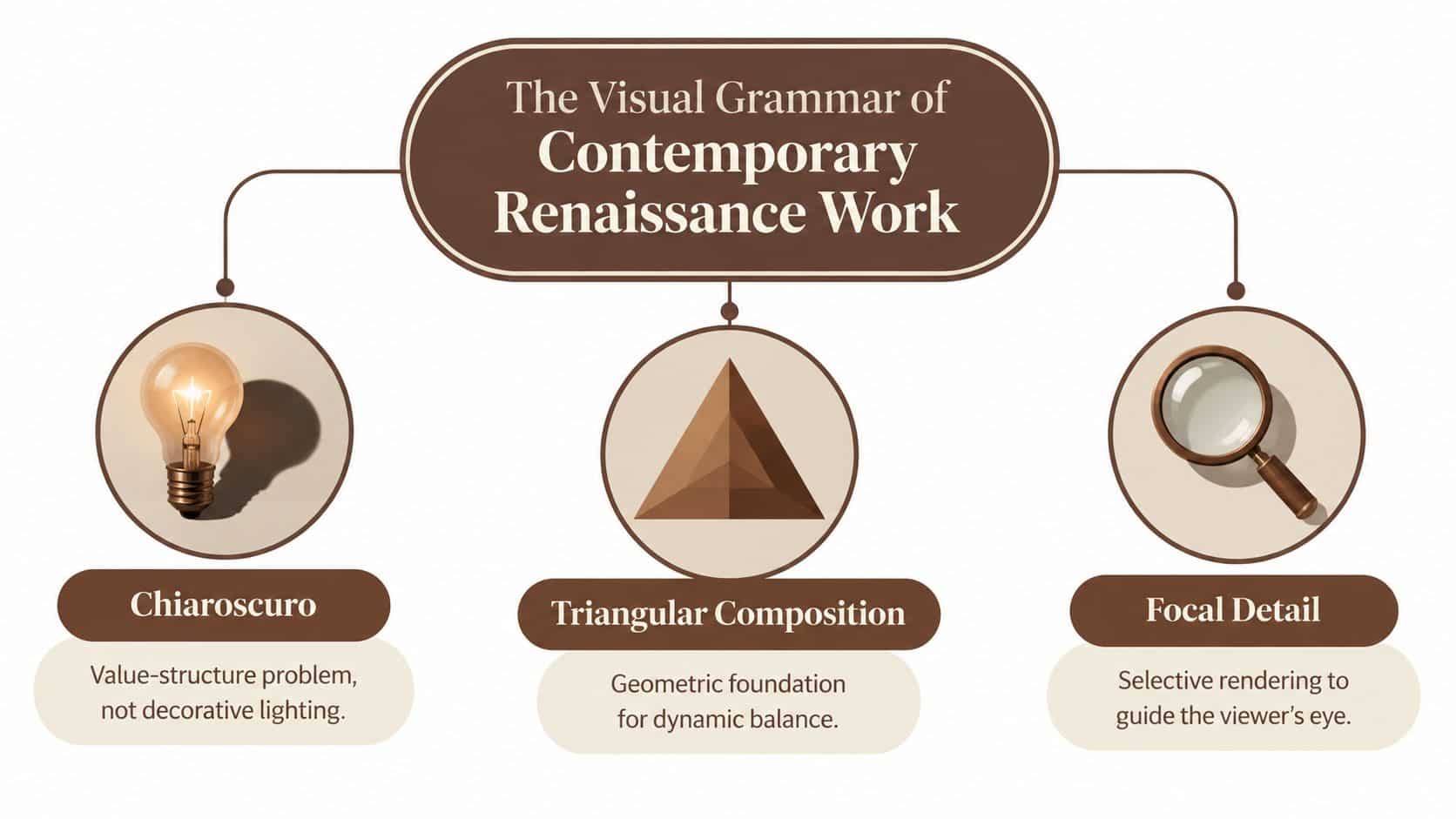
The strongest contemporary Renaissance work uses a grammar that feels old because it’s structurally sound. Chiaroscuro is the main engine. In serious work, it’s not decorative drama. It’s a value-structure problem, one that starts with a dominant midtone, then compresses shadows and places highlights with restraint so the figure holds together under gallery light as noted in studio guidance on chiaroscuro practice.
Chiaroscuro as structure
The tell is not darkness by itself. Many weak paintings are dark. Strong work uses darkness selectively, so the shadow plane supports the form instead of swallowing it. If the face is lit but the hands collapse, the painting has lost hierarchy. If every surface shines, nothing is illuminated.
Triangular composition does similar work at the level of mass. It gives the viewer a stable path through the image. A head, shoulder, and hand can form a quiet pyramid, or a body and object can create a broader geometry that keeps the scene from drifting. The shape is rarely obvious, but when it’s missing, the image feels unanchored.
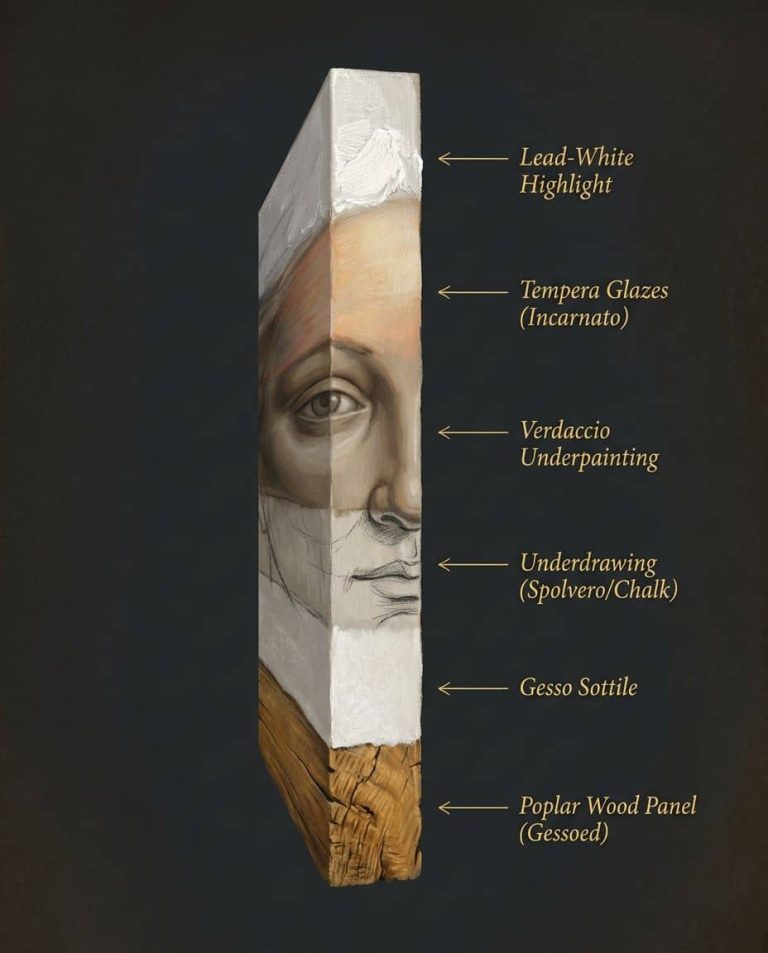
Palette is the other key. Bronze, umber, ochre, oxblood, lapis, and gold are not just romantic choices. They control temperature, depth, and contrast. On archival paper or canvas, those hues only read as luminous if the substrate and layering are right. The same palette can look rich in one print and muddy in another if the paper is wrong or the color separation is rushed as studio and print workflow guidance on paper choice and ink layering explains.
A simple way to judge the quality is to ask whether the focal detail is earned. Good work doesn’t render everything at the same level. Eyes, hands, fabric folds, and select objects get priority. Background forms recede. That controlled hierarchy is what gives the image emotional weight.
What to look for at a glance
- Dominant midtone: the picture should feel built around it, not pasted with contrast.
- Shadow compression: deep tones should support form, not erase it.
- Selective highlight placement: the brightest areas should guide, not clutter.
- Focal restraint: the artist should know where to stop rendering.
The old masters didn’t light everything equally. Serious contemporary work doesn’t either.
AI-Assisted Workflows in Contemporary Practice
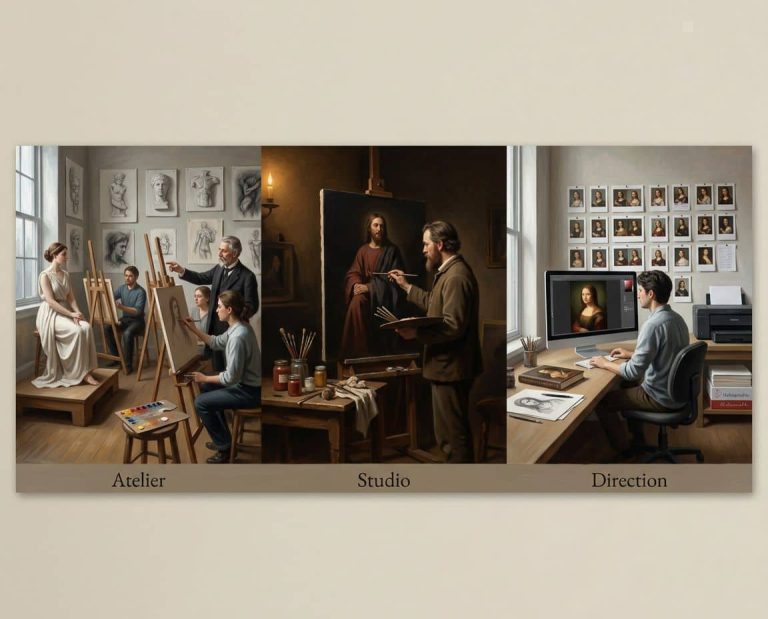
AI belongs in this discussion, because many contemporary Renaissance artists use it as a tool, not a substitute for seeing. The collector question is simple. Is the artist using AI the way a photographer uses a camera, as one stage in a longer process, or is the machine doing the whole job? Transparency answers that faster than rhetoric does.
A practical workflow looks like this:
- Concept stage. AI can be used to explore pose, light, or composition.
- Selection stage. The artist curates outputs instead of posting every draft.
- Hand-finishing stage. The image is refined, often for print, on archival paper or another stable substrate.
- Disclosure stage. The process is documented so a future buyer can audit the work.
Opacity breeds doubt because it leaves too many unanswered questions. Was the image one prompt away from the final piece, or was it shaped through many rounds of drawing, editing, and print testing? Did the artist direct the result, or did the tool make the main aesthetic decisions? Those are not abstract concerns. They go straight to authorship and resale confidence.
Fixed editions and process records matter even more here, because they give AI-assisted work a paper trail. When the workflow is visible, the collector can separate an experimental image from a finished fine-art object. That distinction is the difference between a file and a collectible.
Evaluating Provenance and Edition Integrity
A strong image can still be a weak purchase if the provenance is sloppy. In prints, the collector’s real protection is not just a signature. It’s the chain of evidence around the object. Authoritative print guidance emphasizes numbered certificates of authenticity, documented provenance, batch or process logs, and persistent registry links so ownership can be checked later Guardian Print Shop guidance.
What good provenance looks like
A secure system should answer four questions without hesitation. Who made it, what exact edition is it in, how was it produced, and where is it recorded now? If those answers are spread across vague emails and social posts, the object may still be attractive, but it isn’t strong.
| Benchmark | What it should show | What it tells the collector |
|---|---|---|
| Certificate of Authenticity | Numbered, signed, and specific to the print | The object is tied to a defined edition |
| Provenance chain | Studio origin, ownership history, transfer record | The work can be traced over time |
| Process logs | Batch notes, paper choice, production details | The print is documented, not improvised |
| Persistent registry link | A permanent public record of edition status | Ownership and status can be checked later |
Museum and library holdings of Renaissance prints also underscore the value of secure provenance and fine condition, which is why auditability still matters so much in the print market Guardian Print Shop guidance. The object's story is part of its collectability.
Chapter-based edition systems are especially useful because they create fixed, traceable bodies of work. Sold-out records remain visible. Reprints are ruled out. That makes it harder for a seller to blur the status of an edition later. It also reduces counterfeit risk, because each work's status is machine-verifiable and historically traceable.
Collector rule: if the edition can't be checked later, the scarcity claim is mostly marketing.
Purchasing Limited Editions with Confidence
Buying a limited edition is easier when the rules are visible before the first print sells. Print-market guidance commonly requires the artist to document total edition size before selling the first copy, issue a signed certificate of authenticity for each print, and destroy or invalidate production files or plates when the edition closes print edition guidance. That structure protects the buyer because it prevents the edition from expanding later.
The price path should also be plain. A print-pricing guide gives one concrete example of a 40-piece edition priced in four steps, rising from $180 to $220 to $260 to $300 across successive quarters of the run, and another industry guide says tiered pricing can raise prices by 10–20% at the 50% sold mark and again at 75% print pricing guide. You don't need the same exact schedule to buy well. You do need a schedule that was published in advance and kept intact.
| Element | What to Look For | Why It Matters |
|---|---|---|
| Edition size | Stated before sales begin | Prevents hidden expansion |
| Signed certificate | Included with each print | Confirms authorship and status |
| No reprint rule | Clear closure language | Protects scarcity |
| Price schedule | Fixed steps, not ad hoc changes | Makes timing and value legible |
| Registry or records | Public, persistent edition status | Supports resale and trust |
The biggest red flag is inconsistency. If a seller says the edition is fixed but later offers smaller reissues, posters, or digital-file versions after closure, the original promise has been broken. That doesn’t just weaken value. It weakens the object’s identity.
For a practical example of strict edition language, limited-edition print rules and signed numbering show the kind of documentation collectors should ask for before buying. The point isn’t hype. It’s clarity.
Displaying and Curating Contemporary Renaissance Work
Contemporary Renaissance work holds a wall best when the framing and lighting respect the image’s tonal range. Bronze and umber palettes can look rich under soft, even light, but they flatten fast under glare. That’s why archival framing, stable glazing choices, and careful placement matter as much as the print itself. If the room fights the shadows, the work loses depth.
A coherent chapter release is especially useful in residential and hospitality settings because it gives designers a set that can live together. One print may carry a portrait. Another may lean into still life or symbolic imagery. If the series shares composition, palette, and tonal control, it reads as a body of work rather than isolated wall decor.
Practical display choices
- Use archival framing: acid-free mats and stable backing keep the print’s condition closer to market-safe standards.
- Avoid harsh overhead glare: direct reflections can kill chiaroscuro.
- Match scale to sightlines: the focal point should land where viewers naturally pause.
- Group by chapter logic: related works hold more authority than random mixes.
For hospitality and trade presentations, expo booth design is a useful reference point because the same principles apply, clear sightlines, controlled lighting, and a visual hierarchy that makes people stop and look. Good presentation doesn’t dress the work up. It lets the structure breathe.
The right question for a curator is whether the work can carry a room without shouting. Serious contemporary Renaissance work usually can, because it has discipline. The figures are legible. The tonal structure is built. The wall feels finished without feeling overdesigned.
Market Context and Collector Opportunity
The market context is favorable for work that takes craft seriously. The Art Basel and UBS Global Art Market Report 2026 estimated total global art sales at USD 59.6 billion in 2025, and Artprice reported that the contemporary art segment rose from about $103 million in 2000/01 to $2.3 billion in 2022/23, a roughly 22-fold increase Art Basel and UBS report. In that same 2022/23 period, the segment reached a record 123,450 lots sold same report. The message is not that every contemporary print is a good buy. It’s that the market for contemporary work is broad enough to reward specialized, disciplined practices.
Figurative painting remains central inside that market. A 2023 Artprice report said paintings accounted for 74% of global contemporary-art auction turnover, with sculpture at 10%, drawings at 9%, prints at 4%, and photographs at 2%. It also said the United States led the segment with $857 million in auction turnover over 12 months, while the average contemporary-art auction price reached $18,600 Artprice report summary. That matters because Renaissance-derived practice sits inside a market where figurative painting is still the dominant and most monetized category.
What collectors are really buying now is not just style. They want meaning, narrative, and craft. Current trend coverage points to renewed interest in figurative work, traditional technique, and image density, especially where the work feels emotionally readable rather than merely decorative 2025 art trend coverage. That’s why transparent workflows and public provenance records matter so much. In a market where digital-native collecting is accelerating, skepticism falls when the artist can show process, edition rules, and ownership history.
For sellers and advisors, taap.bio art sales tips is worth reading alongside the market data because it reinforces a simple point, presentation and clarity affect buyer confidence. For collectors, the opportunity is straightforward. Seek work that is technically legible, editioned without ambiguity, and grounded in a visual language that can live across a wall, a collection, or a room without fading into trend noise.
ARTIST6 makes contemporary Renaissance work as limited, signed, and numbered archival prints with public edition records and documented process. If you want to evaluate this kind of practice through the lens of provenance, edition integrity, and AI-assisted authorship, visit ARTIST6 Renaissance fine artworks and review the chapter releases directly.