
How Renaissance Painters Used Light: A Five Hundred Year Conversation Between the Eye and the Window
There is a small painting in the National Gallery in London called The Virgin of the Rocks. If you stand close to it, the figures seem to be lit from somewhere that is not in the painting. The light arrives from above and to the left, falls onto the Virgin’s forehead, picks out the edge of an angel’s wing, and then surrenders to a depth of shadow so soft that you cannot quite say where the figures end and the grotto begins. Leonardo da Vinci spent years on this painting. He spent those years not because he was lazy, though his patrons thought he was, but because he was solving a problem most of his contemporaries had not yet fully realized was a problem. The problem was light.
How Renaissance painters used light is, in the end, the story of how Western art stopped being decorative and started being optical. For a thousand years before the Renaissance, paintings in the Christian West were largely flat. They were beautiful, often deeply moving, and sometimes structurally sophisticated, but they did not pretend to be windows onto a world. They were gilded surfaces. They were objects of devotion. The figures stood out from a background of gold leaf because gold leaf was sacred, not because the figures had volume.
Then, over the course of about two hundred years, painters in Florence, Bruges, Venice, and a handful of other cities figured out how to make a flat panel feel like a real space. Light was the tool. This is how they did it.
The Inheritance: What Painters Were Working Against
To understand how Renaissance painters used light, you need to picture what they were trying to escape. The medieval altarpiece, in its classic late-Gothic form, had no real interest in light as a physical phenomenon. The background was almost always gold leaf over a red bole undercoat, burnished to a high shine. The light in the painting was, in a sense, the gold itself. The figures were modeled, but only just, with dark outlines around their forms and modest tonal variation inside those outlines.
This was not bad painting. It was a different kind of painting, with different goals. A late-Gothic altarpiece was meant to glitter in candlelight in a dim chapel, to draw the eye to the sacred subject through material splendor. Gold was a theological choice as much as an aesthetic one. Light, as the theologians at Chartres had argued in the twelfth century, was God, and a gilded surface participated in that idea by reflecting actual light back into the room.
What this approach did not do, though, was give viewers a sense that they were looking through a window into a real place. There was no air in a late-Gothic altarpiece. There was no time of day. The painters who would become the early Renaissance masters wanted both. They wanted the sacred subject and they wanted the air around it. To get the air, they had to learn to paint light.
Giotto and the First Solid Bodies
The conventional starting point for the Renaissance treatment of light is Giotto di Bondone, working in the first decades of the fourteenth century, mostly in Padua and Assisi. Giotto’s revolution, looking back, seems almost embarrassingly modest. He simply darkened one side of his figures.
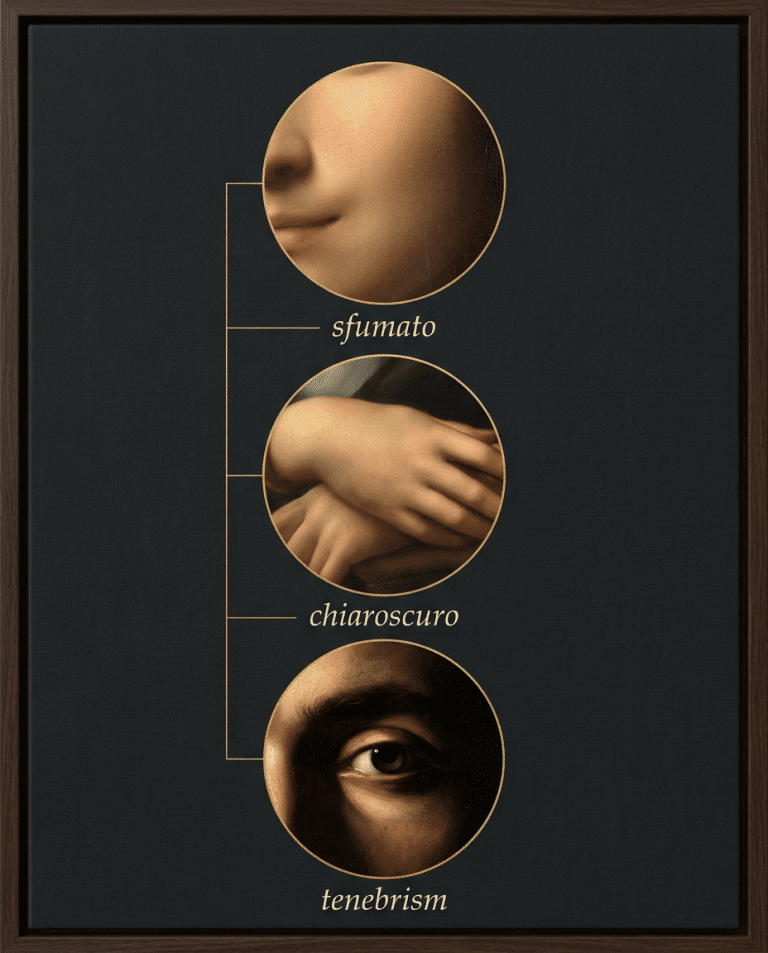
What Giotto did was treat the figure as a solid mass that occupied space. If light fell on it from one side, the other side was in shadow. The shadow was not just a darker line around the form; it was a tone that softened gradually from the lit side to the dark side, around the curve of a cheek or the bulge of a draped knee. This is, technically, the first appearance of what would later be called chiaroscuro in Italian painting, though Giotto worked in fresco and tempera and did not have the medium to push the technique very far.
What he did have was the intuition. Once Giotto established that a painted figure could be a body with weight, every Italian painter after him had to reckon with that. The whole next two centuries of Renaissance painting can be read as a long, patient working out of the implications of that single observation.
Alberti, the Treatise, and the Theory of Light
By the 1430s, the painters of Florence had a new problem. They were getting much better at painting solid figures, but they had no shared vocabulary for what they were doing. Then, in 1435, the humanist Leon Battista Alberti wrote a short Latin treatise called De pictura, later translated by Alberti himself into Italian as Della pittura. It was, in effect, the first working theory of Renaissance painting.
Alberti divided painting into three parts: drawing the outline of bodies, composing those bodies into groups, and the reception of light, which is to say the rendering of color and tone. That third part was the radical one. Alberti argued that painters should mix their colors with black to render shadows naturalistically, rather than using pure unchanged colors in shadow areas the way late-medieval painters had. This was a small technical instruction with enormous consequences. It said, in effect, that painting should obey the laws of optics rather than the conventions of decoration.
Alberti also gave painters the famous metaphor that would define the next four centuries of Western image-making. A painting, he said, is an open window through which the viewer looks into a depicted world. Once you accept that metaphor, the rest follows. A window admits real light. Real light has direction, intensity, and color. Painting, after Alberti, was no longer an arrangement of holy symbols. It was a controlled study of light in a contained scene.
The Northern Breakthrough: Oil Paint and the Long Glaze
While the Florentines were working out their theory, something quieter and more technical was happening in the Burgundian Netherlands. A painter named Jan van Eyck, working in Bruges in the 1430s, was perfecting a medium that would transform what was possible with light in painting. The medium was oil.
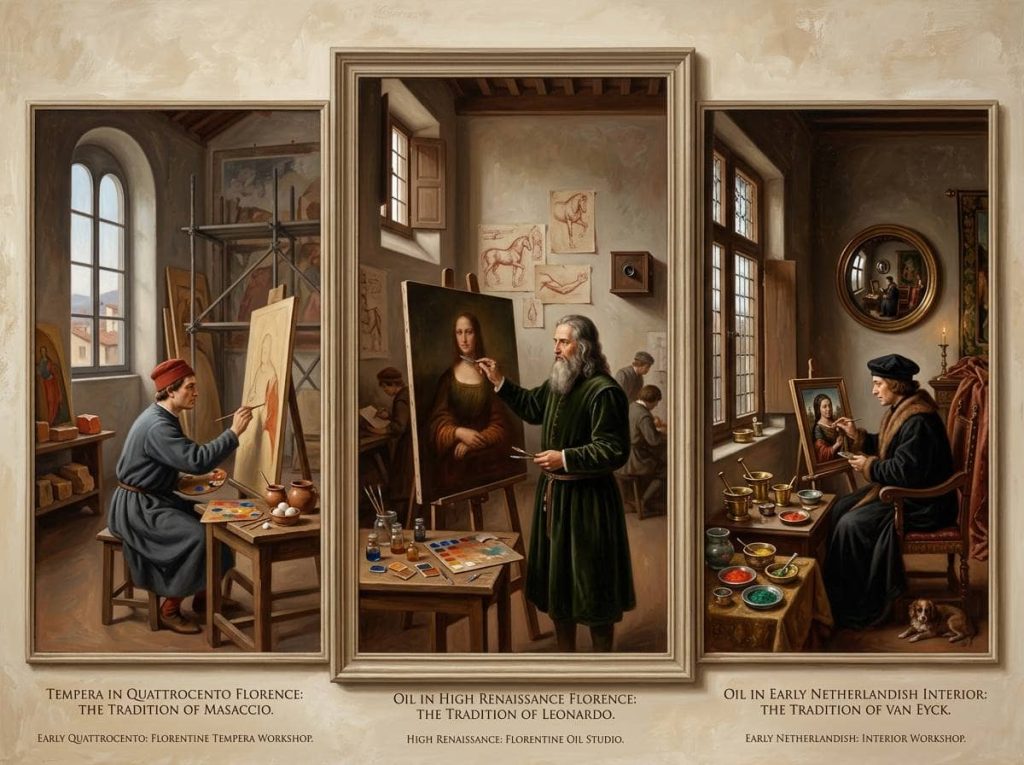
Egg tempera, the standard panel-painting medium of the Italian fourteenth and early fifteenth centuries, dries fast. A tempera painter has to commit to a tone almost instantly. Tempera is excellent for bright clear colors and crisp outlines, but poor for the soft gradual transitions that real light produces on real surfaces. Oil paint, by contrast, dries slowly. The pigment is suspended in a drying oil, usually linseed in the North, that takes days or weeks to fully cure. While the paint is wet, the painter can blend it, lift it, soften it. More importantly, once a layer is dry, the painter can apply a second transparent layer on top, called a glaze. Light passes through that glaze, hits the underlying layer, and is reflected back, picking up the color of the glaze on the way out. This is why oil-painted skin in a Van Eyck looks almost backlit. The light the viewer sees is not just reflecting off the surface; it is reflecting back through multiple layers of translucent color.
According to The Met’s Heilbrunn Timeline of Art History, the adoption of oil paint in Italy from about 1475, drawing on the techniques developed by Belgian and French painters such as Robert Campin, Jan van Eyck, Rogier van der Weyden, and Hugo van der Goes, had lasting effects on painting practices worldwide. Without oil paint, there is no Mona Lisa, no Virgin of the Rocks, no Caravaggio. The medium was the precondition for the optical revolution.
The Single Light Source: A New Discipline
Once oil paint allowed for soft transitions, the next question was what kind of light a Renaissance painting should represent. The answer that emerged, slowly and across many studios, was the single light source.
A late-Gothic painting often had no consistent light source. Different parts of the same scene might be illuminated as if by different unrelated lamps, or simply lit from everywhere at once. By contrast, a High Renaissance painting almost always has one identifiable direction of light. It might be the upper left or the upper right, but it is consistent across every figure, every object, every fold of cloth in the scene. This was not just an aesthetic preference. It was an honesty test. If a painter could place a single light source and render every surface in the scene in accordance with that source, the painter was demonstrating a real understanding of how light works.
The single light source also did something subtler. It gave the painting a time of day. A scene lit from the upper left, low, with a warm color, is morning light. A scene lit from above, sharper and whiter, is midday. A scene lit from a single small bright zone against absorbing dark is candlelight or a shuttered window. The light became a way of locating the scene in time, not just in space.
Leonardo: Light as Science
By the time Leonardo da Vinci was working seriously in the 1480s and 1490s, all of these foundations were in place. What Leonardo added was a level of scientific obsession with light that no painter before him had matched, and arguably no painter after him has matched either.
Leonardo did not just paint light. He studied it. His notebooks, compiled posthumously into the document now known as the Treatise on Painting, are full of observations about how shadows behave on curved surfaces, how the eye perceives soft transitions between tones, how light bends through air over distance, how the pupil dilates in dim conditions and contracts in bright. He experimented with the camera obscura, the optical device that projects an external scene onto an interior wall through a small aperture, in order to study how the eye itself works.
This research fed directly into his paintings. The sfumato technique, the smoky blurring of edges for which he became famous, was not just a stylistic flourish but a deliberate attempt to paint the world the way the human eye actually receives it, with soft uncertain boundaries rather than sharp diagrammatic outlines. Leonardo’s Last Supper, on the wall of the refectory at Santa Maria delle Grazie in Milan, is in some ways his most ambitious experiment with light. The room is set inside an interior with a far wall pierced by three windows that look onto a landscape; the light in the room is consistent with that landscape, and every figure casts shadows that match the implied direction of those windows. The whole composition is, in a real sense, a calculation.
A Comparison of How Light Worked Across the Renaissance Schools
Different Renaissance traditions used light in distinct ways, even when they shared the same general goals. The table below pulls out the working differences between the major schools, with the diagnostic features a viewer can use to tell them apart.
| School or Period | Approximate Dates | Primary Light Strategy | Characteristic Surface | Representative Figures |
|---|---|---|---|---|
| Late Gothic / International Gothic | c. 1380 to 1420 | Gold ground; diffuse decorative light | Burnished gilding, tempera | Lorenzo Monaco, Gentile da Fabriano |
| Early Florentine Renaissance | c. 1420 to 1475 | Single direction modeling in tempera; sharp clear light | Tempera on poplar panel, fresco | Masaccio, Fra Angelico, Piero della Francesca |
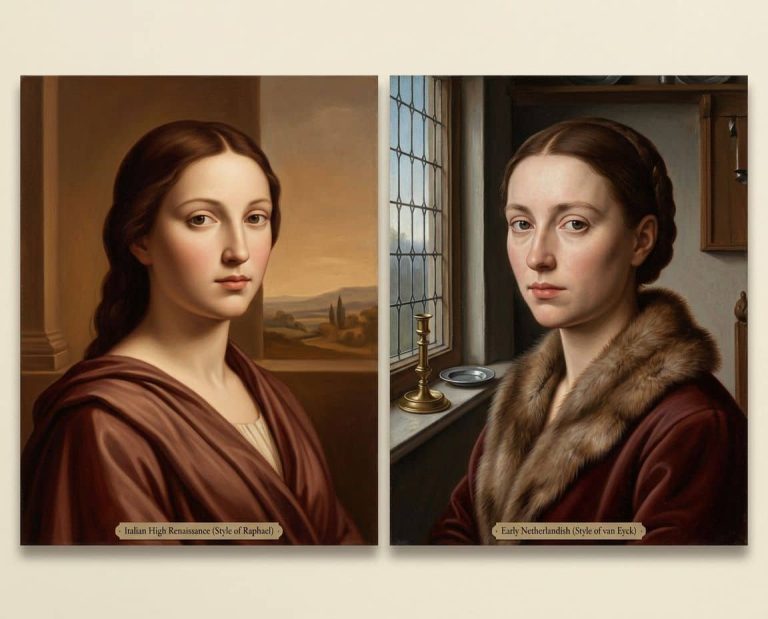
| Early Netherlandish | c. 1420 to 1500 | Oil glazing; light held inside paint film | Oil on oak panel, multiple translucent layers | Van Eyck, Van der Weyden, Memling |
| High Renaissance (Florence and Rome) | c. 1495 to 1520 | Chiaroscuro modeling, sfumato softening, balanced atmosphere | Oil on panel, then on canvas | Leonardo, Raphael, Michelangelo |
| Venetian Renaissance | c. 1475 to 1580 | Atmospheric color, warm ambient light, soft edges | Oil on canvas, looser brushwork | Bellini, Giorgione, Titian, Veronese |
| Mannerism | c. 1520 to 1600 | Unnatural light, dramatic color shifts, theatrical sources | Oil on panel or canvas | Pontormo, Bronzino, El Greco |
| Late Renaissance into Baroque | c. 1590 to 1620 | Single dramatic light, deep shadow, tenebrist contrast | Oil on canvas, dark grounds | Caravaggio, early Ribera |
Florence and Venice: Two Renaissance Approaches to Light
By the High Renaissance, two distinct Italian traditions had crystallized around two different ideas of what light should do in a painting. The Florentine school, descended from Giotto and most influenced by Alberti, treated light primarily as a structural tool. The Venetian school, working two hundred miles to the northeast, treated it as atmosphere.
In Florence, the point of light was to make the figure feel solid. Painters like Masaccio, working in fresco in the Brancacci Chapel in the 1420s, used light to model the human body the way a sculptor models clay. Piero della Francesca, working in Arezzo and Urbino a generation later, took this further; his figures are almost sculptural, with clear light, precise shadow, and an architectural sense of weight. This Florentine concern with what painters called disegno, the modeling of form, made light a servant of structure. Its job was to make the figure legible.
Venice took the opposite path. Venetian painters had constant atmospheric softness in front of them every day: mist on the lagoon, light reflected from canals onto walls, a humid air that softens distant views. By the time Giovanni Bellini was working in the 1480s, Venetian painters had largely abandoned poplar panel for canvas, which suited looser brushwork. In a Bellini, a Giorgione, or a Titian, the light lives in the color itself. It is warm or cool, morning or evening, hazy or clear, because the pigment is warm or cool, not because the lines are carefully drawn.
These two traditions would shape almost everything that followed. The Florentine line runs through Raphael into the academic tradition. The Venetian line runs through Rubens, through the colorists of every later century, and into modern painting itself.
Northern Light: The Window in the Room
The Northern Renaissance, centered in Bruges and Ghent in the early fifteenth century and later in Antwerp, had its own distinct approach to light. Where the Italians were interested in idealized bodies in idealized spaces, the Northerners were interested in interiors. They wanted to paint rooms with windows, with the light coming through those windows, falling on real objects, with real reflection and real shadow.
A Van Eyck interior is, in many ways, the first modern painting of light in a room. The Arnolfini Portrait, in the National Gallery in London, is the canonical example. Light enters from a window on the left and behaves differently on each surface in the room, because each surface has different optical properties; the convex mirror at the back wall reflects the room from its own distorted perspective, the brass chandelier picks up exact specular highlights on each curved arm, the brocade of Arnolfini’s robe absorbs and returns light at a completely different rate than the fur of the small dog.
This level of optical exactitude was something the Italians did not yet attempt. They would learn from it. The infiltration of Northern oil technique into Italian practice in the late fifteenth century is part of why Italian painting after about 1475 begins to feel atmospherically richer than it did in the earlier century.
The Symbolic Layer: Light as Meaning
Through all of this technical development, Renaissance painters never lost the sense that light meant something. Light, in Christian theology, was associated with divinity, with revelation, with the moment of grace breaking into ordinary life. Renaissance painters used the new optical tools they had developed to make those theological meanings visible, not to replace them.
When a beam of light falls on the Virgin in a Renaissance Annunciation, it is both an optical event and a theological one. The painter has chosen to render the light as a real, physical, single-source illumination, with proper falloff and proper shadow, but the meaning of the light is that the divine is entering the room. The optical realism enhances rather than dilutes the theological message.
This is one of the persistent and underappreciated truths about Renaissance painting. The new technical mastery of light did not secularize the work. It deepened it. A medieval Annunciation symbolized the entry of the divine through gold leaf and conventional gesture. A Renaissance Annunciation enacted that entry through a specific quality of light falling at a specific angle, which the viewer’s own eye could read as real. The miracle became more credible because the light was now physically plausible.
The Materials That Made the Light Possible
Renaissance painters did not just have ideas about light. They had materials, and the materials shaped what was possible. Three deserve specific mention.
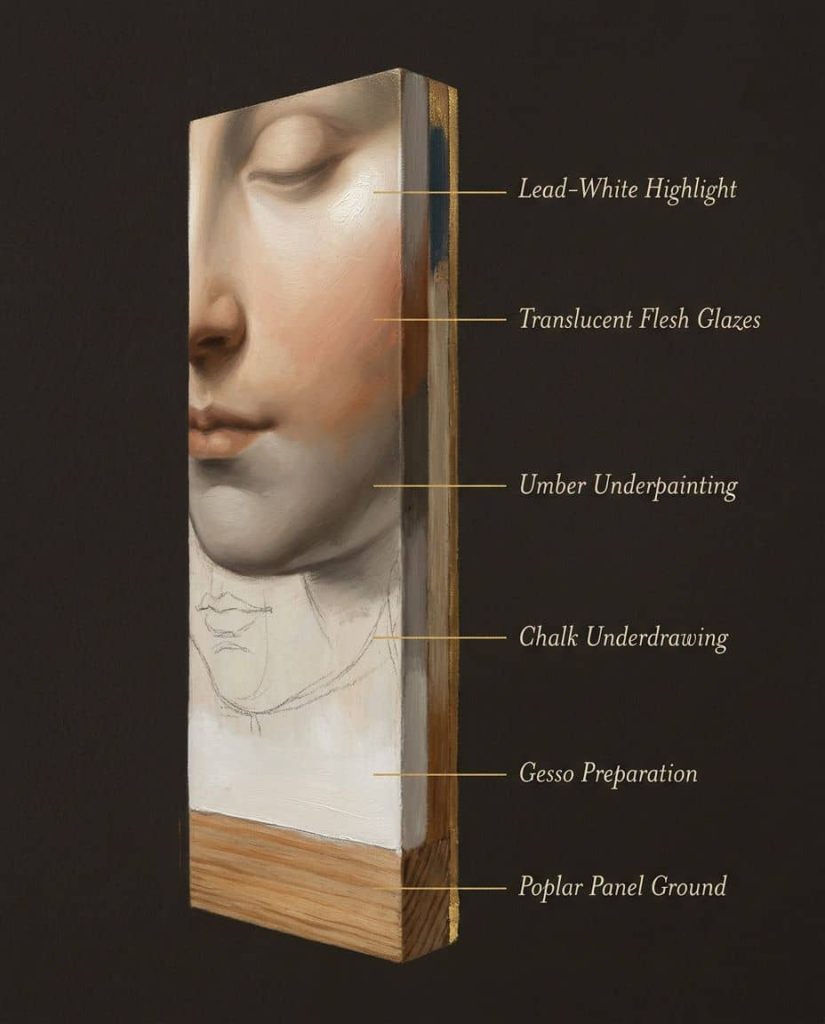
Linseed oil was the foundational medium for Northern oil painting, and later for almost all European oil painting. It dries slowly, allows for glazing, and yellows only gradually over centuries. White lead, also called lead white or flake white, was the dominant white pigment of the Renaissance. Its particular property of scattering light strongly while remaining slightly translucent made it the perfect pigment for the highest highlights, the points where the painter wanted real glow rather than just a brighter tone. Leonardo built his Mona Lisa face on a foundation of lead white with tiny additions of vermillion for warmth.
Ultramarine, made by grinding lapis lazuli stone imported from what is now Afghanistan, was the most expensive pigment of the Renaissance. According to Britannica’s overview of Renaissance pigments, ultramarine was often reserved by contract for the Virgin’s robe in religious commissions, because it was both the most beautiful blue available and a demonstration of the patron’s seriousness about the commission. Ultramarine glazed over white lead created a depth of blue that no synthetic pigment has ever quite matched.
These were not infinite resources. The whole world of color in a Renaissance painting was built out of perhaps twelve or fifteen reliable pigments, used with extraordinary economy and combined into hundreds of subtle mixtures and glazes.
The Studio Practice: How Renaissance Painters Actually Worked
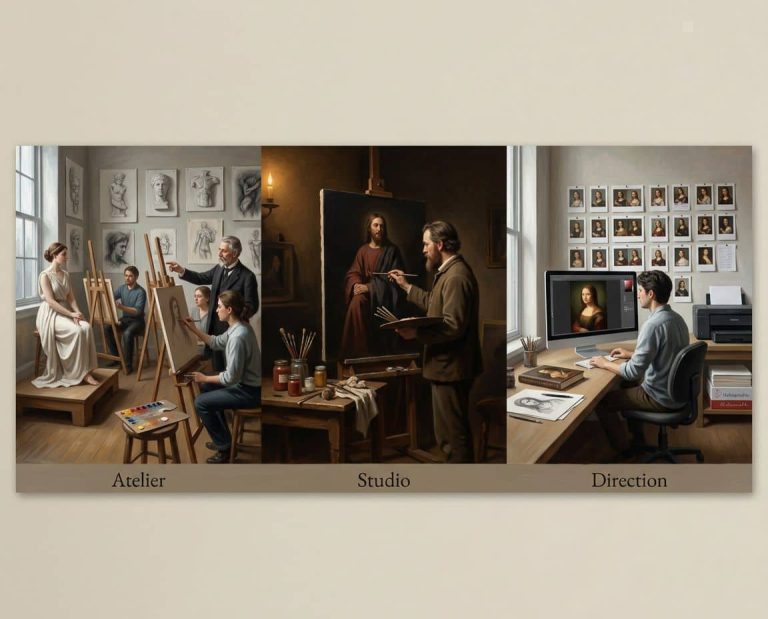
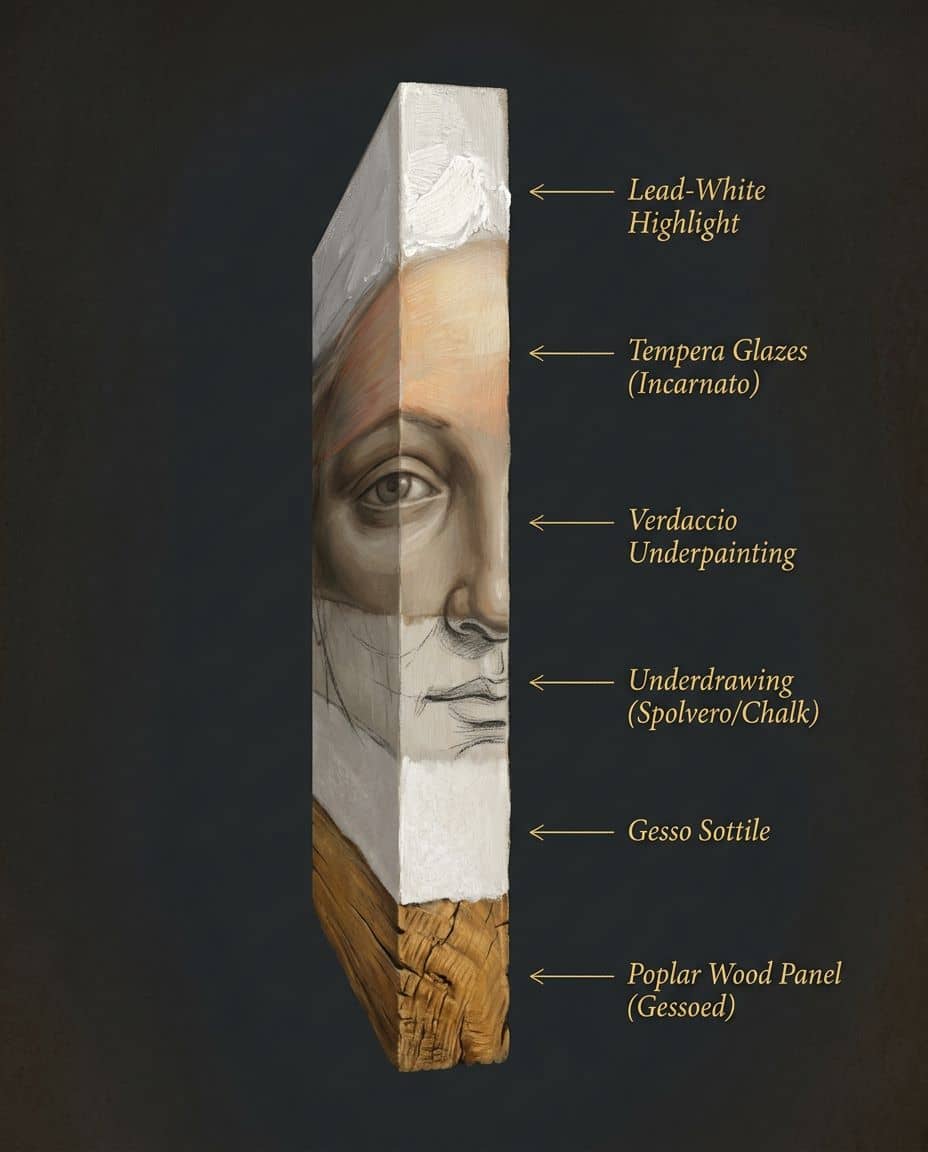
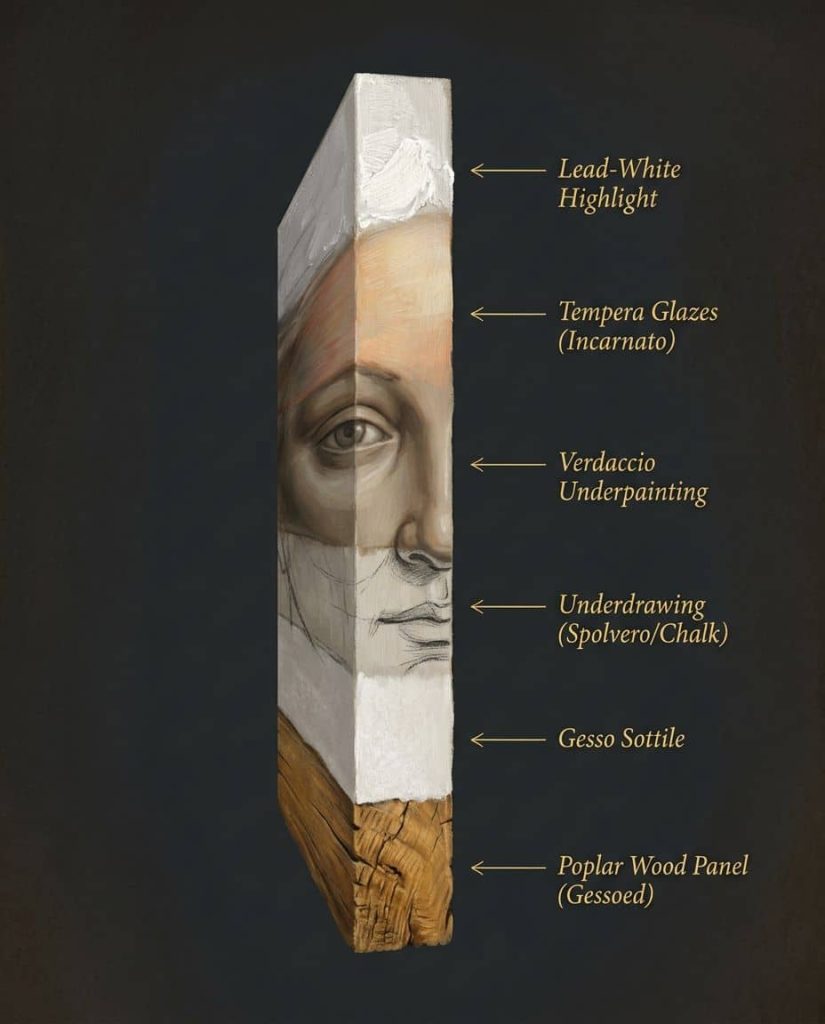
It is one thing to talk about light and oil paint in the abstract. It is another to understand what daily work in a Renaissance studio looked like. A typical High Renaissance painting moved through three phases. The underdrawing came first, in chalk or thinned ink, on a prepared white gesso ground; this established composition, anatomy, and the placement of all major elements. The underpainting came next, often executed in a single neutral tone, sometimes fully in shades of gray, called grisaille. This is where the painter did the actual modeling of light, establishing where the lights and darks would be before any color was added.
Color came in layers above the underpainting, often translucent, often built up over weeks or months. The final highlights, the brightest specular points of light, were almost always the last marks the painter made. They were applied with lead white, often with a tiny touch of warm pigment to keep them from looking chalky. A Renaissance painter could spend a working day placing a dozen highlights and consider that a productive day.
This is why painters like Leonardo had a reputation for slowness. The technique itself was slow. A surface built out of twenty or thirty thin glazes, with weeks of drying time between layers, cannot be made quickly. The compensation was that the finished surface had a depth and a luminosity no faster medium could produce.
The Inheritance That Followed, and What This Still Means Today
Everything that came after the Renaissance treatment of light is, in some sense, a development of what these painters established. The Baroque masters, including Caravaggio, took the single light source and pushed it into theatrical extremes. The Dutch Golden Age painters, Rembrandt and Vermeer above all, took the Northern interest in interior light and made it the central subject of their work. Even the Impressionists, who in many ways were rebelling against the academic tradition, were still trying to paint light as it actually behaves, just at a different scale and with a different medium.
The Renaissance lessons about light are working lessons. The principle of the single consistent light source is still the foundation of any image that wants to feel real. The principle of warm light producing cool shadow, and cool light producing warm shadow, is still how skilled portrait painters keep flesh from looking dead. The principle of the highest highlight being placed last, after all surrounding tones are established, is still how oil painters build a sense of glow into a finished face. In a small studio working in the Renaissance tradition today, in any medium, these lessons are still studied as living craft. What the masters worked out about light still works. The eye has not changed. The behavior of light on a curved surface has not changed.
A Note on What to Look For in a Museum
If you are standing in front of a Renaissance painting and want to read its use of light quickly, three diagnostic gestures are worth practicing.
Look first for the light’s direction. Where is the light coming from in this scene? Trace the shadow on a single figure, follow it back to its implied source, and check whether the next figure over agrees with that source. A consistent light direction is the first sign of a serious Renaissance painter.
Look next at the highlights, the brightest points in the painting. Where has the painter placed them? On the bridge of a nose, on the rim of a lower eyelid, on the curve of a forehead, on the edge of a satin sleeve. The placement of highlights is one of the most personal aspects of a painter’s signature.
Look finally at the shadows. Are they sharp or soft? Are they deep black or warm umber? Are they full of detail or fully absorbed? The treatment of shadow tells you whether the painter is closer to the Florentine architectural tradition, the Venetian atmospheric tradition, the Northern observational tradition, or the late-Renaissance theatrical tradition that would become tenebrism.
Once you can read these three things at a glance, every Renaissance painting in every museum becomes substantially more legible. Find original Renaissance fine artworks at Artist6.com homepage.