

Bread, Salt, and the Open Psalter
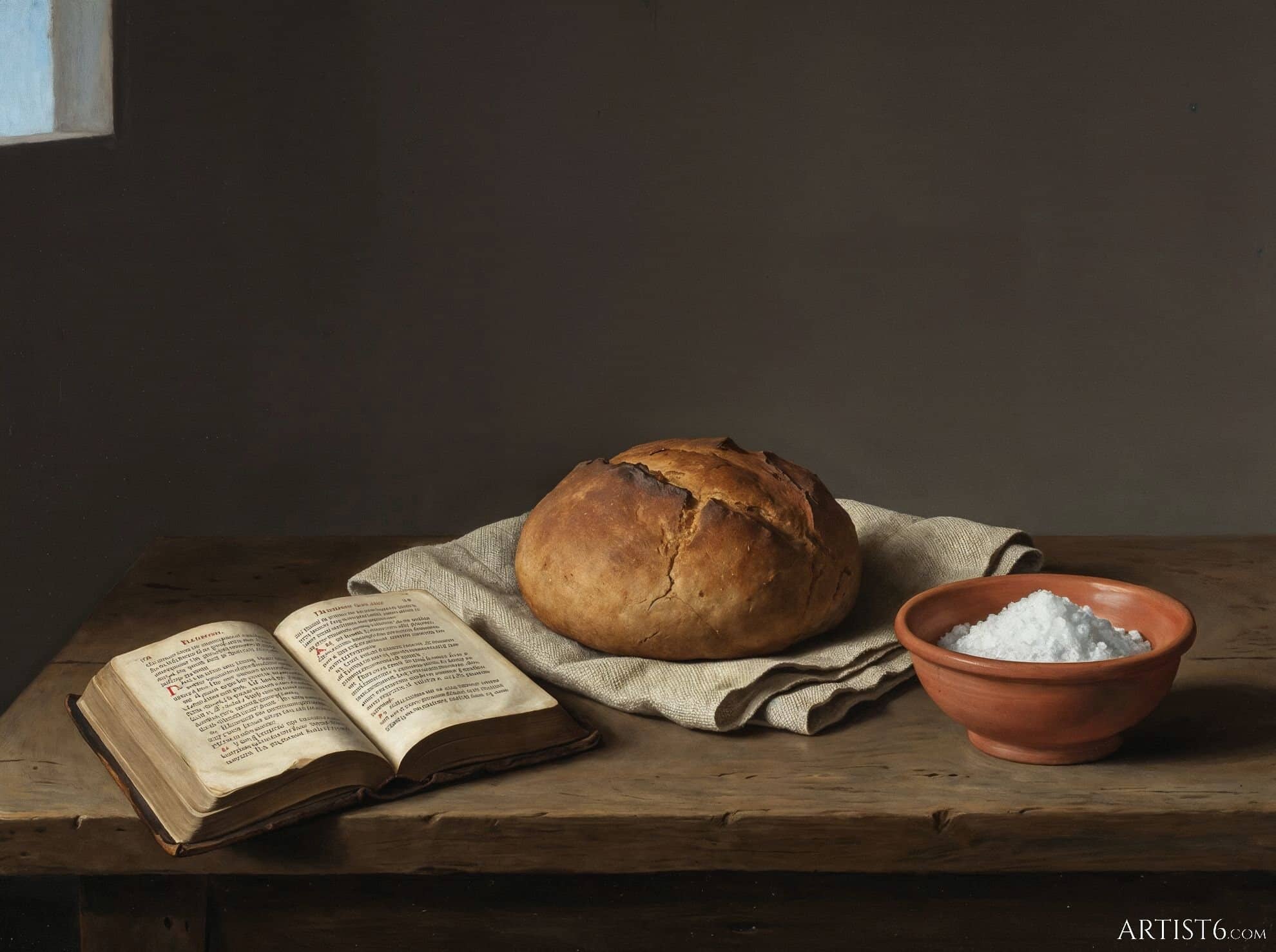
A still life of bread, salt, and an open psalter, on a wooden refectory table, the dawn.
Description
Artwork statement:
I made this work from a description in the 1660 chronicle of a Spanish monastery, of a small panel by the late workshop of Francisco de Zurbarán hung in the refectory anteroom. The chronicle describes the panel as showing the three things that begin the day at table, pan, sal, y salmo, bread, salt, and a psalm. The panel was lost in the secularizations of 1835. I wanted to make the painting the refectory remembered.
The composition is a heavy wooden refectory table at the cool blue hour before dawn. On the table, at the centre, lies a small round loaf of plain bread on a coarse linen cloth, the crust dark gold, the loaf still whole. Beside it, a small unglazed earthenware bowl holds a quantity of coarse white salt. To the left of the loaf, an open psalter lies face up, the visible pages showing Psalm 90 in the Latin Vulgate, the page worn at the edge by many readings. Above and behind the table, a single high small window admits the first cool blue light of dawn. There is no figure. There is no other ornament.
I painted these objects because the Memorial register in the Spanish tradition, especially in the late Zurbarán, understood that the three things that begin the day at a religious table are the iconographic compression of a whole way of living. Bread is the daily labor. Salt is the bond. The open psalm is the framing of the labor in praise. The work is about the morning practice that holds a life together, the smallest possible gathering of objects that can carry the weight of a life of devotion. It is asking what we begin each day with, and whether the things we begin with are the things we should be.
Iconographic reading:
The whole loaf of bread. A bread loaf intact, not yet broken, is the Spanish monastic iconography of the day not yet entered, the labor not yet begun. The whole loaf signifies the gift of the day before it is consumed.
The salt in the earthenware bowl. Salt in the Christian iconographic tradition signifies the bond of covenant, going back to the salt of the offering in Leviticus. In the Spanish monastic refectory tradition, salt is the binding of the community, the shared substance that holds the household together.
The open psalter. The psalter open to Psalm 90 is the iconography of the day framed by the psalm, Lord, you have been our dwelling place in all generations. The psalm is the structure into which the bread and salt are received. The worn edge of the page is the iconographic mark of long practice.
The first dawn light. The cool blue first light of dawn through the small high window is the Spanish convention for the hour of beginning, the moment when the religious day starts before the world has begun to make its demands. The hour signals that the practice depicted is voluntary and undertaken before it is required.
Meaning register: Memorial, with Devotional register secondary.
Craft statement:
The composition was built over thirteen weeks in the early winter of 2026. The work began as studies of the relationship between the three objects, which had to read as a single iconographic unit rather than as a sequence. The cool blue light of dawn was reworked across approximately thirty iterations until it could be felt on the page rather than seen. The open psalter was studied from a 1640s Spanish convent psalter held in a private collection, with the visible page set to Psalm 90.
The work is printed as an archival pigment print on Hahnemühle Photo Rag 308gsm, a cotton paper that holds the work to museum conservation standards. The inks are Epson UltraChrome Pro, rated for resistance to light fading in excess of one hundred years under normal display conditions. The prints are produced in a small batch at a fine art printing partner in London.
Each print in the edition is signed in graphite and numbered in the lower margin by the artist. Each is accompanied by a Certificate of Authenticity, hand signed by the artist and bearing the embossed ARTIST6 studio seal. Each is recorded in the public edition register, where the work’s full provenance is available.
Specifications:
| Title | Bread, Salt, and the Open Psalter |
| Year | MMXXVI |
| Medium | Archival pigment print |
| Paper | Hahnemühle Photo Rag 308gsm |
| Ink | Epson UltraChrome Pro pigment inks |
| Sizes available | 20 x 24 inches (paper 24 x 28 inches), Edition of 30 |
| 30 x 36 inches (paper 34 x 40 inches), Edition of 10 | |
| Edition format | Limited edition |
| Edition status | Available |
| Signed and numbered | Yes, in graphite, lower margin |
| Certificate of Authenticity | Yes, hand signed, embossed studio seal |
| Edition register | View the public edition register for Bread, Salt, and the Open Psalter |
Edition information
Reviews
There are no reviews yet.