
Fine Art Print Shop: What Collectors Actually Need to Know
The most popular advice about buying a fine art print is also the least useful: look for the word archival. That label tells you almost nothing unless the shop can identify the paper, ink system, printing process, edition rules, signature method, and record that follows the work after sale.
A fine art print is a physical object with a production history. The collector's job isn't to accept a polished description. It's to verify that history. The paper should have a documented specification. The artist's signature should be clear. The edition should be fixed. The certificate should correspond to a registry entry rather than sit alone in a drawer. A serious fine art print shop makes those checks possible before payment.
The category deserves that care. In 2024, 54,602 print lots were sold at auction, the highest number in a decade, while total print sales value fell from about $427 million in 2023 to $368.4 million in 2024. That was a 14% year-over-year decline, still smaller than the 27% fall in overall global fine art auction sales, as reported by Artnet's market coverage. Prints aren't a marginal format. They're one of the market's most active ways to collect art.
Table of Contents
- What a Fine Art Print Shop Actually Is
- Studio-Run Versus Commercial Print Shops
- The Collector Checklist Before You Buy
- Paper and Ink Specifications That Matter
- Provenance, Registries, and Authentication
- Edition Size and How Pricing Schedules Work
- Framing, Display, and Long-Term Care
- How a Transparent Studio Operates
What a Fine Art Print Shop Actually Is
A fine art print shop isn't interchangeable with a poster printer. A poster printer sells a reproduction service. A fine art print shop manages a controlled edition and accepts responsibility for the object that leaves the studio.
That responsibility begins with a fixed edition size. The shop declares how many impressions exist, how they're numbered, and whether separate proofs are included. It continues with the physical sheet, the ink, the press, the artist's signature, and the paperwork. The result is not an image transferred to paper. It's an editioned work whose identity can be checked later.
A retail printer usually optimizes for speed, material choice, and unit cost. Those priorities can make sense for posters, event graphics, or decorative wall pieces. They don't answer the questions a collector has about scarcity and authorship. A collector needs to know whether the number on the sheet corresponds to a real limit, whether the artist applied the signature, and whether the studio will still recognize the work after the original sale.
The commitments that define the category
A working shop should be able to provide, in writing:
- A fixed edition rule: The total number of impressions must be stated before purchase, with no quiet reissue in another size after closure.
- A material specification: The paper manufacturer, type, weight, surface, and ink system should be identifiable.
- A signature method: The shop should say whether the artist signs each impression by hand or uses another method.
- A permanent record: Each sold impression should have a corresponding certificate or registry entry.
The buyer should be able to ask for the edition number, printer, substrate weight, and paper batch and receive a written answer before payment. That standard is more useful than a vague promise of premium quality. For a visual overview of how print collections are presented in a retail setting, Galleryy's print collection overview offers helpful context, but the same inspection should still apply to every seller.
A fine art print shop exists to bind an artist's intent to a durable physical object, then verify that binding when someone asks years later. If the seller can't explain that chain, you're looking at a reproduction service, whatever the storefront calls itself.
Studio-Run Versus Commercial Print Shops
The difference between a studio-run shop and a commercial print shop is structural, not atmospheric. A studio-run operation normally has the artist or a small printmaking team accountable for one body of work. A commercial service bureau handles files from many clients, often on shared equipment and with a workflow designed around throughput.
Neither model is automatically wrong. Commercial printers can be useful when a client needs broad substrate options, volume pricing, or a short lead time. The issue is fit. A collector buying a limited edition needs continuity, documentation, and a person who can answer for the entire run.
In a studio model, one master printer or studio director can oversee colour, registration, proof approval, drying, inspection, and numbering. The studio may retain the master file or plates, process one edition at a time, and update its registry as impressions leave the premises. A commercial shop may produce excellent individual prints, but its standard service often ends when the order is packed.
Operational signals worth checking
Ask how the shop handles the edition, not how elegantly it describes the paper. Look for a named printer, a declared press model and ink set, a written edition cap, and a record of proofs. If the shop publishes registry entries, check whether they identify the work and edition status rather than merely displaying a sales badge.
A growth story such as Darsi Studio's results from Crescade may show how a creative business presents its development, but marketing performance isn't evidence of archival production. Keep those questions separate.
| Signal | Studio-Run Shop | Commercial Shop |
|---|---|---|
| Accountability | Artist or named master printer oversees the edition | Service team manages a client order |
| Production focus | One coherent body of work or artist programme | Multiple clients and varied jobs |
| Edition records | Fixed cap, proof policy, and registry may be published | Certificates and public registries may not be standard |
| Material disclosure | Paper, ink set, and printer can be named | Options may be listed without a work-specific record |
| Lead time | Deliberate production and inspection | Often organised around faster fulfilment |
| Auditability | The trail can be reconstructed from studio records | Records may stop at the transaction |
The practical difference is auditability. A commercial shop can make a beautiful sheet. A studio-run shop is better positioned to prove why that sheet is the one it claims to be.
The Collector Checklist Before You Buy
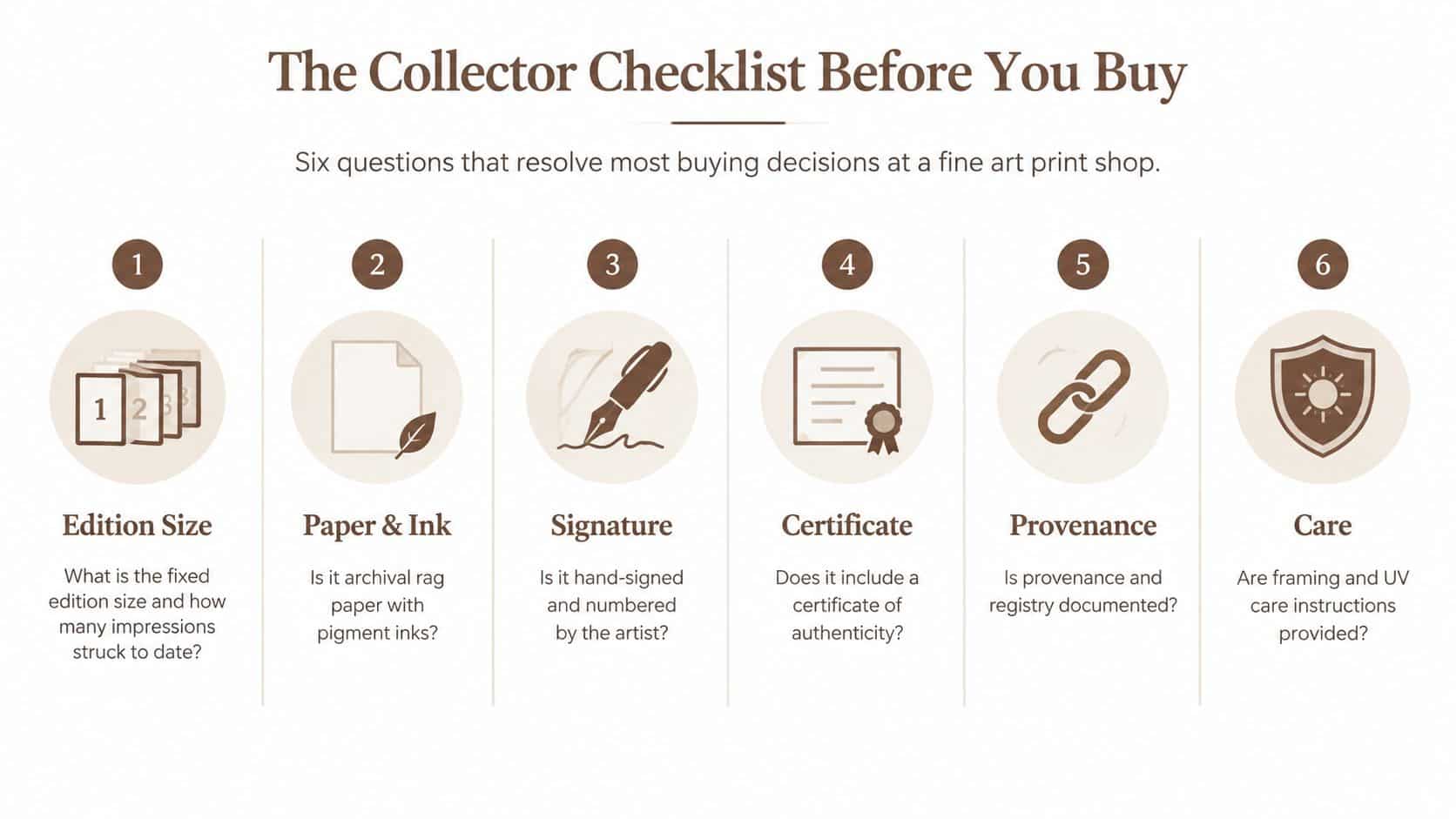
Ask the questions in a fixed order. The answers will tell you whether the shop has a real edition or only a product description.
-
What's the fixed edition size, and how many impressions have been struck?
This establishes scarcity and lets you compare the declared limit with the number printed on your sheet. A shop should also explain whether artist's proofs, printer's proofs, or hors commerce copies exist outside the numbered edition. -
Is the signature hand-applied by the artist?
A stamped or printed signature may be part of a legitimate process, but it isn't the same documentary act as a wet signature. The seller should state the method plainly. -
How is the impression numbered?
A signed and numbered limited edition uses a fraction. The first number identifies the individual impression and the second identifies the total edition. Thus, 12/100 means the 12th print in an edition of 100, as explained in this signed-and-numbered print glossary. Ask whether the studio's convention matches the notation on the print. -
Does the certificate belong to the studio?
It should name the work and edition, identify the issuing studio, and connect to a registry reference or certificate code. A generic template offers little protection.
-
What substrate is specified?
Look for the manufacturer, paper type, weight, surface, and fibre content. “Fine art paper” is too broad to function as a specification. Acid-free cotton and alpha-cellulose papers are common archival choices, but the exact sheet still matters. -
Which printing process is declared?
The shop should identify archival pigment ink, traditional intaglio, or another stated process. The process should make sense beside the edition, materials, and price. You can also compare how a studio explains its contemporary work through ARTIST6's contemporary fine art collection.
Practical rule: If a limited-edition shop can't answer these questions in writing, treat the missing paperwork as part of the buying decision.
These checks aren't bureaucratic decoration. They answer six different questions: how scarce the work is, who signed it, which impression you own, where the record lives, what the sheet is made from, and how the image was placed on it. A careful seller won't regard that scrutiny as difficult.
Paper and Ink Specifications That Matter
Archival permanence starts with the paper, but it doesn't end there. ISO 9706 sets requirements for permanent paper, including a cold-extract pH between 7.5 and 10.0, an alkaline reserve of at least 2% calcium carbonate, minimum tearing resistance of 350 mN, and a Kappa number below 5, according to the ISO standard for permanent paper. These thresholds address the sheet's resistance to acid-driven embrittlement, oxidation, and mechanical failure.
ISO 9706 applies to unprinted paper. The permanence of the printed image is a separate matter. That distinction matters because a compliant sheet can still be paired with an unsuitable ink system, poor display conditions, or an undocumented printer profile.
What the shop should name
A credible specification sheet identifies the paper manufacturer, product name, weight, surface, and fibre. Buffered cotton rag and alpha-cellulose papers are widely used for archival fine art work, but “archival” should never replace the product name.
The ink should also be identified. Pigment systems are the technical benchmark for archival fine art output because their performance depends on the complete ink, paper, printer, and viewing environment. Hahnemühle states that its archival papers comply with ISO 9706 and that, with high-quality UV-resistant pigment inks from major printer manufacturers and appropriate environmental control, fine-art inkjet prints can last more than 100 years. Its archival certification guidance explains that this is a system claim, not a guarantee attached to paper alone.
| Specification | Archival Standard | What to Demand in Writing |
|---|---|---|
| Paper chemistry | Permanent paper should meet ISO 9706 requirements | Manufacturer, exact product, pH information, alkaline reserve |
| Fibre | Cotton rag or alpha-cellulose are established choices | Fibre content and whether the sheet is buffered |
| Ink | Pigment ink is preferred for archival fine art workflows | Ink set, printer model, and stated permanence information |
| Surface | Selected for image character and viewing conditions | Matte, textured, or smooth surface, plus paper weight |
| Print format | Border and edge treatment affect presentation and framing | Image size, paper size, border dimensions, flush or bordered edge |
Dye inks or non-archival papers can fade much sooner under sunlight exposure. Independent technical guidance places some pigment-ink combinations on archival cotton papers in the range of roughly 100 to 200 years of estimated display permanence, while dye inks or non-archival papers can fall into a 10- to 20-year fading range under sunlight exposure, as summarised in the verified technical material. Treat those figures as test-condition estimates, not promises for every room.
Provenance, Registries, and Authentication
Provenance isn't a story told at the counter. It's a record that travels with the work and remains useful after the first buyer has moved on.
At minimum, the certificate should identify the artist, title, medium, paper, edition number, and total edition size. It should also be signed and dated by the issuing studio. A certificate on its own is helpful, but it's still a document supplied by the seller. The stronger system connects that certificate to an on-site or online edition registry.
What a registry records
A working registry can record the impression number, edition status, proof categories, certificate details, and sale history. A buyer should be able to search by edition number or certificate code, then compare the result with the physical print. The record doesn't need to reveal private buyer information to be useful. It does need to remain accessible and specific.
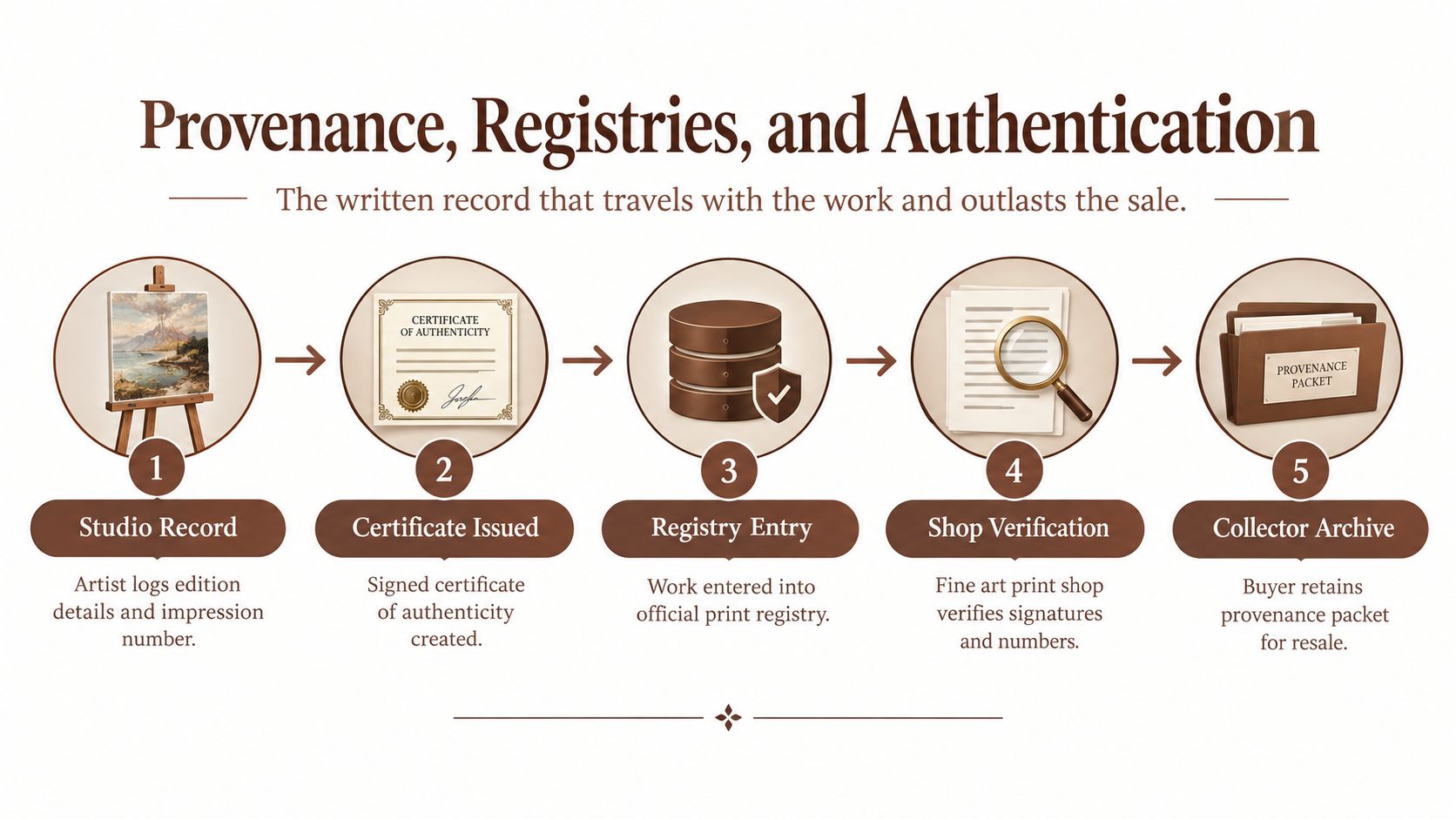
The process is straightforward:
- The studio logs the edition details and impression number.
- The issuing studio creates and signs the certificate of authenticity.
- The work enters the official print registry.
- The shop verifies signatures, seals, and numbering.
- The collector keeps the provenance packet with the work.
Independent systems already use this logic. Hahnemühle's Art Registry documents edition status and certificate or hologram details, while some studios issue certificates listing the artist, title, media, edition number, and date on archival paper, as described in this print-finishes and provenance reference.
The registry becomes especially valuable when the work changes hands. A later owner, dealer, or appraiser can check whether the number exists, whether it was issued, and whether the certificate corresponds to the edition. Without that record, provenance depends on memory and paper handling. With it, provenance becomes infrastructure.
This matters in the primary market, not only after resale. Recent discussion of authentication and provenance describes growing pressure around lender requirements, regulation, and assets that can't be verified, while institutions continue publishing provenance research. Coverage of AI, authentication, and provenance risk helps explain why a permanent registry should be created at the point of sale, not years later.
Edition Size and How Pricing Schedules Work
An edition size is a scarcity rule. A pricing schedule is the mechanism that makes that rule visible to the buyer.
The smaller the declared edition, the tighter the supply. Contemporary limited editions often use sizes such as 25, 50, or 100, and pricing generally rises as an edition sells down, according to this guide to pricing artwork. That doesn't make a smaller edition automatically better. It gives the studio a clear structure for positioning the work and gives the collector information about availability.
Ask four questions before buying:
- What is the total edition? Confirm that the number on the sheet belongs to that edition, not a larger open run.
- Are proofs separate? Artist's proofs may use a notation such as AP or a separate fraction. Printer's proofs should be disclosed rather than assumed.
- What triggers a price increase? The studio should publish the sell-through threshold before the first sale.
- What happens at closure? Unsold numbers should either remain documented, be retired, or be handled under a stated policy. They shouldn't return as a new edition.
A useful schedule can be simple. It doesn't need artificial complexity to communicate scarcity.
| Tier | Edition Numbers | Trigger Condition | Price |
|---|---|---|---|
| Opening tier | First published group | Available before the first sell-through threshold | Published base price |
| Second tier | Next group | First stated sell-through threshold reached | Published step-up price |
| Third tier | Later group | Second stated sell-through threshold reached | Published step-up price |
| Final tier | Remaining available numbers | Final stated threshold reached | Published final price |
The exact price belongs to the studio's own schedule. A transparent shop records when each step took effect and doesn't negotiate a private exception that changes the meaning of the public system. For a practical example of how limited-edition artwork can be presented as a collectible object, see ARTIST6's limited-edition print collection.
Read the edition number and pricing schedule together. One tells you which impression you own. The other tells you how the studio treats its remaining supply.
Framing, Display, and Long-Term Care
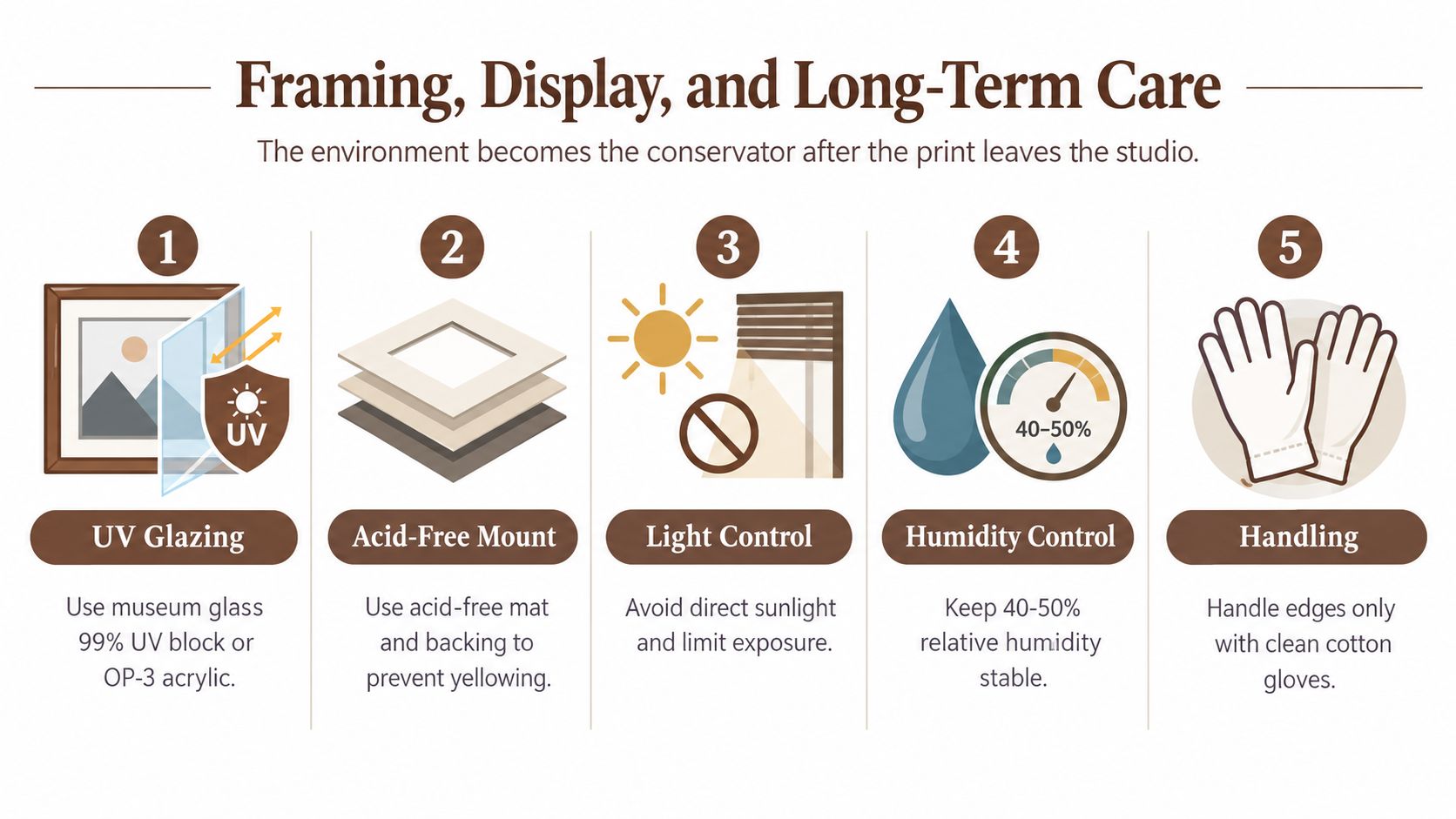
Once a print leaves the studio, the room becomes part of its conservation system. Good paper and pigment ink can't cancel prolonged direct sunlight, unstable humidity, acidic backing, or careless mounting.
Start with glazing. Museum glass with a 99% UV-blocking interlayer or OP-3 acrylic provides a strong barrier against ultraviolet exposure, but neither makes direct sunlight harmless. The frame should also create space between the print and glazing so the sheet doesn't press against the surface or develop contact-related damage.
Build the frame around reversibility
Use archival ragboard or aluminium separators rather than ordinary cardboard. Mount with reversible hinges made from starch paste or Japanese tissue. Self-adhesive tape is fast, but it leaves adhesive in the conservation system and makes future removal harder.
The display environment matters just as much. Keep relative humidity stable between 40% and 55%, avoid exterior walls where temperature shifts can be greater, and keep framed work away from direct sun. Unframed sheets belong in flat archival drawers, interleaved with acid-free tissue and placed in a buffered enclosure for long storage.
- Control light: UV glazing reduces exposure, but placement still matters.
- Protect the edges: Handle the sheet by its edges with clean cotton gloves.
- Separate the layers: Use a mat or spacer to prevent contact with glazing.
- Keep the support neutral: Acid-free ragboard or another conservation-grade backing is preferable to cardboard.
- Store flat: Avoid leaning or rolling a sheet for long-term storage unless the studio or conservator specifies otherwise.
A short visual guide can help when you're choosing materials with a framer. This video provides another way to review the relationship between display and preservation:
For offices and shared interiors, the same principles apply, with added attention to glare, traffic, cleaning routines, and wall placement. ARTIST6's art prints for offices can be considered alongside those practical display constraints. The right frame protects the work without overpowering it.
How a Transparent Studio Operates
Transparency in a fine art print shop isn't a tone of voice. It's a set of commitments that another person can audit.
The studio publishes the paper brand, weight, and fibre content. It names the printer model and pigment-ink set. It states the edition cap, proof policy, numbering convention, and price thresholds before the work is released. The artist signs each sheet by hand, and the certificate matches a permanent registry entry.
The claim must have a location
A buyer shouldn't need a phone call to discover the central facts. Each one belongs somewhere visible and stable.
| Indicator | What to Look For | Where It Should Appear |
|---|---|---|
| Materials | Paper brand, weight, fibre, surface, ink set | Product page and process documentation |
| Edition | Total cap, numbering sequence, proof policy | Product page and certificate |
| Signature | Hand-applied signature method | Product description and inspection record |
| Pricing | Base price, sell-through triggers, closure policy | Published pricing schedule |
| Provenance | Certificate code and edition status | Certificate and public registry |
| File preparation | Declared source workflow and print-ready requirements | Studio journal or file guide |
The source file belongs in that chain too. A studio using digital tools should disclose how the image was developed, selected, refined, and prepared for print. A practical print-ready file guide from File Studio is useful for understanding the technical handoff, but the artist or studio still has to explain its own workflow.
The strongest model combines process disclosure, fixed edition rules, permanent registry records, and a published schedule. It also states what happens when a print is damaged, returned, or rejected during inspection. A transparent shop doesn’t rely on mystique to protect value. It uses records.
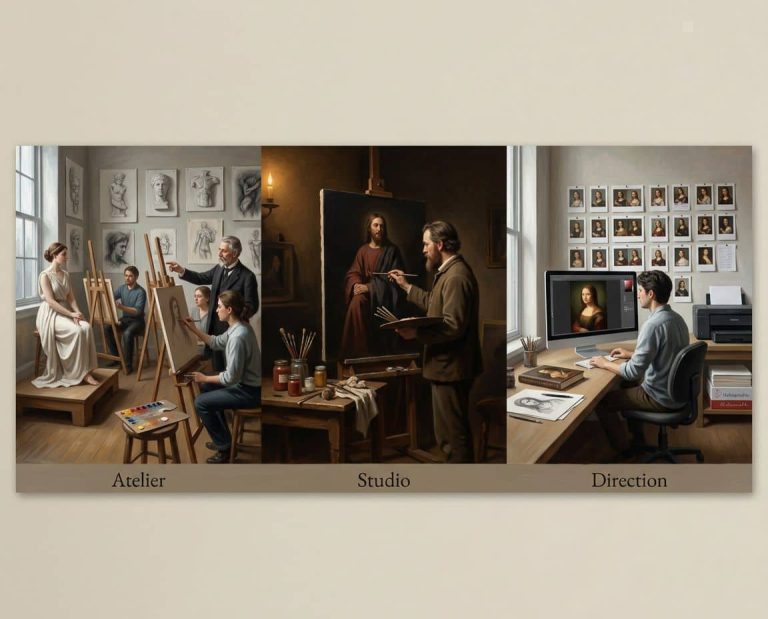
That is the distinction between a shop that sells fine art prints and one that prints art. The collector can follow the object from source and material selection to numbered impression, certificate, registry, framing, and future verification.
ARTIST6 produces limited, signed, numbered, and sealed archival prints in fixed editions of 6, with chapter-based series, documented materials, and a permanent public edition registry. Visit ARTIST6.com to discover original Renaissance fine art prints.