

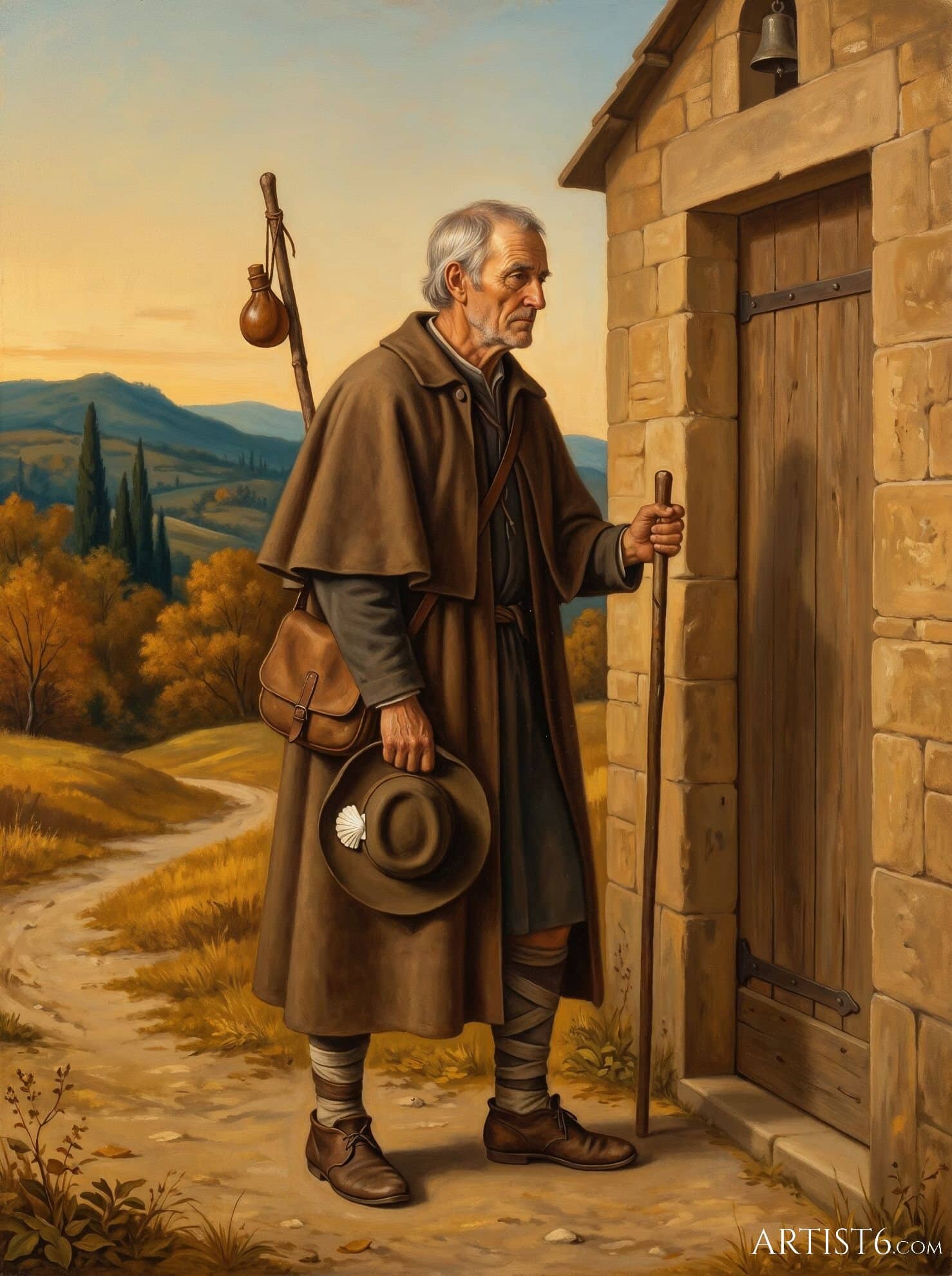
The Pilgrim’s Return

Description
Description
Artwork statement:
I made this work from a small painted predella panel attributed to the Bellini workshop, recorded in the 1532 inventory of a Veronese parish church and lost in the church fire of 1689. The inventory describes the panel as showing un vecchio ritornato dal pellegrinaggio, an old man returned from pilgrimage, at the door of his home village’s chapel. The fire took the painting. The inventory entry is two lines. I wanted to make what the parish lost.
The figure is an elderly man, perhaps seventy, who has just arrived at the wooden door of a small stone country chapel at the edge of his village in the late autumn evening. He carries a worn pilgrim’s staff in his right hand and a leather scrip over his left shoulder. The pilgrim’s shell, the cockle of Saint James, is sewn to the brim of his low-crowned travelling hat, which he holds in his left hand. His face is weathered and quiet. He has not yet knocked. He stands at the door in the moment before the return, looking at the wood as though he is reading it. The light is the long gold of late autumn at the hour before dark. Behind him, the path he has walked is visible, disappearing into the hills.
I created him because the Devotional register in the Venetian tradition understood, better than the dramatic centres of Italian art, that the deepest religious moment is rarely the departure or the journey but the return. The pilgrim who goes is the figure of desire. The pilgrim who returns is the figure of devotion. The work is about coming home as the actual content of a religious life, and the door of one’s own parish chapel as the place where the long journey is completed. It is asking what we have done with our own years away from home, and what we have brought back.
Iconographic reading:
The pilgrim’s shell. The cockle of Saint James, sewn to the hat, identifies the figure as a pilgrim returned from Compostela, the longest of the medieval pilgrimage routes. The shell is the iconographic signature of a journey completed at the limit of endurance.
The hat held in the hand. The pilgrim removes his hat at the chapel door in the gesture of one who is no longer travelling, who has arrived. The medieval convention reserves this gesture for the moment of formal return to a sacred place.
The long evening light. The deep gold of late autumn evening is the Bellini workshop convention for the completion of a long undertaking. The hour signals that the journey has been measured against the light of a life, and that the light is now turning.
Reviews
There are no reviews yet.