
Italian Renaissance Art vs. Northern Renaissance Art
There is a useful exercise that almost no one does the first time they walk through a European painting gallery. Stand in front of a Raphael Madonna for a minute. Then walk into the next room and stand in front of a Van Eyck Madonna. Both paintings are from the fifteenth or early sixteenth century. Both are Renaissance works. Both depict the same subject. Both were made by painters at the height of their craft, with technical mastery that almost no painter today could match.
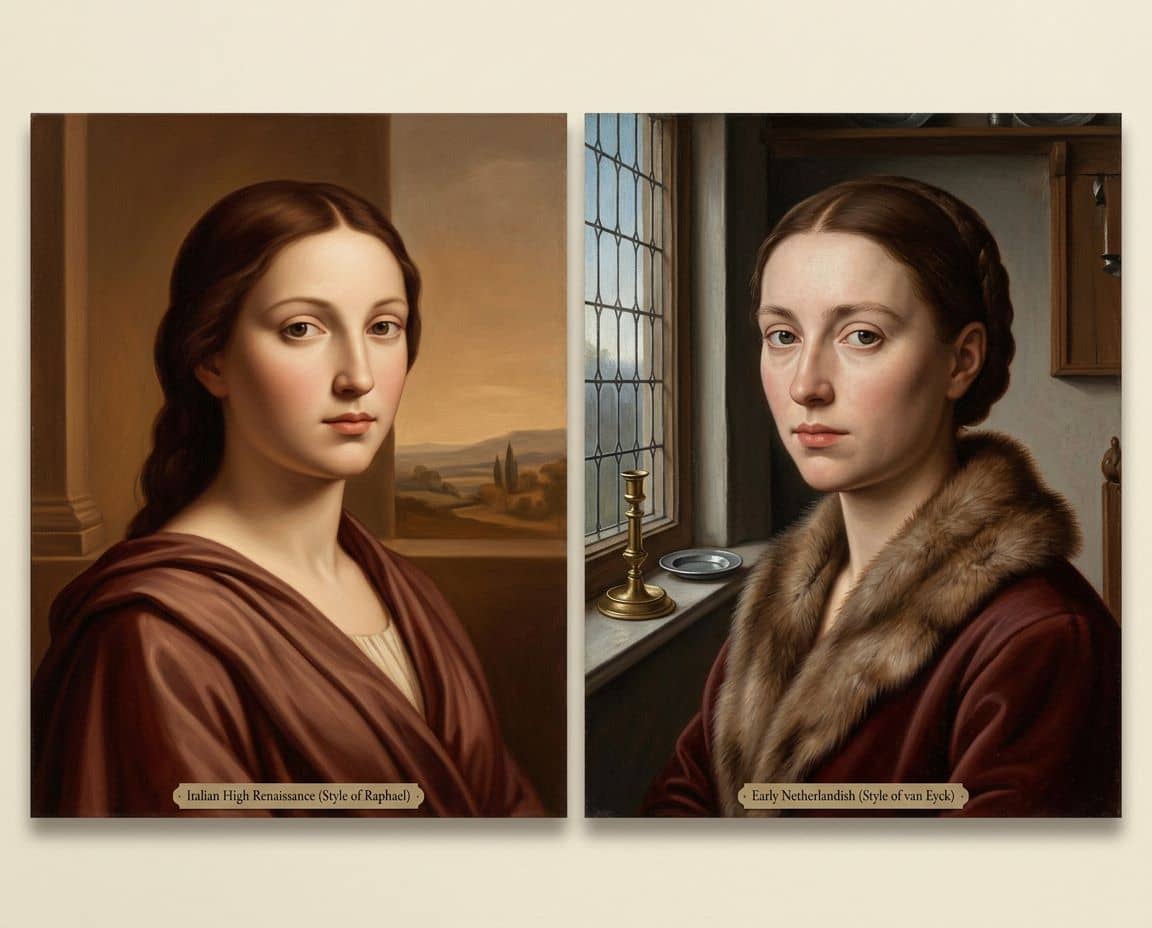
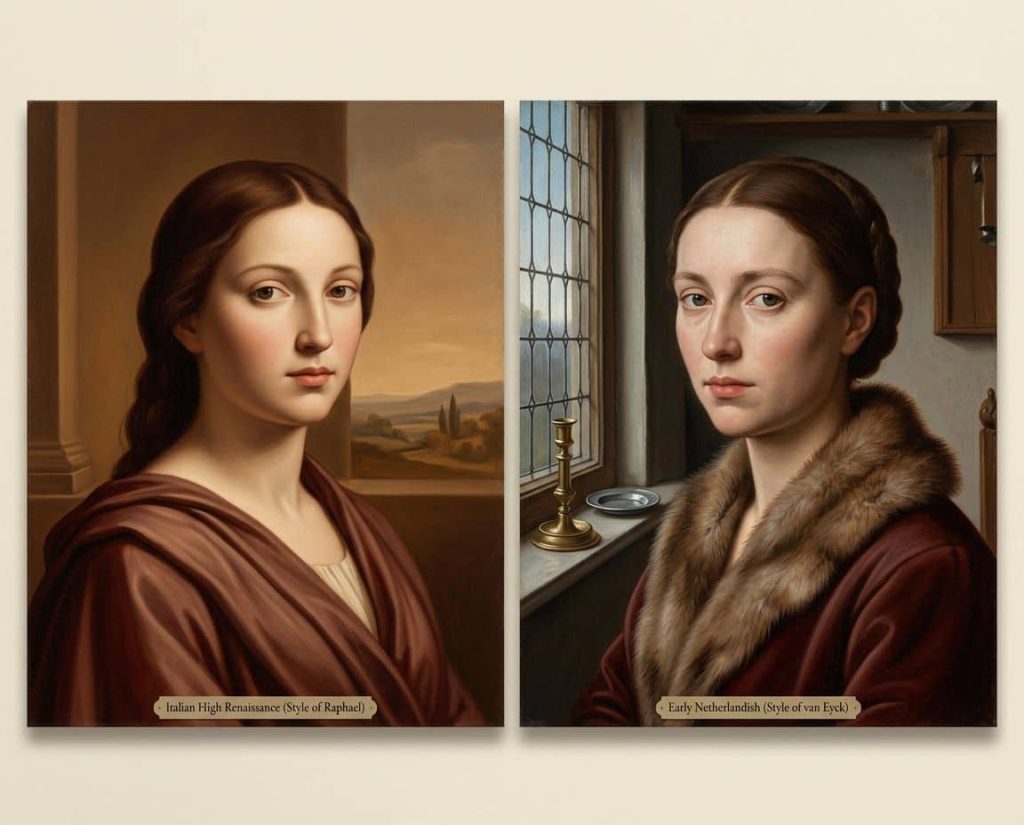
And yet the two paintings are doing something completely different. The Raphael is calm, balanced, and idealized; the Madonna’s face is a perfect oval, her drapery falls in noble curves, the space around her feels architectural and ordered. The Van Eyck is intimate, microscopic, and observed; you can count the threads in her veil, see the individual hairs of a small dog at her feet, watch light reflect from the surface of a brass candlestick in the room. The Italian Renaissance and the Northern Renaissance are not the same movement seen from two angles. They are two different answers to the same cultural moment, produced by painters who, for a long time, did not know each other’s work.
This piece is a working guide to those two answers. What was the Italian Renaissance trying to do, what was the Northern Renaissance trying to do, where did they overlap, and how can a reader walk into a gallery tomorrow and tell them apart at a glance.
The Question Both Traditions Were Trying to Answer
To understand the difference, you have to start with what the two traditions had in common. Both the Italian and the Northern Renaissance were responses to the same broad cultural shift in Europe between roughly 1380 and 1580. Medieval art, particularly in the late Gothic period, had grown highly formalized, stylized, and decorative. Figures stood against gold backgrounds. Their proportions did not necessarily match real bodies. Space in the painting was largely symbolic rather than physical. The viewer was not meant to feel like they were looking through a window onto a real scene; they were meant to feel like they were standing in front of a sacred object.
By the late fourteenth century, a growing number of painters, patrons, and scholars across Europe wanted something different. They wanted images that felt real. They wanted bodies that looked like real bodies, rooms that looked like real rooms, light that behaved the way real light behaves. They wanted, in short, a credible visual world.
Both Italy and the North set out to build that credible world. They did it from completely different starting points, with completely different resources, and with completely different cultural goals. The result is two traditions that share the same general ambition but look almost nothing alike when you stand in front of them.
The Italian Renaissance: The Recovery of Antiquity
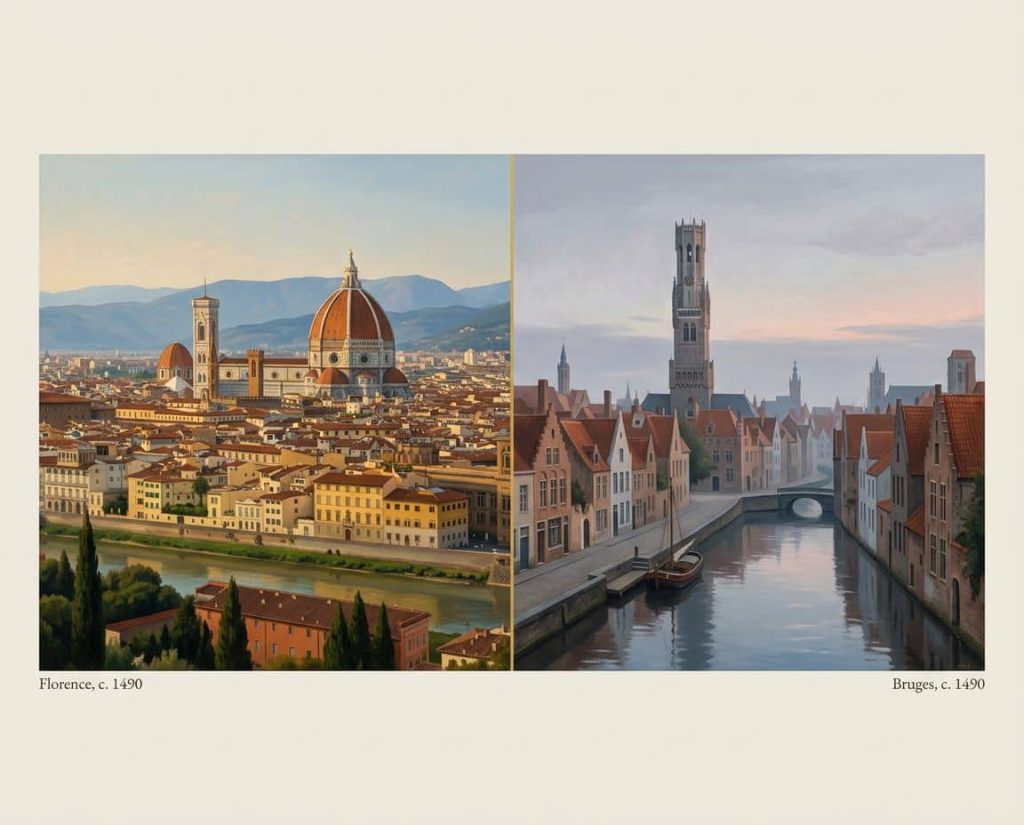
The Italian Renaissance, broadly dated from about 1400 to 1600, was centered first in Florence and later in Rome, Venice, and a handful of smaller courts. The Italian project was, at its core, a recovery project. Italian humanists, writers, and painters were surrounded by the physical remains of the classical Roman world. Ancient sculpture turned up in fields. Ancient buildings stood in every Italian city. Ancient texts, recently rediscovered through contact with Byzantine scholars and Arabic translations, were circulating in new vernacular editions.
The Italian Renaissance set out to recover what classical antiquity had known about the human body, about architecture, about proportion, about composition, and to apply that knowledge to a new Christian world. According to Britannica’s overview of the Italian Renaissance, this revival emerged in fourteenth-century Italy as a humanist response to medieval scholasticism, with painters and sculptors looking back to classical models for guidance on how to render the human figure and the natural world.
This is why an Italian Renaissance painting tends to look architectural even when it is not depicting architecture. The figures are constructed on geometric principles, often with idealized proportions drawn directly from classical sculpture. Compositions are typically built around triangles, circles, or other stable geometric shapes. The space is rendered using linear perspective, the mathematical system for representing three-dimensional space on a two-dimensional surface, which the Italians developed and codified in the early fifteenth century.
The dominant subjects of Italian Renaissance painting were religious and classical: Madonna and Child compositions, Annunciations, scenes from the life of Christ, altarpieces. But alongside these, increasingly through the sixteenth century, Italian painters were also producing scenes from classical mythology, allegories drawn from Greek and Roman poetry, and portraits of patrons posed in classical attitudes. The Italian Renaissance gave Western painting the secular nude, the mythological scene, the allegorical portrait, and the conviction that classical learning could sit comfortably inside Christian devotion.
The Northern Renaissance: The Observed World
The Northern Renaissance, dated roughly from 1420 to about 1580, was centered in the cities of the Burgundian Netherlands, primarily Bruges, Ghent, and later Antwerp and Brussels. Other major Northern centers included Nuremberg in Germany, Basel in Switzerland, and various Hanseatic trading cities. The North did not have the same direct contact with the physical remains of classical antiquity. There were no Roman ruins in Bruges.
What the North had instead was wealth and observation. The fifteenth century in the Low Countries was a period of explosive commercial prosperity. Bruges was one of the great trading cities of Europe, with merchants from Italy, Spain, England, and the Hanseatic League passing through every week. The wealth produced by this trade flowed into the patronage of art, but the patrons were largely merchants, lay devotees, and middle-class burghers, not popes and dukes.
The art these patrons wanted was different from what Italian patrons wanted. According to The Met’s Heilbrunn Timeline essay on Early Netherlandish Painting, the Early Netherlandish painters working in the wealthy cities of the Burgundian Netherlands developed a tradition of small-scale devotional panels, portraits, and altarpieces commissioned by both ecclesiastical and lay patrons, with a focus on detailed observation of the natural world and a profound engagement with religious symbolism.
What this meant in practice was a tradition built on the close observation of the everyday world. Northern Renaissance painters did not idealize. They rendered. They painted what a brass candlestick actually looks like, what a fur collar actually feels like to the eye, how light actually falls through a leaded window onto a tiled floor. They were less interested in the perfect human body and more interested in the specific human person, with the particular nose, the particular set of the mouth, the particular wrinkle at the corner of the eye. They were the inventors, in many ways, of modern portraiture.
The dominant subjects of Northern Renaissance painting were religious and domestic: Annunciations and Nativities and Crucifixions, certainly, but rendered as if they were happening in a Flemish merchant’s parlor. Donor portraits of the merchant himself, kneeling in prayer alongside the sacred scene. Single portraits, sometimes formal, sometimes intimate. Genre scenes of everyday life, especially as the tradition matured into the work of Pieter Bruegel the Elder. And, increasingly through the sixteenth century, landscape as a subject in its own right, which the North effectively invented.
A Side by Side Comparison
The table below pulls out the working differences between the two traditions, with the diagnostic features a viewer can use to tell them apart in front of an actual painting.
| Feature | Italian Renaissance | Northern Renaissance |
|---|---|---|
| Primary centers | Florence, Rome, Venice, Urbino, Milan | Bruges, Ghent, Antwerp, Nuremberg, Basel |
| Approximate dates | c. 1400 to 1600 | c. 1420 to 1580 |
| Primary inspiration | Classical Greek and Roman antiquity | Direct observation of the natural world |
| Treatment of the body | Idealized, geometrically proportioned | Specific, particular, individual |
| Treatment of space | Linear perspective, architectural order | Atmospheric, microscopic detail, observed light |
| Dominant medium | Fresco (early), oil on panel and canvas (later) | Oil on oak panel from the start |
| Surface quality | Smooth modeling, sometimes sculptural | Glazed, jewel-like, surface-specific |
| Subject range | Religious, mythological, allegorical, classical | Religious, domestic, portrait, landscape, genre |
| Symbolism | Often classical and overt | Often domestic and disguised |
| Patronage | Church, princes, popes, civic | Merchants, lay devotees, burghers |
| Print tradition | Limited until later sixteenth century | Foundational; Dürer the master |
| Defining figures | Leonardo, Raphael, Michelangelo, Titian | Van Eyck, Van der Weyden, Dürer, Bruegel |
| One-line shortcut | The ideal body in classical space | The observed object in real light |
The Body vs. The Object: Two Subjects
If you had to name the single deepest difference between the two traditions, it would be this. Italian Renaissance painting took the human body as its primary subject. Northern Renaissance painting took the observed object as its primary subject.
An Italian painter trained for years in the drawing of the human figure. The body, ideally a nude or semi-nude classical body, was the central preoccupation. Even when the subject was the Virgin Mary or a fully clothed saint, the body underneath the clothing was understood. The drapery fell in folds that revealed the anatomy beneath. The figure stood in a pose, called contrapposto in the classical tradition, that gave it weight and grace and a sense of internal balance. The whole painting was, in a real sense, an argument about what a human body should look like.
A Northern painter trained for years in the rendering of surfaces. The body was a subject, but one subject among many. The same painstaking attention given to a face was given to a brass dish, a glass vessel, a window pane, a wooden floor, a piece of fur, a leaf. Each surface had its own optical behavior, and the Northern painter wanted to render that behavior with absolute specificity. The whole painting was an argument about how the visible world actually looks when you slow down and pay attention to it.
Idealization vs. Hyperrealism
Closely connected is the difference between idealization and hyperrealism.
Italian Renaissance painters idealized. When Raphael painted a portrait, he subtly adjusted the sitter’s features in the direction of classical beauty. The nose was straightened slightly. Proportions were nudged toward the classical canon. The skin was smoothed. The idealization was not a flattery; it was a philosophical position. The Italian Renaissance believed that beauty was a real property of the world, that it could be studied and understood through classical example, and that the painter’s job was to find and present that beauty rather than to record the accidents of any particular face.
Northern Renaissance painters did the opposite. When Hans Holbein painted a Tudor courtier, he recorded every flaw, every asymmetry, every shadow under the eye. When Albrecht Dürer painted himself in 1500, he showed himself with such precise particularity that you can almost smell his hair. When Jan van Eyck painted Giovanni Arnolfini, he gave the merchant a face that no one would call beautiful by classical standards, but which has such specific human presence that the man is alive on the panel.
The Northern position was also philosophical. The North believed that truth was found in the specific, the particular, the observed. To smooth out the asymmetry of a real face was, in the Northern view, to lie about what God had actually made. The Northern hyperrealism was a kind of religious humility. The painter’s job was to record what was there, not to improve it.
Religion: Catholic Humanism vs. Christian Devotion
Both traditions were deeply Christian. But the way Christianity inflected the work was different.
Italian Renaissance Christianity was Catholic, papal, and increasingly humanist. The fifteenth-century Italian church was not yet under the pressure of the Reformation, which would not begin until 1517. Italian painters could safely combine Christian and classical iconography in the same painting. A Madonna could be flanked by classical allegorical figures. A papal commission could include a depiction of pagan philosophers conversing in a sacred architectural setting, as in Raphael’s School of Athens.
Northern Renaissance Christianity was, especially in the fifteenth century, more devotional and intimate. The North developed a tradition called the Devotio Moderna, or modern devotion, which emphasized personal piety, individual relationship with God, and the contemplative reading of religious texts. Northern paintings were often made for private devotion, hung in a small chapel or even a domestic room, intended to be looked at quietly for long periods.
This changed dramatically in the sixteenth century. When Martin Luther launched the Reformation in 1517, large parts of Northern Europe began rejecting the use of religious images in worship. Protestant iconoclasm, particularly severe in the Netherlands in the 1560s, destroyed thousands of religious paintings and effectively shut down the altarpiece market in Protestant regions. Northern painters responded by shifting their subjects. They painted more portraits, more landscapes, more domestic scenes, more genre subjects. By the seventeenth century, the Dutch Republic had effectively invented the modern category of secular painting as a commercial market.
Italy, by contrast, doubled down on religious painting during the Counter-Reformation. The dramatic religious scenes of Caravaggio and the Baroque painters who followed him were, in part, a deliberate Catholic effort to make religious imagery more emotionally compelling and more theologically pointed.
Symbolism: Open vs. Disguised
Both traditions used symbolism extensively. But they used it differently.
Italian Renaissance symbolism tended to be open and classical. A figure holding a sword and a pair of scales is Justice. A figure with a flame above her head is Faith. A naked woman riding a shell out of the sea is Venus. The symbols are drawn from classical mythology, Christian iconography, or the allegorical traditions inherited from medieval art, and they are usually large, visible, and meant to be read by an educated viewer with some classical training. Italian symbolism worked the way the classical statues in the painter’s city worked: the meaning was there to be seen.
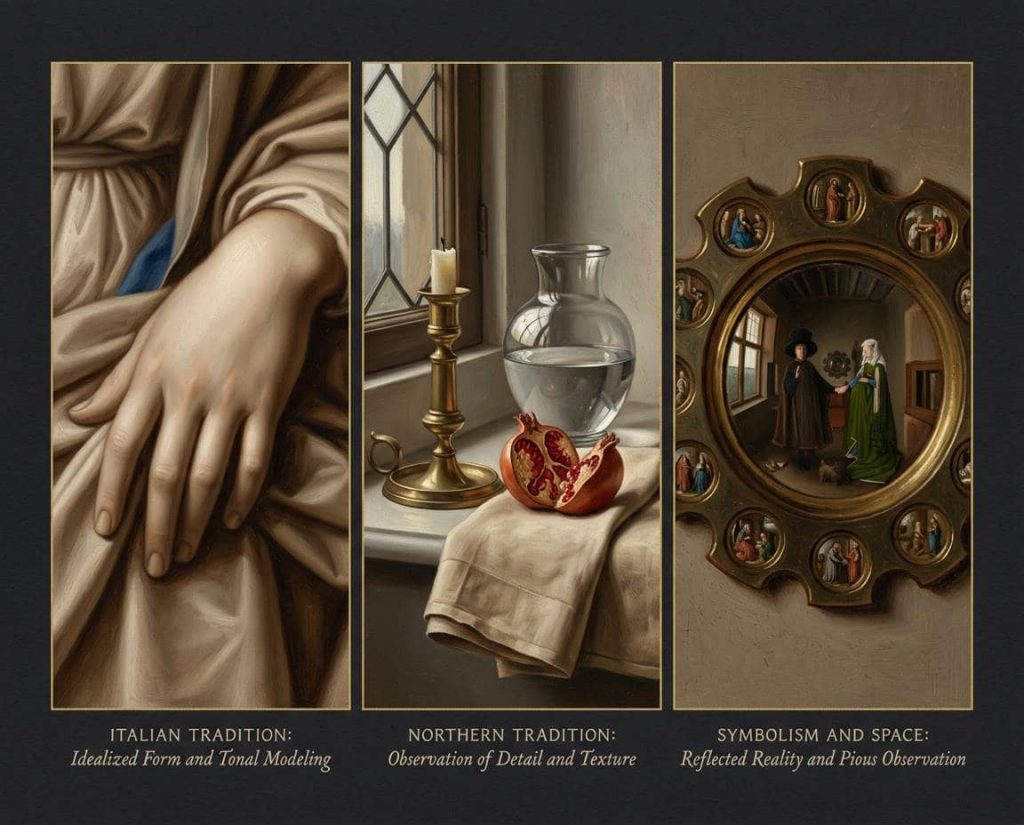
Northern Renaissance symbolism worked through what the twentieth-century art historian Erwin Panofsky called disguised symbolism. The Northern painter would hide the symbolic content inside ordinary domestic objects. A small dog in the corner of a portrait might mean fidelity. An apple on a shelf might allude to the Fall. A single lit candle in a daytime scene might represent the presence of God. The reader, looking carefully, could discover layer after layer of theological meaning hidden in what appeared at first to be simply a beautifully rendered room.
The classic example is the Arnolfini Portrait by Jan van Eyck, in the National Gallery, London. The painting appears at first to be simply a finely observed interior, with a merchant and his wife standing in a Flemish room. Closer inspection reveals that almost every object in the painting carries a possible symbolic charge. The small dog at the couple’s feet is associated with fidelity. The single lit candle in the chandelier, burning in daylight, is associated with the all-seeing presence of God. The convex mirror at the back wall, surrounded by ten roundels showing scenes from the Passion of Christ, reflects the entire room and includes two small figures who may be the artist himself. The painting can be read as a portrait, as a marriage contract, as a memorial, or as a quiet theological meditation, all at once. This kind of layered, embedded, decodable symbolism is one of the most distinctive features of Northern Renaissance painting, and it has no real equivalent in the Italian tradition.
Materials: Fresco, Tempera, and the Northern Oil Revolution
The technical foundations of the two traditions were also different, at least at first.
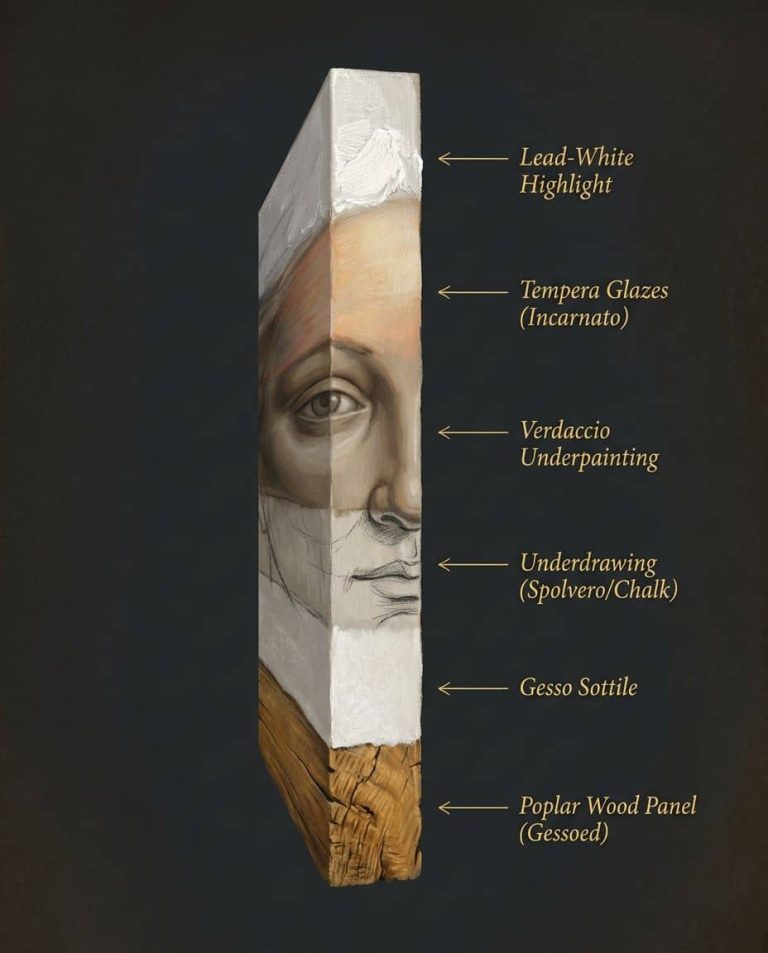
Italian painters in the early Renaissance worked primarily in two media. The first was fresco, the technique of painting onto wet plaster on a wall, which is essentially permanent once it dries because the pigment becomes part of the wall itself. Frescoes are durable, large, and dramatic, but they are also fast; the painter has to commit to a section while the plaster is still wet. The second was egg tempera, which used powdered pigment mixed with egg yolk and applied to a wooden panel prepared with gesso. Tempera dries fast, produces bright clear colors, and rewards precise drawing, but it does not blend easily and cannot produce the soft transitions of oil paint.
Northern painters, by contrast, were perfecting oil paint from the early fifteenth century onward. Jan van Eyck was not the inventor of oil paint, despite the persistent legend, but he and his contemporaries developed the technique to a level no one had previously matched. Oil paint, made by suspending pigment in a drying oil like linseed, dried slowly, allowed for blending and reworking, and could be applied in transparent glazes layered over an opaque underpainting. The result was a paint surface that seemed to glow from within.
The Italians eventually adopted oil paint, beginning around 1475, largely through Venetian contact with Northern painters. By the time of Leonardo, Raphael, and Titian, oil paint had become the dominant Italian medium for panel and canvas painting, while fresco continued to be used for large wall commissions. The oil paint revolution had started in the North; the Italians borrowed it and reshaped it for their own ends.
Patronage: Who Was Paying
The two traditions were also funded by different kinds of patrons, and this shaped what each tradition produced.
Italian Renaissance patronage was, broadly, top-down. The largest commissions came from the church, particularly the papacy in Rome, which paid for the decoration of churches, chapels, and entire architectural complexes. Other major patrons were ruling princes (the Medici in Florence, the Sforza in Milan, the Gonzaga in Mantua, the Este in Ferrara, the Montefeltro in Urbino) and civic governments, which commissioned public statues, frescoes, and altarpieces for civic chapels. The scale tended to be large. The visibility tended to be public.
Northern Renaissance patronage was, broadly, more diffuse. The Burgundian dukes were major patrons, certainly, and the church commissioned altarpieces throughout the period. But a great deal of Northern patronage came from a class of wealthy merchants, urban professionals, and lay devotees who wanted smaller, portable, private works. A merchant in Bruges might commission a small devotional diptych for his own home. A Hanseatic trader might commission a portrait that would travel with him to his trading partners abroad. The scale tended to be smaller. The visibility tended to be private.
This is part of why the formats of the two traditions are so different. The defining Italian Renaissance object is the large fresco cycle on a chapel wall or the major altarpiece on a public altar. The defining Northern Renaissance object is the small oak panel that fits in a private room, often hinged into a portable diptych or triptych that could be opened for devotion and closed for safekeeping.
Print Culture: The North’s Other Revolution
There is one area in which the Northern Renaissance produced a tradition that the Italian Renaissance did not match, and that area is printmaking.
The combination of the printing press, developed by Johannes Gutenberg in Mainz in the 1450s, and the deep Northern engraving and woodcut tradition produced a print culture in fifteenth and sixteenth century Northern Europe that had no real equivalent in Italy. Albrecht Dürer, working in Nuremberg from the 1490s into the 1520s, was the dominant figure in this tradition. His engravings and woodcuts, particularly the Apocalypse series of 1498 and the great single-sheet engravings like Knight, Death, and the Devil, Melencolia I, and Saint Jerome in His Study, are among the most technically refined and intellectually ambitious prints ever made.
Prints traveled. A Dürer engraving could be in Florence within weeks of being struck in Nuremberg. This is part of how the two traditions eventually began to learn from each other, and Dürer himself, who traveled to Venice in 1494 and again in 1505, was one of the key figures in the cultural exchange that bridged North and South.
The Crossover: Where the Two Traditions Met
By the sixteenth century, the strict separation of Italian and Northern Renaissance was breaking down. Northern painters, especially after Dürer’s journeys, were studying Italian work and incorporating elements of Italian composition, anatomy, and classical iconography. Italian painters, especially in Venice through long-standing Flemish trade contacts, were learning Northern oil techniques and absorbing Northern attention to atmosphere and surface.
By late sixteenth century Mannerism, the regional categories begin to lose their sharpness. The seventeenth-century painters who follow, including Caravaggio in Italy, Rubens in Flanders, Rembrandt and Vermeer in the Dutch Republic, and Velázquez in Spain, are working in what is recognizably a single international Baroque tradition that has absorbed lessons from both Italy and the North. But the original difference remained legible, and remains legible today. A trained eye can still walk into a gallery and tell at a glance whether a fifteenth-century painting was made in Florence or in Bruges.
Famous Works, Compared
A short list of paired works, for the reader who wants to take this comparison directly to the gallery floor or to a museum website.
For the Italian tradition, look at Botticelli’s Primavera in the Uffizi, Florence; Leonardo’s Last Supper in Milan; Raphael’s School of Athens in the Vatican; Michelangelo’s Sistine Chapel ceiling; and Titian’s Venus of Urbino. These give you the full range of the Italian project: classical mythology rendered in idealized bodies, religious narrative in architectural space, papal humanism on a monumental scale.
For the Northern tradition, look at the Ghent Altarpiece by Jan and Hubert van Eyck in Saint Bavo’s Cathedral in Ghent; the Arnolfini Portrait in the National Gallery, London; the Descent from the Cross by Rogier van der Weyden in the Prado, Madrid; the engravings of Albrecht Dürer; and the great peasant scenes of Pieter Bruegel the Elder in the Kunsthistorisches Museum in Vienna. These give you the Northern project: religious devotion rendered in observed Flemish space, intimate portraiture with disguised symbolism, the moral world of the everyday.
If you can see only two paintings, one from each tradition, look at a Raphael portrait and at the Arnolfini Portrait. The first will teach you what the Italian Renaissance wanted to do. The second will teach you what the Northern Renaissance wanted to do.
What This Means for Looking at Renaissance Art Today
For the modern viewer, the practical lesson is that there is no single Renaissance to be understood. There are at least two, and once you can tell them apart, every gallery visit becomes substantially more legible.
When you enter a room of Renaissance painting, ask yourself first about the body. Is the body idealized, proportioned, classically posed? You are in front of an Italian work. Is the body specific, particular, with its real wrinkles and its real proportions intact? You are in front of a Northern work.
Ask yourself next about the surfaces. Does the painting feel smooth, modeled, almost sculptural in its sense of solid form? Italian. Does the painting feel jewel-like, with every surface in the scene resolved at microscopic detail, brass behaving like brass and velvet behaving like velvet? Northern.
Ask yourself finally about the space. Is the space architectural, with clear linear perspective and figures placed in a grand stable order? Italian. Is the space domestic, with light entering from a window and falling on real objects in a real room? Northern.
Three questions, three diagnostics, and the painting begins to tell you which tradition it belongs to. Find more Renaissance fine art on the Artist6.com homepage.